
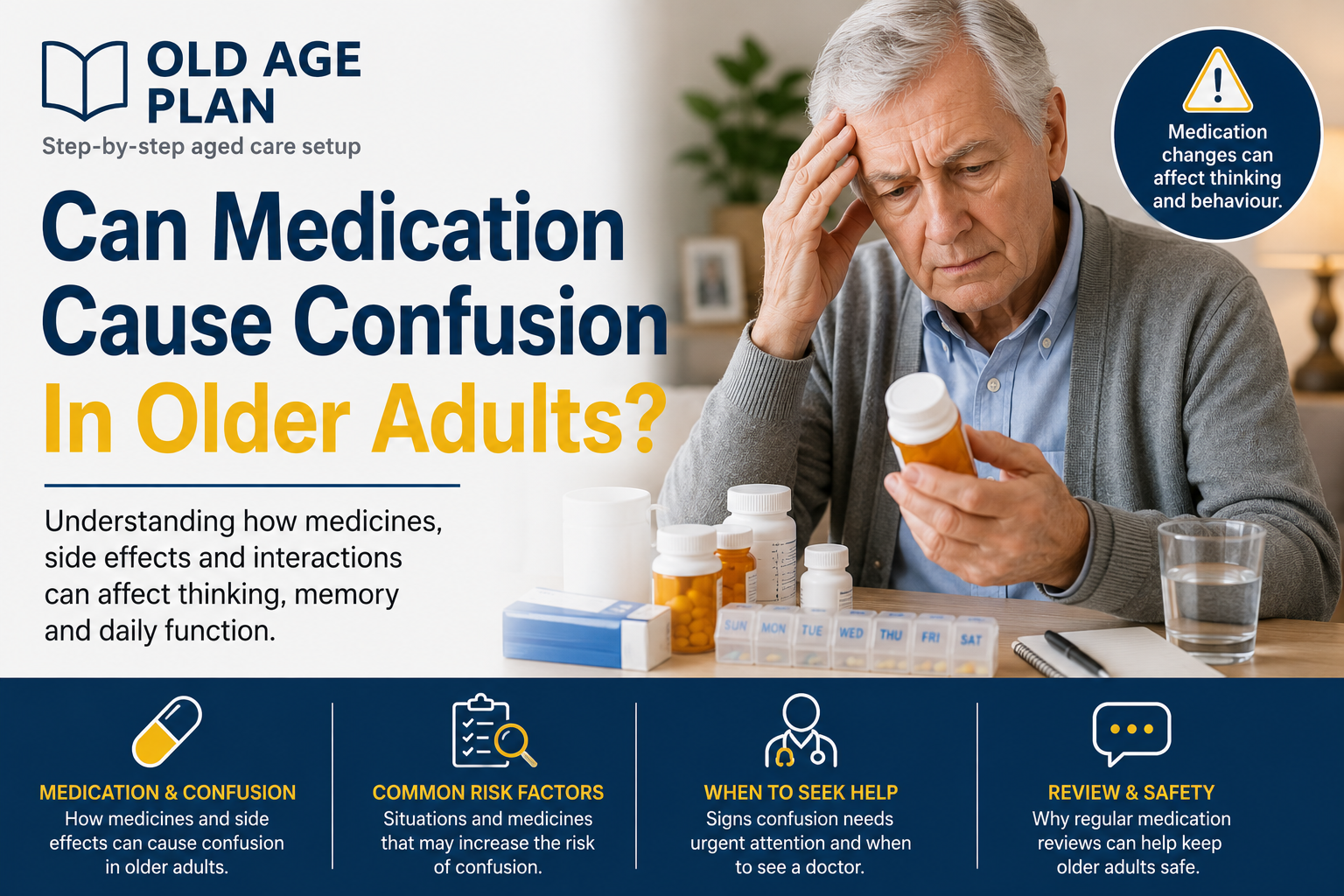

Can Medication Cause Confusion In Older Adults?
Confusion in an older adult can be worrying, especially when it appears suddenly or seems to follow a change in medicine.
Can medication cause confusion in older adults?
Yes. Some medicines, medicine combinations, dose changes and side effects can cause or worsen confusion, memory problems, sleepiness, dizziness or changes in thinking.
This does not mean medication is always the cause. However, it is important to check, especially if confusion is new, sudden or affecting safety.
Short Answer
Medication can cause confusion in older adults, particularly after a new medicine is started, a dose is changed, several medicines are used together, or the person becomes unwell or dehydrated.
Older adults may be more sensitive to side effects because the body can process medicines differently with age.
If confusion appears suddenly, becomes worse, or follows a medication change, a GP, pharmacist or urgent medical service should be contacted for advice.
Key Takeaway
Key takeaway: Medication can cause or worsen confusion in older adults. The safest decision is not to stop medicines suddenly, but to arrange a proper medication review and seek urgent help if confusion comes on quickly.
Why Medication Can Affect Thinking
Medication affects the body in different ways.
Some medicines can affect alertness, balance, sleep, mood, concentration or memory.
Other medicines may become harder for the body to process if the person is dehydrated, unwell, has kidney problems or is taking several medicines at once.
This can make confusion look like dementia from the outside.
However, medication-related confusion may sometimes be reversible or manageable once the cause is identified.
When Medication Confusion Is More Likely
Medication-related confusion may be more likely when there has been a recent change.
This may include:
- starting a new medicine
- increasing a dose
- taking several medicines together
- using over-the-counter medicines as well as prescriptions
- recent hospital treatment
- recent surgery
- dehydration or infection
- missed doses or double doses
- changes in kidney or liver function
The timing matters.
If confusion begins soon after a medication change, that should be mentioned clearly to the GP or pharmacist.
Medicines That May Contribute To Confusion
Different medicines can affect people differently.
Some types of medicines may be more likely to contribute to confusion, sleepiness or reduced alertness in older adults.
These may include some medicines used for:
- sleep problems
- pain
- anxiety
- allergies
- bladder symptoms
- nausea
- depression
- blood pressure
This does not mean these medicines are always unsafe.
It means changes in thinking should be reviewed carefully, especially if more than one medicine may be involved.
Do Not Stop Medication Suddenly Without Advice
If medication may be causing confusion, it can be tempting to stop it immediately.
That can be risky.
Some medicines need to be reduced slowly. Others may be treating serious health conditions.
The safer step is to contact a GP, pharmacist or prescribing doctor and explain what has changed.
If the confusion is sudden, severe or linked with safety concerns, urgent medical help may be needed.
Medication Confusion Or Dementia?
Medication-related confusion and dementia can look similar.
Both may involve forgetfulness, poor concentration, unusual behaviour or difficulty managing daily tasks.
One difference is that medication-related confusion may appear suddenly or shortly after a medicine change.
Dementia usually develops more gradually, although symptoms can appear worse during illness, poor sleep, infection or medication changes.
The safest question is not:
“Is this medication or dementia?”
A better question is:
“What changed, when did it change, and what needs to be checked?”
When Confusion Should Be Treated As Urgent
Sudden confusion should always be taken seriously.
It may be a sign of delirium, infection, dehydration, medication reaction, stroke or another medical problem.
Seek urgent medical help if confusion appears with:
- sudden disorientation
- difficulty staying awake
- fever or signs of infection
- new weakness or speech problems
- falls or head injury
- hallucinations or unusual behaviour
- severe agitation
- rapid worsening over hours or days
In these situations, it is safer not to wait and see.
What A Medication Review May Involve
A GP or pharmacist may look at all medicines the person is taking.
This includes prescription medicines, over-the-counter products, vitamins, supplements and medicines taken only sometimes.
They may check:
- whether doses are correct
- whether medicines interact
- whether any medicine may be causing side effects
- whether medicines are still needed
- whether the person is taking them as intended
- whether recent illness has changed how medicines affect them
This can help separate medication effects from dementia, delirium, depression, anxiety or other health issues.
What You May Really Be Trying To Decide
Many families asking this question are not only asking about medication.
They are trying to work out whether a change in thinking is temporary, dangerous or part of something bigger.
The real questions may be:
- Did this start after a new medicine?
- Should we call the doctor now?
- Is this dementia or a side effect?
- Could this be delirium?
- Is it safe for them to be alone?
- Should their medicines be reviewed?
The balanced decision is to avoid guessing.
Medication can be part of the problem, but sudden confusion should be checked properly.
Decision Support Questions
Before contacting a GP or pharmacist, it may help to note:
- When did the confusion start?
- Was any medicine started, stopped or changed recently?
- Has the person taken extra doses or missed doses?
- Are they taking over-the-counter medicines as well?
- Have they been unwell, dehydrated or recently in hospital?
- Is the confusion sudden or gradually worsening?
- Is safety, driving, medicine use or daily care affected?
Clear information can make the review more useful.
Related Old Age Plan Articles
- Can Anxiety Cause Memory Problems?
- Can Depression Cause Dementia-Like Symptoms?
- When Should Memory Loss Be Checked?
- When Should You See A Doctor About Memory Problems?
- What Are The Early Signs Of Dementia?
- How Is Dementia Diagnosed?
Sources
- healthdirect Australia — Medicines
- healthdirect Australia — Medicine safety
- healthdirect Australia — Confusion
- healthdirect Australia — Delirium
- NPS MedicineWise — Medicines and older people
Disclaimer
This article provides general information only. It is not medical, legal or financial advice. Medication side effects, confusion and cognitive changes can have many causes. Do not stop or change prescribed medicines without advice from a qualified health professional. If confusion appears suddenly, worsens quickly or safety is at risk, seek urgent medical help.
Summary
Medication can cause or worsen confusion in older adults, especially after a new medicine, dose change, illness, dehydration or hospital stay.
Confusion should not automatically be dismissed as dementia or as a normal part of ageing.
If confusion is new, sudden, persistent or affecting safety, a GP, pharmacist or urgent medical service should be contacted for advice.