
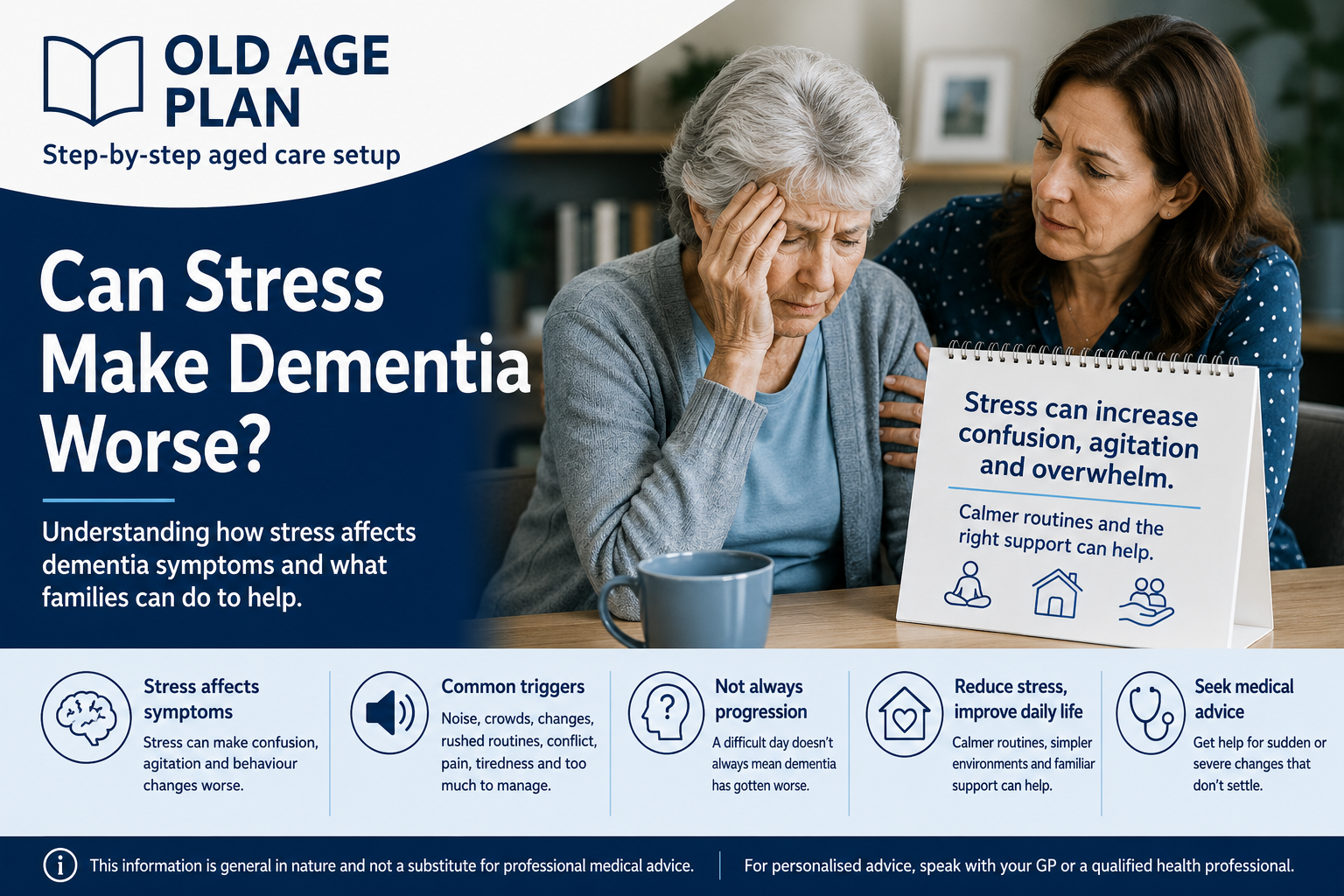

Can Stress Make Dementia Worse?
A person with dementia may seem more confused after a busy day, a difficult conversation, a change in routine or too much noise around them.
They may become unsettled in a crowded shopping centre, agitated during appointments, or more forgetful when several things happen at once.
Then, in a quieter setting, they may seem more like themselves again.
If you are asking can stress make dementia worse, you may also be trying to work out whether the dementia is progressing, whether the situation is making symptoms harder, or whether support at home needs to change.
Short Answer
Yes, stress can make dementia symptoms seem worse.
Stress does not usually mean dementia has suddenly progressed, but it can make thinking, memory, communication, mood and behaviour harder to manage.
Noise, pressure, unfamiliar places, rushed routines, conflict, pain, tiredness or too many demands at once can all increase confusion or distress.
The practical question is not only whether stress is present. It is whether the person’s current routine and support still help them cope safely.
Key takeaway: Stress can make dementia symptoms worse in daily life. Before assuming dementia has progressed, look at what changed around the person, what demands increased, and whether calmer routines or better support may help.
What Stress May Look Like For Someone With Dementia
Stress does not only mean emotional stress.
For someone with dementia, stress can also come from cognitive overload, physical discomfort, rushed routines or environments that demand more processing than the person can comfortably manage.
Stress may not always look like worry.
A person with dementia may not be able to clearly explain that a situation feels too hard.
Instead, stress may show up as:
- more confusion
- repeating questions more often
- becoming agitated or restless
- withdrawing from conversation
- refusing help
- becoming tearful, suspicious or frustrated
- having trouble following instructions
- finding words harder to use
- wandering or pacing
- becoming more tired after ordinary tasks
This does not automatically mean the person is choosing to be difficult.
It may mean the situation has become harder than their brain can comfortably manage.
Why Stress Can Make Symptoms Worse
Dementia can reduce a person’s ability to process information, adapt quickly and manage several demands at once.
When stress increases, the person may have less ability to compensate.
For example, they may cope with one instruction but not three.
They may manage a quiet home routine but not a noisy waiting room.
They may follow a familiar plan but become confused when the plan changes suddenly.
The important OAP question is:
Is this dementia getting worse, or is the person being asked to cope with too much?
Common Stress Triggers That Can Affect Dementia
Stress triggers are not always obvious from the outside.
What seems like a small change to one person may feel large to someone with dementia.
Common triggers may include:
- noise, crowds or busy environments
- unfamiliar places
- appointments or long waiting times
- rushed mornings
- changes in routine
- family conflict or tense conversations
- too many questions at once
- being corrected repeatedly
- pain, tiredness or poor sleep
- hunger, dehydration or missed medication
- hospital stays or transitions between care settings
Not every trigger can be removed.
But noticing patterns can help families understand what may be making symptoms worse.
Stress Or Dementia Progression?
This is the part families often struggle with.
A stressful week may make dementia symptoms look worse.
That does not always mean the dementia itself has suddenly advanced.
However, repeated stress-related changes can still matter.
If the person regularly becomes confused, unsafe or distressed in ordinary situations, the support arrangement may need review.
The question is not only:
Was this caused by stress?
It may also be:
What does this tell us about the support the person now needs?
When Stress May Signal A Bigger Support Need
Stress may reveal that the current routine is no longer working well.
For example:
- shopping may now be too confusing without help
- appointments may need someone to attend with the person
- medication may need a more reliable routine
- family discussions may need to be calmer and simpler
- personal care may need more time and patience
- home routines may need to be more predictable
This does not mean everything has to change immediately.
It means the family may need to separate what is optional from what is now necessary.
Can Reducing Stress Improve Dementia Symptoms?
Sometimes, yes.
Reducing stress may help the person seem calmer, clearer or more able to manage familiar tasks.
This does not mean dementia has been reversed.
It may mean the environment, routine or support has become easier for the person to manage.
Helpful changes may include:
- keeping routines predictable
- reducing noise and distractions
- allowing more time for tasks
- using simple instructions
- avoiding too many choices at once
- planning appointments at better times of day
- checking pain, hunger, thirst and tiredness
- using familiar people and familiar places where possible
These are not magic fixes.
They are ways of reducing pressure so the person has a better chance of coping.
When Medical Advice May Be Needed
Stress can make symptoms worse, but it should not be used to explain every change.
Seek medical advice if changes are sudden, severe, unusual or do not settle.
This is especially important if there is:
- sudden confusion
- new aggression or hallucinations
- new falls or unsteadiness
- fever or signs of infection
- reduced eating or drinking
- new pain or discomfort
- major sleep changes
- recent medication changes
Dementia Australia notes that delirium can cause sudden changes and may be linked with illness, infection, dehydration, pain, constipation or medication effects.
This matters because sudden worsening may need medical review, not just a calmer routine.
Why This Matters For Care Decisions
Stress-related worsening can make families unsure what to do next.
On a calm day, support may seem unnecessary.
On a difficult day, it may feel urgent.
The better approach is to look at the pattern.
Ask what situations are becoming harder.
Ask what support is already happening quietly.
Ask what would happen if that support stopped.
The goal is not to remove every source of stress.
The goal is to understand which parts of daily life now need more structure, more time or more reliable help.
What You May Really Be Trying To Decide
If you are searching for whether stress can make dementia worse, the real question may be:
Is this progression, or is the current situation too much?
That is an important distinction.
If symptoms worsened during a stressful event but settle afterwards, the next step may be routine changes and monitoring.
If symptoms suddenly worsen and do not settle, medical advice may be needed.
If stress keeps exposing safety or care gaps, the next step may be more structured support.
The decision is not simply “more care” or “no care”.
It is working out what support is actually needed now.
Related Old Age Plan Articles
- What Is Dementia?
- Can Dementia Symptoms Come And Go?
- Can Dementia Progress Suddenly?
- Can Dementia Improve?
- Does Dementia Always Get Worse?
- How Fast Does Dementia Progress?
Sources
- Dementia Australia – Mood changes
- Dementia Australia – Delirium
- Healthdirect Australia – Dementia
- My Aged Care – Living with memory loss, dementia or depression
Disclaimer
This article provides general information only. It is not legal, medical or financial advice.
Dementia symptoms, medical guidance, aged care services and government policies may change over time and individual circumstances can vary.
Always seek advice from qualified healthcare professionals and refer to official Australian Government, My Aged Care and Dementia Australia resources for current information.
Summary
Stress can make dementia symptoms seem worse.
A person may become more confused, unsettled, withdrawn or less able to cope when routines change, environments are busy, or too many demands happen at once.
This does not always mean dementia has suddenly progressed.
Families should look at what changed, seek medical advice for sudden or severe symptoms, and consider whether the current support arrangement still matches the person’s needs.