
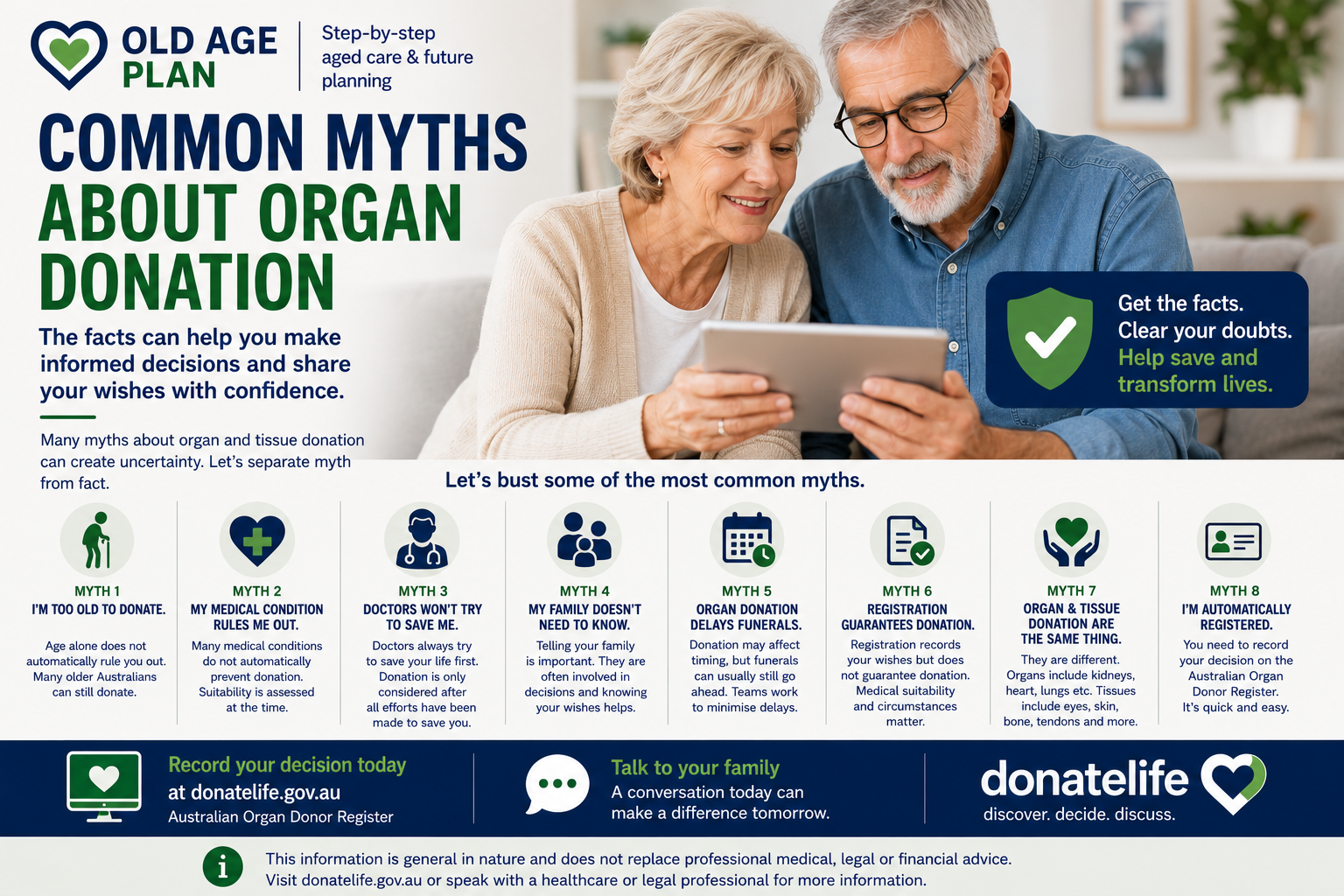

Common Myths About Organ Donation
Common myths about organ donation can stop people from recording their wishes or talking with their family.
Many Australians support organ and tissue donation.
However, misunderstandings can still create uncertainty.
Some people think they are too old.
Others believe a medical condition automatically rules them out.
Some families are unsure whether registration is enough.
This article explains common organ donation myths in plain English.
Short Answer
Many organ donation myths are based on misunderstanding.
In Australia, people aged 16 and over can register their organ and tissue donation decision.
Age and medical conditions do not automatically rule someone out.
Donation does not happen automatically, and family conversations still matter.
Myth 1: I Am Too Old To Donate
Many older people assume they cannot become organ or tissue donors.
This is not necessarily true.
Age alone does not automatically prevent someone from registering or being considered for donation.
Medical specialists assess suitability if donation becomes possible.
You can read more here: Can Older People Donate Organs?
Myth 2: My Medical Condition Rules Me Out
Some people believe any medical condition means donation is impossible.
That is not always correct.
Many people with medical conditions can still register their decision.
If donation becomes possible, specialist medical teams assess suitability at the time.
You can read more here: Can People With Medical Conditions Donate Organs?
Myth 3: Doctors Will Not Try To Save Me
This is one of the most concerning myths.
The first priority of healthcare professionals is always to care for the patient.
Organ donation is only considered after every appropriate effort has been made to save the person’s life.
The treating medical team and donation team have different roles.
You can read more here: How Does Organ Donation Work?
Myth 4: My Family Does Not Need To Know
Registering your decision is important.
However, telling your family is also important.
Families are often involved in donation discussions.
If your family already understands your wishes, the conversation may be clearer during a difficult time.
You can read more here: Should You Tell Your Family You Want To Be An Organ Donor?
Myth 5: Organ Donation Always Delays Funerals
Many families worry that donation will prevent or seriously delay funeral arrangements.
Organ donation may affect timing because medical procedures need to occur.
However, funeral arrangements can usually still proceed.
Specialist teams work carefully to support families and minimise delays where possible.
You can read more here: Does Organ Donation Delay A Funeral?
Myth 6: Registration Guarantees Donation Will Happen
Registration does not guarantee donation will happen.
Donation depends on medical suitability, how and where the person dies, the condition of organs or tissues, and consent requirements.
However, registration still matters.
It records your decision and may help your family understand what you wanted.
You can read more here: What Is The Australian Organ Donor Register?
Myth 7: Organ Donation And Tissue Donation Are The Same Thing
Organ donation and tissue donation are connected, but they are not the same.
Organ donation may involve organs such as kidneys, heart, lungs, liver or pancreas.
Tissue donation may involve eye tissue, heart valves, skin, bone or tendons.
In some cases, tissue donation may be possible when organ donation is not.
You can read more here: What Is The Difference Between Organ And Tissue Donation?
Myth 8: I Am Automatically Registered
Some people believe they are automatically registered as an organ donor.
In Australia, people need to record their decision on the Australian Organ Donor Register.
Supporting organ donation in your mind is not the same as formally recording your decision.
If donation matters to you, it may help to register and tell your family.
You can read more here: What Is The Australian Organ Donor Register?
Myth 9: Family Members Always Agree
Family members do not always have the same views about organ donation.
Disagreements can happen when people are grieving, uncertain or unclear about what their loved one wanted.
Earlier conversations may help reduce confusion.
You can read more here: What Happens If Family Members Disagree About Organ Donation?
Myth 10: An Advance Care Directive Is Enough
An Advance Care Directive may help communicate healthcare values and future wishes.
However, it should not be the only place organ donation wishes are recorded.
The Australian Organ Donor Register remains important.
Family conversations also remain important.
You can read more here: Can An Advance Care Directive Include Organ Donation Wishes?
What Should Families Understand?
Families do not need to know every medical detail about donation.
However, it helps to understand the basics.
Organ and tissue donation decisions are clearer when:
- The person has recorded their decision
- The family understands the person’s wishes
- Common myths have been addressed
- Questions are asked early
- Documents and conversations are consistent
A checklist may help families keep track of future planning conversations.
However, the most important step is making wishes clear.
Real-Life Example
Linda always supported organ donation.
However, she assumed her age and health history meant she could never donate.
After learning that suitability is assessed by medical specialists, she registered her decision and told her family.
Even if donation was never possible, her family now understood what she wanted.
FAQs About Common Organ Donation Myths
What are common myths about organ donation?
Common myths include thinking you are too old, medical conditions always rule you out, family conversations are unnecessary, or registration guarantees donation.
Can older people register as organ donors?
Yes. Older people can register. Age alone does not automatically rule someone out.
Can people with medical conditions register?
Yes. Many people with medical conditions can still register. Suitability is assessed if donation becomes possible.
Does registering mean donation will definitely happen?
No. Donation depends on medical suitability and the circumstances at the time.
Should I tell my family about my donation wishes?
Yes. Telling your family can help them understand and support your wishes if donation is ever discussed.
Key Takeaway
Many common myths about organ donation are based on misunderstanding rather than fact.
Age, medical conditions and family concerns do not automatically prevent someone from recording their wishes.
Understanding the facts, registering your decision and discussing it with family can help provide greater clarity.
Final Thoughts
Common myths about organ donation can stop people from making their wishes known.
Many of these myths are based on uncertainty, not fact.
If organ and tissue donation matters to you, it may help to record your decision, talk with your family and seek information from trusted Australian sources.
Clear wishes can make a difficult time easier for the people you love.
Related Articles
- What Is Organ Donation?
- How Does Organ Donation Work?
- What Is Tissue Donation?
- What Is The Difference Between Organ And Tissue Donation?
- Who Can Become An Organ Donor?
- Can Older People Donate Organs?
- Can People With Medical Conditions Donate Organs?
- Can Family Override Organ Donation Wishes?
- Should You Tell Your Family You Want To Be An Organ Donor?
- What Happens If Family Members Disagree About Organ Donation?
- Who Makes Organ Donation Decisions?
- Does Organ Donation Delay A Funeral?
- Can An Advance Care Directive Include Organ Donation Wishes?
- What Is The Australian Organ Donor Register?
Sources
- DonateLife — Organ and Tissue Donation Information
- DonateLife — Myths About Donation
- DonateLife — Register As A Donor
- Services Australia — Australian Organ Donor Register
- Healthdirect — Organ And Tissue Donation
Disclaimer
This article provides general information only. It is not legal, medical or financial advice.
Organ donation laws, policies and procedures may change over time and individual circumstances can vary.
Always seek advice from qualified healthcare professionals and refer to official Australian Government and DonateLife resources for current information.