
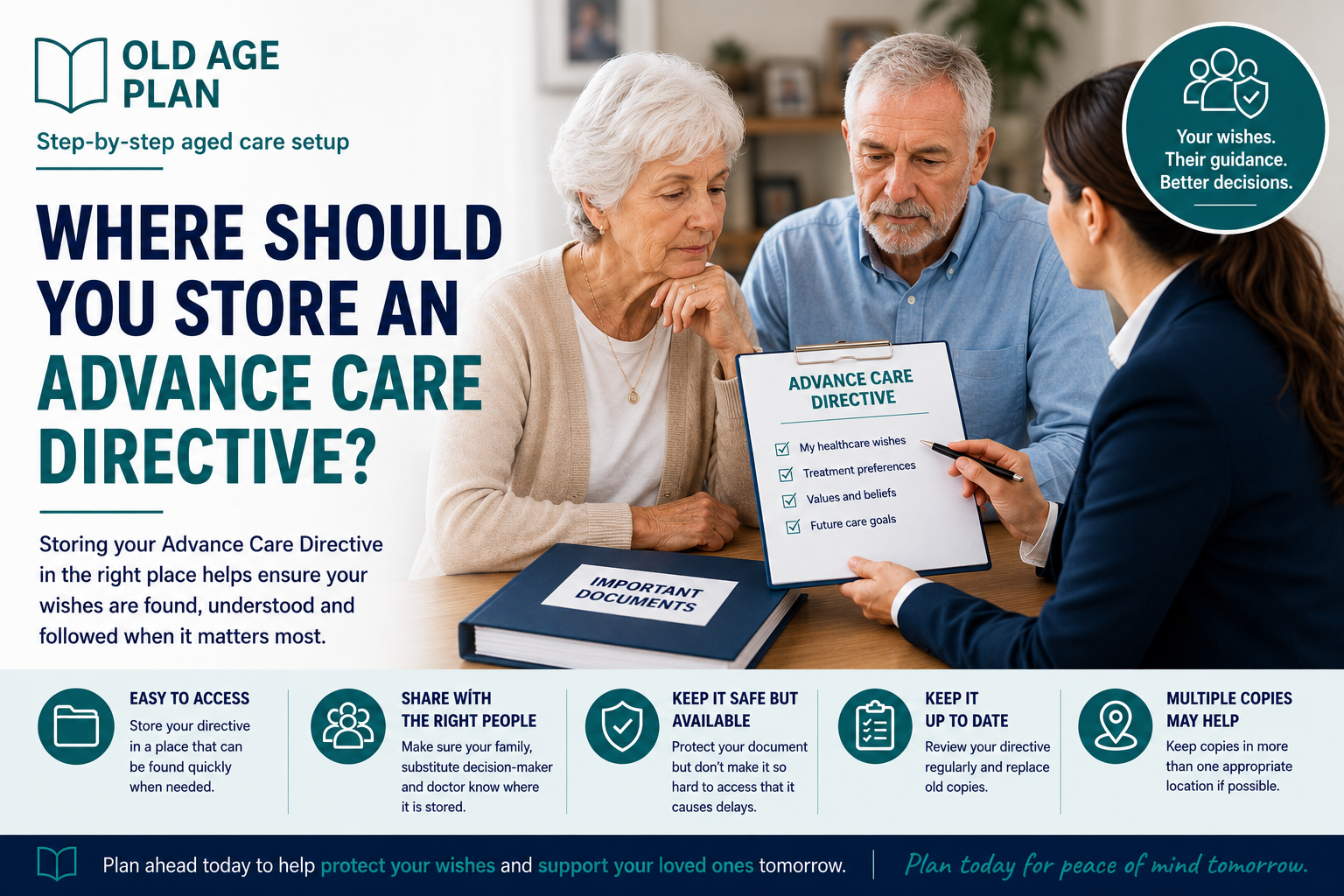

Where Should You Store An Advance Care Directive?
An Advance Care Directive is only helpful if people can find it when it matters.
You may have written down your healthcare wishes clearly. You may have spoken to your family. You may have made careful decisions about future medical treatment.
But if your Advance Care Directive is locked away, hidden in a drawer, or nobody knows where it is, it may not help during a hospital emergency.
That is why many families ask: where should you store an Advance Care Directive?
The best answer is usually simple: keep the original somewhere safe and make sure the right people can access a current copy when needed.
Why Storage Matters
An Advance Care Directive records your wishes for future healthcare.
It may guide doctors, family members and substitute decision-makers if you become unable to speak for yourself.
But timing matters.
If the document cannot be found during a medical crisis, your family may still be left guessing.
Good storage is not just about keeping the document safe. It is also about making sure the right people know where the current version is kept.
Keep The Original In A Safe Place
The original signed document should usually be kept somewhere safe and protected.
This may be a home filing cabinet, important documents folder, secure drawer, or another trusted location.
The key is that it should not be so hidden that nobody can find it.
A document that is safe but impossible to access may not be useful when urgent decisions need to be made.
Give A Copy To Your Substitute Decision-Maker
Your substitute decision-maker should usually know where your Advance Care Directive is stored.
In many cases, they should also have a copy.
This may be your Enduring Guardian, medical treatment decision-maker, appointed attorney for health matters, or another recognised decision-maker depending on your state or territory.
If they are expected to speak for you, they need to understand your wishes and know how to access the document quickly.
Give A Copy To Your GP
Your GP is often one of the most practical people to give a copy to.
Your GP may know your health history, current conditions and ongoing care needs.
If your Advance Care Directive is kept with your medical records, it may be easier for healthcare providers to understand your wishes.
Ask your GP clinic how they store advance care planning documents and what happens if you update the document later.
Ask Hospitals How They Record It
If you regularly attend a hospital or health service, ask how they record Advance Care Directives.
Some hospitals may be able to add a copy to your health record.
Others may have their own process for storing or noting advance care planning documents.
This can be especially important if you have ongoing treatment, a serious diagnosis, or planned surgery.
Do not assume the hospital automatically has a copy. Ask.
Consider Uploading It To My Health Record
In Australia, some advance care planning documents may be uploaded to My Health Record.
This can help make the document available to healthcare providers who are involved in your care.
According to the Australian Digital Health Agency, you generally need a scanned PDF copy of the document and details of the document custodian to add advance care planning documents to My Health Record.
This does not replace telling your family and decision-maker where the document is kept. It is one extra way to help make the information easier to access.
Should Your Family Have Copies?
Some family members may need a copy. Others may only need to know where the current version is kept.
This depends on your family situation.
The most important people are usually the people who may be contacted during a medical emergency or involved in future care decisions.
This may include your spouse, partner, adult children, close relatives or trusted support people.
The goal is not to give a copy to every person you know. The goal is to avoid confusion when decisions need to be made.
Should An Aged Care Provider Have A Copy?
If you receive aged care services, your provider may need to know that your Advance Care Directive exists.
This may apply to home care, respite care or residential aged care.
If you move into residential aged care, ask how they store healthcare planning documents.
Also ask who will be contacted if your health changes.
This can help ensure your wishes are not missed during future care planning.
Should You Store It With Your Will?
Some people keep their Advance Care Directive with their Will and other important documents.
This may seem organised, but there is one important issue.
A Will is usually used after death. An Advance Care Directive may be needed while you are still alive but unable to make or communicate healthcare decisions.
If it is stored only with your Will, family may not think to look there during a medical emergency.
If you store it with estate planning documents, make sure your family and decision-maker know it is there.
Should You Keep A Copy In Your Phone Or Computer?
A digital copy can be useful, especially if family members need to access it quickly.
However, digital copies can also be hard to access if passwords, devices or accounts are unavailable.
If you keep a digital copy, make sure a trusted person knows how to find it.
Do not rely only on a phone, email inbox or computer folder if nobody else can access it.
What If You Update The Document?
If you update your Advance Care Directive, storage becomes even more important.
Old copies can create confusion.
One person may have the current version. Another person may still have the old version. A healthcare provider may have no update at all.
If you make a new version, tell the people who had the old one.
Give them the updated copy and clearly explain that it replaces the previous version.
Do Storage Requirements Differ Across Australia?
Yes.
Advance Care Directive laws, document names, healthcare processes and storage recommendations vary between Australian states and territories.
Some jurisdictions have different forms, terminology and rules for substitute decision-makers.
It is important to understand the requirements that apply where you live and seek professional advice where appropriate.
Common Storage Mistakes To Avoid
Keeping The Only Copy At Home
If the only copy is at home, it may not help during a hospital emergency.
Not Telling Your Decision-Maker
The person expected to speak for you should know where the document is stored.
Forgetting To Update Copies
If the document changes, old copies should be replaced where possible.
Assuming Doctors Already Have It
Do not assume your GP or hospital has a copy unless you have provided one.
Storing It Somewhere Too Secure
A locked safe may protect the document, but it may also stop people accessing it when needed.
Real-Life Example
Helen completed an Advance Care Directive after talking with her GP.
She placed the original in a folder at home with her other important documents.
But she also gave a copy to her daughter, her GP and her appointed decision-maker.
When Helen later went to hospital unexpectedly, her daughter knew exactly where the document was.
She was able to provide the current version quickly.
This helped the healthcare team understand Helen’s wishes and gave the family more confidence during a stressful time.
Frequently Asked Questions
Where is the best place to store an Advance Care Directive?
Keep the original in a safe place and make sure the right people can access a current copy quickly.
Should my GP have a copy?
Yes, it is often sensible to give your GP a copy so your healthcare wishes can be noted with your medical records.
Can I upload my Advance Care Directive to My Health Record?
Advance care planning documents may be uploaded to My Health Record. Check the current My Health Record process and requirements.
Should I keep it with my Will?
You can, but make sure family understand that an Advance Care Directive may be needed while you are alive, not after death.
Who should know where it is stored?
Your substitute decision-maker, close family, GP and relevant healthcare or aged care providers should usually know where the current version can be found.
What should I do if I update it?
Replace old copies wherever possible and tell the people who previously had a copy that the new version is current.
Sources
- Advance Care Planning Australia — Store And Share Your Documents
- Australian Government Department of Health — Advance Care Directive
- Australian Digital Health Agency — Advance Care Planning In My Health Record
- NSW Health — Making An Advance Care Directive
- Office Of The Public Advocate Victoria — Making An Advance Care Directive
- WA Health — Advance Health Directives
- Office Of The Public Advocate South Australia — Advance Care Directives
- My Aged Care
Related Resources
- What Is An Advance Care Directive?
- Advance Care Directive vs Enduring Guardianship
- Advance Care Directive vs EPOA
- When Should You Create An Advance Care Directive?
- Can Family Override An Advance Care Directive?
- What Happens If There Is No Advance Care Directive?
- Talking To Family About Future Care Decisions
- Hospital And Advance Care Directives
- Can You Change An Advance Care Directive?
- Who Should Receive A Copy Of Your Advance Care Directive?
- How Often Should You Review An Advance Care Directive?
- Common Advance Care Directive Mistakes
- Can An Advance Care Directive Expire?
- Estate Planning Pillar
- What Is Enduring Guardianship?
- What Is An Enduring Power Of Attorney?
- What Is A Will?
- Free Aged Care Tools
Disclaimer
This article provides general information only. It is not legal, medical or financial advice. Advance Care Directive laws, storage options and healthcare processes vary across Australian states and territories. Always check the rules in your location and seek professional advice for your personal situation.