
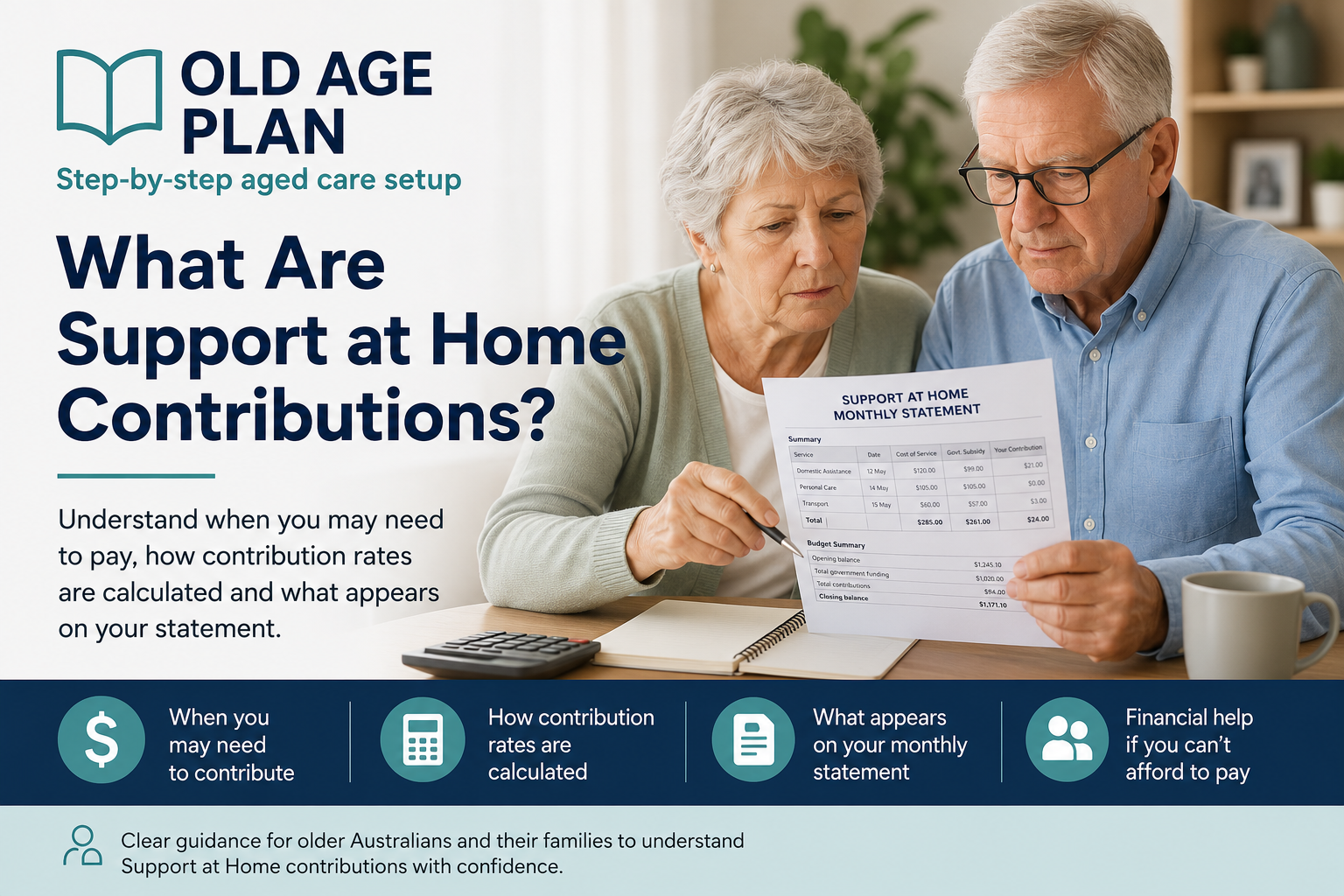

What Are Support at Home Contributions?
Support at Home contributions are the amounts some participants pay towards the cost of particular aged care services they receive at home.
The Australian Government pays part or all of the approved service price. The participant may pay the remaining percentage, depending on the type of service and their financial circumstances.
This does not mean every Support at Home service attracts an out-of-pocket cost. Clinical services are fully government-funded, while contribution rates for other services vary.
How Do Support at Home Contributions Work?
You only pay a contribution when an applicable service is actually delivered.
Your contribution is calculated as a percentage of the provider’s agreed service price. Services Australia determines your contribution rate using your pension status, income and assets, while the service category determines which rate applies.
The government pays the remaining approved amount to the provider.
Key Takeaway
Your contribution rate and your provider’s price are not the same thing.
Services Australia determines the percentage you contribute. Your provider determines the agreed price of the service. Both affect what you may pay out of pocket.
Why Do Participants Pay Contributions?
Support at Home uses a shared-contribution model for some non-clinical services.
The government funds the full cost of approved clinical supports. Participants may contribute towards services associated with independence or everyday living.
The contribution system is intended to reflect two things:
- the nature of the service being delivered
- the participant’s capacity to contribute based on their financial circumstances
The result is not a single flat fee that applies equally to everyone. Two people may receive the same service but pay different contribution percentages because their financial assessments are different.
Two people with the same contribution percentage may also pay different dollar amounts if their providers charge different service prices.
Which Support at Home Services Have Contributions?
Support at Home services are grouped into contribution categories.
Clinical Supports
Participant contribution: 0%
The Australian Government fully funds approved clinical services.
Examples may include nursing and physiotherapy delivered under the clinical support category.
Independence Services
Participant contribution: varies
These services help a person remain independent, mobile and able to manage daily activities.
The contribution percentage depends on the participant’s financial assessment.
Everyday Living Services
Participant contribution: generally higher
These services support ordinary household and daily living activities.
Examples may include cleaning, gardening and meal-related assistance.
The category attached to a service matters because it determines which contribution rate is applied.
Families should not assume that two services with similar names belong to the same contribution category. The provider should be able to explain how each service is classified before it begins.
What Are The Standard Contribution Rates?
The following standard rates apply from 1 July 2026 to people who entered Support at Home under the standard contribution arrangements.
Full Pensioner
Clinical: 0%
Independence: 5%
Everyday living: 17.5%
Part Pensioner Or Commonwealth Seniors Health Card Holder
Clinical: 0%
Independence: 5% to 50%
Everyday living: 17.5% to 80%
The exact percentage depends on the person’s income and assets assessment.
Self-Funded Retiree At The Maximum Threshold
Clinical: 0%
Independence: 50%
Everyday living: 80%
These are contribution percentages, not fixed dollar fees.
The dollar amount paid for a particular service depends on:
- the provider’s agreed price for that service
- the service contribution category
- the participant’s assessed contribution percentage
Rates and financial thresholds may change through government indexation. Participants should check their Services Australia determination and the current official contribution schedule rather than relying only on older estimates.
How Is The Dollar Contribution Calculated?
The participant contribution is calculated by applying the assessed percentage to the agreed price of the delivered service.
Example: Independence Service
A service costs $100.
The participant’s contribution rate is 5%.
Participant pays: $5
Government pays: $95
Example: Everyday Living Service
A service costs $100.
The participant’s contribution rate is 17.5%.
Participant pays: $17.50
Government pays: $82.50
These examples demonstrate the calculation only. The actual amount depends on the participant’s official rate and the provider’s agreed service price.
If the provider’s price increases, the participant’s dollar contribution may increase even when their assessed percentage stays the same.
Who Determines Your Contribution Rate?
Services Australia determines the participant’s contribution rate.
The assessment considers factors such as:
- Age Pension or other income-support status
- Commonwealth Seniors Health Card eligibility
- income
- financial and non-financial assets
- homeowner status
- whether the person is single or part of a couple
- relevant transition arrangements
Someone receiving a relevant government payment may already have financial information available to Services Australia.
People who do not receive a relevant payment may need to provide income and asset information so Services Australia can calculate their rate.
A self-funded retiree should not automatically assume they must pay the highest possible contribution. Providing financial information may result in a lower assessed rate where their income and assets fall below the maximum thresholds.
What Happens If You Do Not Complete The Financial Assessment?
Failing to provide required financial information may result in the person being charged the maximum applicable contribution rate.
This can create avoidable out-of-pocket costs, particularly when the person may have qualified for a lower rate.
Do Not Assume Services Australia Already Has Everything
Confirm whether further income or asset information is required before services begin.
Do Not Ignore Official Letters
A request for financial information may directly affect the percentage charged for services.
Do Not Confuse Assessment Delays With A Final Rate
An interim rate may later be adjusted after the assessment is completed.
Check Whether An Overpayment Is Owed Back
If a final assessment produces a lower rate, the provider may need to refund contributions that were overpaid.
When Do You Pay A Support at Home Contribution?
A provider may only collect a participant contribution after the applicable service has been delivered.
The provider and participant may agree on a billing schedule, such as:
- weekly
- fortnightly
- monthly
- another agreed billing cycle
The contribution should be connected to identifiable services rather than appearing as an unexplained general charge.
The provider should record contributions in the participant’s individualised budget and monthly statement.
Do You Pay Contributions When A Service Is Not Delivered?
Participant contributions are generally linked to services received.
A participant should not be charged a contribution for a service that was never delivered unless an authorised cancellation arrangement legitimately applies to the service claim.
Monthly statements and invoices should be checked against what actually happened.
Check Service Dates
Confirm that each invoiced service occurred on the date shown.
Check The Service Category
An incorrect category may result in the wrong contribution rate being applied.
Check The Agreed Price
The service price should match the service agreement or an authorised price change.
Check The Percentage
The percentage charged should match the current Services Australia determination.
Are Personal Care Services Free?
Personal care contribution rules are changing.
Until 30 September 2026, approved personal care services continue to attract the applicable independence contribution under the current rules.
From 1 October 2026, the Australian Government will fully fund approved personal care services delivered through Support at Home.
This means participants will not pay an out-of-pocket contribution for approved personal care delivered from that date, provided:
- personal care is approved in the participant’s support plan
- the participant has available Support at Home funding
- the delivered service falls within the official personal care service type
Personal care may include assistance with showering, dressing, hygiene, continence support, eating and self-administration of medication.
Contributions for other independence and everyday living services will continue to apply according to the relevant rules.
What Is The No Worse Off Principle?
Special contribution arrangements protect certain people who were already receiving or approved for a Home Care Package before the aged care reforms.
The no worse off principle generally applies to people who, on or before 12 September 2024, were:
- receiving a Home Care Package
- on the National Priority System
- approved as eligible for a Home Care Package
Eligible participants should pay the same or less under Support at Home than they would have paid under the former Home Care Packages Program.
Under the current no worse off rates:
Full Pensioner
Clinical: 0%
Independence: 0%
Everyday living: 0%
Part Pensioner Or Commonwealth Seniors Health Card Holder
Clinical: 0%
Independence: 0% to 25%
Everyday living: 0% to 25%
Self-Funded Retiree
Clinical: 0%
Independence: 25%
Everyday living: 25%
Services Australia determines whether the no worse off arrangements apply. Families should not try to work this out solely from a provider invoice.
Is There A Lifetime Cap On Contributions?
Yes. Lifetime caps limit the total amount a person can be required to contribute across eligible aged care services over their lifetime.
From 1 July 2026, the published Support at Home lifetime caps are:
- Standard contribution arrangements: $137,917.01
- No worse off contribution arrangements: $86,185.23
These amounts are indexed, so they may change over time.
Relevant contributions paid while receiving home care may also count towards the person’s lifetime cap if they later move into residential aged care.
Services Australia should notify the participant and provider when the applicable lifetime cap has been reached.
Can Your Contribution Rate Change?
A contribution rate is not necessarily permanent.
It may increase, decrease or remain the same because of:
- changes in income
- changes in assets
- changes in pension or concession-card status
- changes in personal circumstances
- government indexation
- changes to the mix of services received
- reaching the applicable lifetime cap
Services Australia reviews contribution rates and may request updated financial information.
If a rate changes, Services Australia should notify the participant or their nominee and the provider in writing.
If the new rate applies retrospectively and the participant has overpaid, the provider may need to issue a refund.
What If You Cannot Afford The Contributions?
A participant experiencing genuine financial difficulty may be able to apply to Services Australia for financial hardship assistance.
Financial hardship assistance is not automatic. The person may need to provide information about their:
- income
- assets
- essential expenses
- debts or liabilities
- circumstances causing financial difficulty
If assistance is approved, the government may pay a fee-reduction supplement covering some or all of the participant’s contributions for the approved period.
Families should seek help before unpaid invoices accumulate. Avoiding the issue can place continuity of services at risk.
A provider must make reasonable efforts to discuss payment arrangements and continuity of care before deciding to cease services because contributions remain unpaid.
What Should Appear On Your Monthly Statement?
The provider’s monthly statement should make it possible to understand how contributions were calculated and charged.
Look for:
- the service delivered
- the date of delivery
- the provider’s service price
- the relevant contribution category
- the participant contribution amount
- the government-funded amount
- payments already received
- refunds or adjustments
- any outstanding participant balance
An invoice may be mathematically correct while still being difficult to understand. The provider should be able to explain each charge in plain language.
Common Contribution Mistakes To Watch For
Confusing The Contribution With The Full Service Price
The contribution is usually a percentage of the agreed price, not the entire service cost.
Assuming Everyone Pays The Same Rate
Rates vary according to service category, financial circumstances and transition arrangements.
Ignoring The Provider’s Price
The same contribution percentage produces a larger dollar payment when the service price is higher.
Paying Without Checking Delivery
Compare invoices with appointments, rosters and services actually received.
Missing No Worse Off Protection
Eligible former Home Care Package participants may have substantially different contribution arrangements.
Delaying A Hardship Application
Seek assistance early when contributions are making essential services unaffordable.
What You May Really Be Trying To Decide
The real concern is often not simply whether contributions exist.
It is:
“Can we afford to keep using the services that are supposed to help Mum or Dad remain safely at home?”
A technically affordable percentage can still create pressure when several services are delivered each week.
The important question is not only what one service costs. It is what the total contribution pattern does to the person’s ability to maintain essential care over time.
That requires looking at:
- which services carry contributions
- how often those services occur
- the provider’s prices
- the person’s official percentage
- which services are essential
- whether cost is causing the person to decline necessary support
Decision Support
Families may be tempted to remove a service as soon as they see an out-of-pocket contribution.
Before reducing care, separate three different questions.
Is The Rate Correct?
Check the Services Australia determination, service category and any no worse off arrangements.
Is The Price Reasonable?
Compare the provider’s agreed price with the service agreement and published pricing information.
Is The Service Still Valuable?
Consider whether the service is reliable, necessary and producing a meaningful care outcome.
Is Financial Help Needed?
Explore hardship assistance or payment arrangements before essential care is abandoned.
A lower contribution is not useful if the service is poor. A valuable service may still be unsustainable if its price and frequency create unaffordable costs.
The goal is to preserve the services that matter while making sure the participant is charged correctly and understands what they are paying for.
Summary
Support at Home contributions are the amounts participants may pay towards particular approved services.
Clinical services are fully government-funded. Independence and everyday living services may attract contributions based on the participant’s income, assets, pension status and transition arrangements.
Services Australia determines the contribution percentage. The provider’s agreed service price determines the dollar amount to which that percentage is applied.
Participants should only be charged after applicable services are delivered, and the charges should appear clearly in their monthly statements.
The central issue is not simply whether a contribution exists. It is whether the rate, price and service arrangement are correct, affordable and still producing the support the person needs at home.
Support at Home Contribution FAQs
Does everyone pay Support at Home contributions?
No. Whether a person contributes depends on the service category, financial assessment and any no worse off arrangements that apply.
Are clinical Support at Home services free?
Approved clinical support services attract a 0% participant contribution. The government pays the approved service cost.
Who calculates the contribution rate?
Services Australia calculates the participant’s contribution rate using their pension status, income, assets and relevant transition arrangements.
Does the provider set the contribution percentage?
No. Services Australia determines the percentage. The provider sets the agreed service price to which the percentage is applied.
Do you pay contributions when no service is delivered?
Contributions are linked to services received. Check any charge for a missed or cancelled service against the provider’s cancellation terms and Support at Home claiming rules.
Will personal care services have contributions after 1 October 2026?
No. Approved personal care services delivered from 1 October 2026 will be fully government-funded where personal care is included in the support plan and funding is available.
Can contribution rates change?
Yes. Rates may change because of financial or personal circumstances, government indexation, service changes or reaching a lifetime cap.
What happens if someone cannot afford their contributions?
They may be able to apply to Services Australia for financial hardship assistance. The provider should also discuss possible payment arrangements and continuity of care.
Sources
- Australian Government Department of Health, Disability and Ageing — Support at Home Participant Contributions
- Australian Government Department of Health, Disability and Ageing — Schedule of Contributions for Support at Home Services
- My Aged Care — Support at Home Costs and Contributions
- My Aged Care — Changes to Contributions While Accessing Support at Home
- My Aged Care — Support at Home Personal Care Contribution Changes
- Services Australia — Support at Home Calculation of Your Cost of Care Form
- Services Australia — Financial Hardship Assistance With Aged Care Costs
Disclaimer
This article provides general information only and is not legal, medical or financial advice.
Aged care contribution rates, thresholds, lifetime caps, service categories, financial assessments, transition arrangements and government policies may change. Individual circumstances and provider prices also vary.
Seek qualified professional advice where appropriate and refer to My Aged Care, Services Australia and the Australian Government Department of Health, Disability and Ageing for current information about Support at Home contributions.