

Reaching Age Pension age does not automatically mean you can receive the Age Pension. You must also meet Australia’s residence rules, along with the applicable income and assets tests.
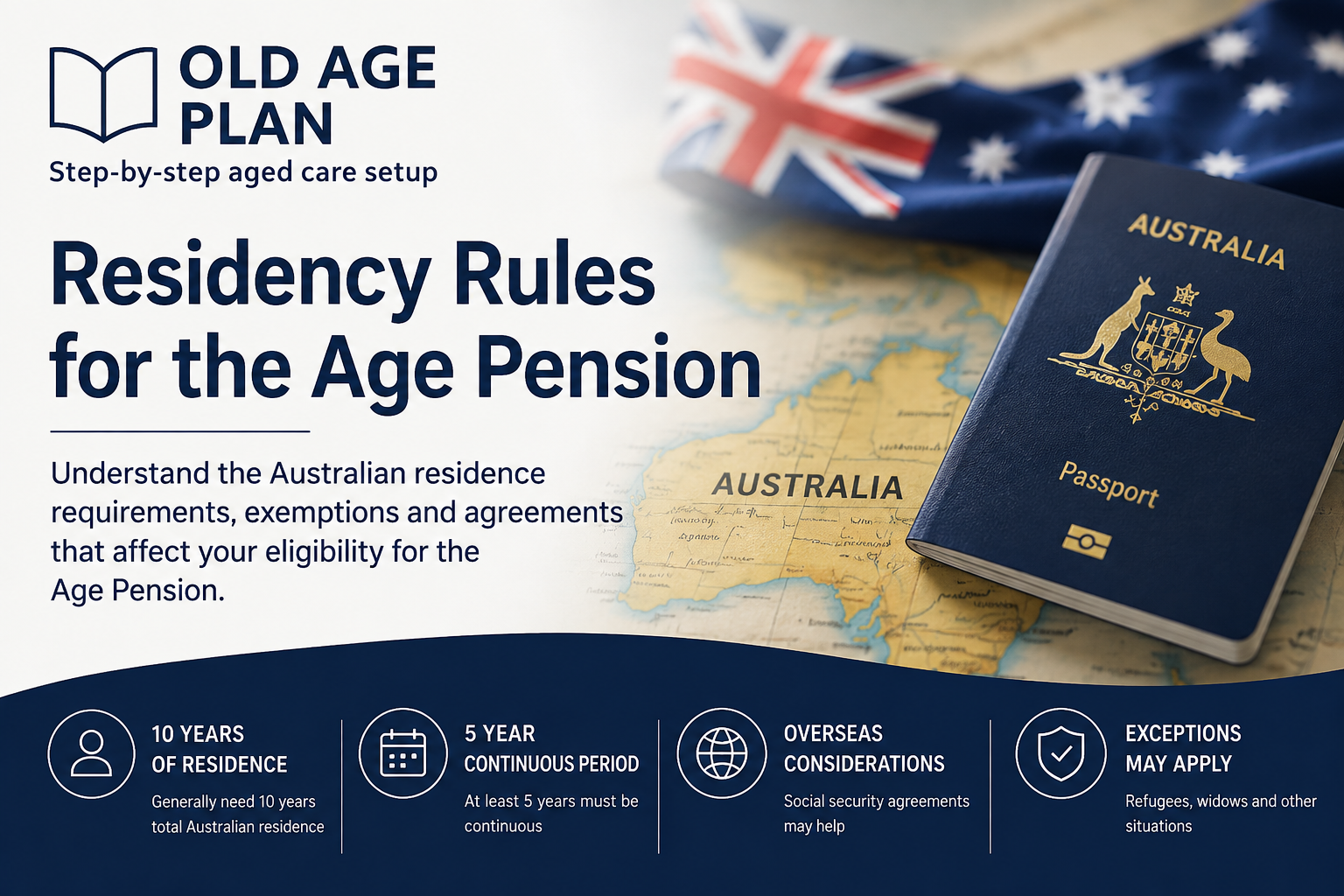
For most people, the key requirement is having been an Australian resident for at least 10 years in total, including at least one continuous period of five years. However, exceptions and international social security agreements may change how the rules apply.
What are the Age Pension residency rules?
To qualify for the Age Pension, you generally need to be an Australian resident and be in Australia when you claim.
You will normally also need to have been an Australian resident for at least 10 years in total, with at least five of those years forming one continuous period.
Some people may qualify with less than 10 years of Australian residence because of an exemption or an international social security agreement.
Key Takeaway
Citizenship, visa status and Age Pension residence are related but separate issues. Holding Australian citizenship does not automatically prove that you meet every Age Pension residence requirement.
What Does Australian Resident Mean for the Age Pension?
For Centrelink purposes, being physically present in Australia is not always enough. Services Australia considers whether Australia is your settled or usual place of residence and whether you have permission to live here permanently.
You may generally be treated as an Australian resident if you are living in Australia and are:
- an Australian citizen
- the holder of a permanent visa
- a protected Special Category visa holder
Temporary visa holders generally do not meet the ordinary Australian residence definition unless a specific exception applies.
Citizenship alone may not settle the question
A person may be an Australian citizen but still need to establish when they were living in Australia as an Australian resident.
Physical presence is not always residence
Holidays, temporary visits and short periods in Australia may not count as periods of Australian residence.
How Long Must You Have Lived in Australia?
To receive the Age Pension under the ordinary residence rules, you generally need at least 10 years of Australian residence in total.
Within those 10 years, at least five years must form one continuous period without a break in Australian residence.
One continuous period
A person who lived in Australia continuously for 10 years may satisfy the ordinary residence-duration rule.
Several periods combined
Separate periods may be added together if they total at least 10 years and one continuous period lasted at least five years.
Less than 10 years
The ordinary rule may not be met, but an exemption or international social security agreement may still help the person qualify.
Does the 10-Year Period Need to Be Continuous?
No. The full 10 years does not necessarily need to be one unbroken period.
Different periods of Australian residence may be combined. However, at least one of those periods must usually have lasted for five continuous years.
Example: Separate periods may qualify
A person lived in Australia for six continuous years, moved overseas and later returned for another four years.
Their periods total 10 years, and the first period was longer than five continuous years. Subject to the remaining eligibility rules, they may satisfy the ordinary residence-duration requirement.
Example: Total residence may still be sufficient
A person lived in Australia for four years, moved overseas and later returned for another six years.
Their periods total 10 years, and the second period provides at least five continuous years. They may satisfy the ordinary duration rule, subject to Centrelink confirming those periods as Australian residence.
The important issue is not simply the dates shown in a passport. Centrelink may need to determine whether each period was genuinely a period of Australian residence.
Do You Need to Be in Australia When You Claim?
Under the ordinary rules, you generally need to be an Australian resident and physically present in Australia on the day you lodge your Age Pension claim.
Different arrangements may apply if you are living in a country that has an international social security agreement with Australia.
These agreements may allow eligible periods in another country to help you meet minimum qualification rules or allow you to lodge a claim while living overseas.
Living overseas can change the claim pathway
Do not assume you can lodge an ordinary domestic Age Pension claim from any country. The rules may depend on whether Australia has a social security agreement with that country.
Qualifying is different from payment portability
Meeting the residence rules to receive Age Pension is separate from the rules that determine what happens to your payment after you leave Australia.
Can Time Spent Overseas Count Towards the Residence Requirement?
Time spent living overseas does not ordinarily count as Australian residence merely because you remained an Australian citizen.
However, an international social security agreement may allow periods of residence, insurance contributions or employment in an agreement country to help you satisfy certain qualification requirements.
These agreements do not mean every overseas period automatically becomes Australian residence. Each agreement contains its own rules and must be applied to the person’s circumstances.
Which Countries Have Social Security Agreements With Australia?
Australia has social security agreements with a number of countries. Depending on the agreement, time spent living or working in one of those countries may help a person qualify for the Australian Age Pension.
Agreement countries and the rules applying under each agreement can change. Services Australia should confirm whether a particular agreement applies to your residence and employment history.
An agreement may help with the minimum residence requirement, but you must still satisfy the other applicable Age Pension conditions.
Are Refugees Exempt From the 10-Year Rule?
A refugee or former refugee may be exempt from the ordinary 10-year Australian residence requirement.
The exemption does not remove every Age Pension condition. The person must still meet the relevant age, income, assets and other qualification rules.
Centrelink may require documents confirming the person’s refugee or former refugee status before applying the exemption.
Can a Widow Qualify With Less Than 10 Years of Residence?
A woman whose partner has died may qualify under a specific residence exception where both of the following conditions apply:
- she was an Australian resident for the two years immediately before claiming
- both partners were Australian residents when her partner died
This is a specific exception and should not be treated as a general reduction of the 10-year rule for every surviving partner.
What If You Recently Returned to Australia?
If you return to Australia to live after residing overseas, there is generally no separate waiting period before you can lodge an Age Pension claim.
You must still meet all Age Pension qualification requirements, including the residence-duration rule unless an exemption or agreement applies.
A separate rule may affect people who return to Australia, begin receiving Age Pension and then leave Australia again within two years of their return. In some circumstances, their payment may stop when they leave.
Returning to Australia may allow you to claim immediately, but it does not erase the residence history Centrelink must assess.
What Evidence May Centrelink Ask For?
Centrelink may require information to establish when you were an Australian resident and whether particular overseas periods interrupted that residence.
Relevant evidence may include:
- current and previous passports
- visa and citizenship records
- arrival and departure information
- residential addresses
- employment records
- taxation records
- property ownership or rental records
- evidence of family and financial connections
- details of time lived or worked in other countries
Services Australia may ask you to complete a Residence in Australia and other countries form where additional residence history is required.
Common Age Pension Residency Mistakes
Assuming citizenship proves 10 years of residence
Citizenship status does not automatically establish when or for how long you were an Australian resident.
Counting every visit to Australia
Temporary visits and holidays may not be treated as Australian residence.
Ignoring earlier periods of residence
Separate periods may be combined, so an older period of Australian residence may still be important.
Assuming overseas work never helps
Residence or contribution periods in an agreement country may affect eligibility under an international social security agreement.
Confusing qualification with overseas payment rules
The rules for becoming eligible are different from the rules governing how much Age Pension is paid after leaving Australia.
Waiting until the claim to reconstruct residence history
Missing passports and incomplete dates can make a complicated residence history harder to establish.
What You May Really Be Trying to Decide
Most people checking Age Pension residency rules are not only asking whether they have lived in Australia for 10 years.
They may be trying to work out:
- whether years spent overseas have interrupted their eligibility
- whether earlier periods in Australia can be combined
- whether citizenship is enough
- whether they need to return to Australia before claiming
- whether an overseas pension or social security agreement affects the claim
- whether leaving Australia again could stop or reduce their payment
These questions require a timeline of residence, not simply a current address or passport status.
Decision Support
Before claiming, build a clear residence history showing when you lived in Australia, when you lived overseas and what your legal residence status was during each period.
Step 1: Map your Australian residence periods
Record the start and end dates of every period in which Australia was your settled or usual home.
Step 2: Identify the continuous period
Check whether at least one recognised period of Australian residence lasted five years without a break.
Step 3: Record overseas residence and work
Identify every country where you lived or worked and whether Australia has a social security agreement with that country.
Step 4: Check possible exceptions
Consider whether refugee status, bereavement provisions or another specific rule may apply.
Step 5: Gather supporting records
Locate passports, visa records, address histories and employment evidence before Centrelink requests them.
Step 6: Separate claiming rules from travel rules
If you plan to leave Australia, check how travel timing and length may affect an approved payment.
Age Pension Residency FAQs
How many years must I live in Australia to get the Age Pension?
You generally need at least 10 years of Australian residence in total, including at least one continuous period of five years.
Do the full 10 years need to be continuous?
No. Separate periods may be combined, but at least one period must generally have lasted for five continuous years.
Does being an Australian citizen automatically qualify me?
No. Citizenship does not remove the need to satisfy the Age Pension age, residence, income, assets and other applicable eligibility requirements.
Can permanent residents receive the Age Pension?
A permanent visa holder may satisfy the Australian resident definition, but they must still meet the required period of Australian residence and all other Age Pension rules.
Can time spent overseas count towards the 10 years?
Overseas time does not ordinarily count as Australian residence. However, an international social security agreement may allow certain overseas residence or contribution periods to help establish eligibility.
Can I claim the Age Pension while living overseas?
You generally need to be an Australian resident and in Australia when claiming. A social security agreement may allow an eligible person to claim while living in an agreement country.
Is there a waiting period after returning to Australia?
There is generally no separate waiting period for a returning resident to lodge an Age Pension claim, but all qualification rules must still be met.
Can my Age Pension stop if I leave Australia after returning?
It may. If you returned to Australia to live, began receiving Age Pension and then leave within two years, your payment may stop unless another rule or social security agreement allows it to continue.
Are refugees exempt from the residence requirement?
Refugees and former refugees may be exempt from the ordinary 10-year residence rule, but they must still meet the other relevant Age Pension conditions.