
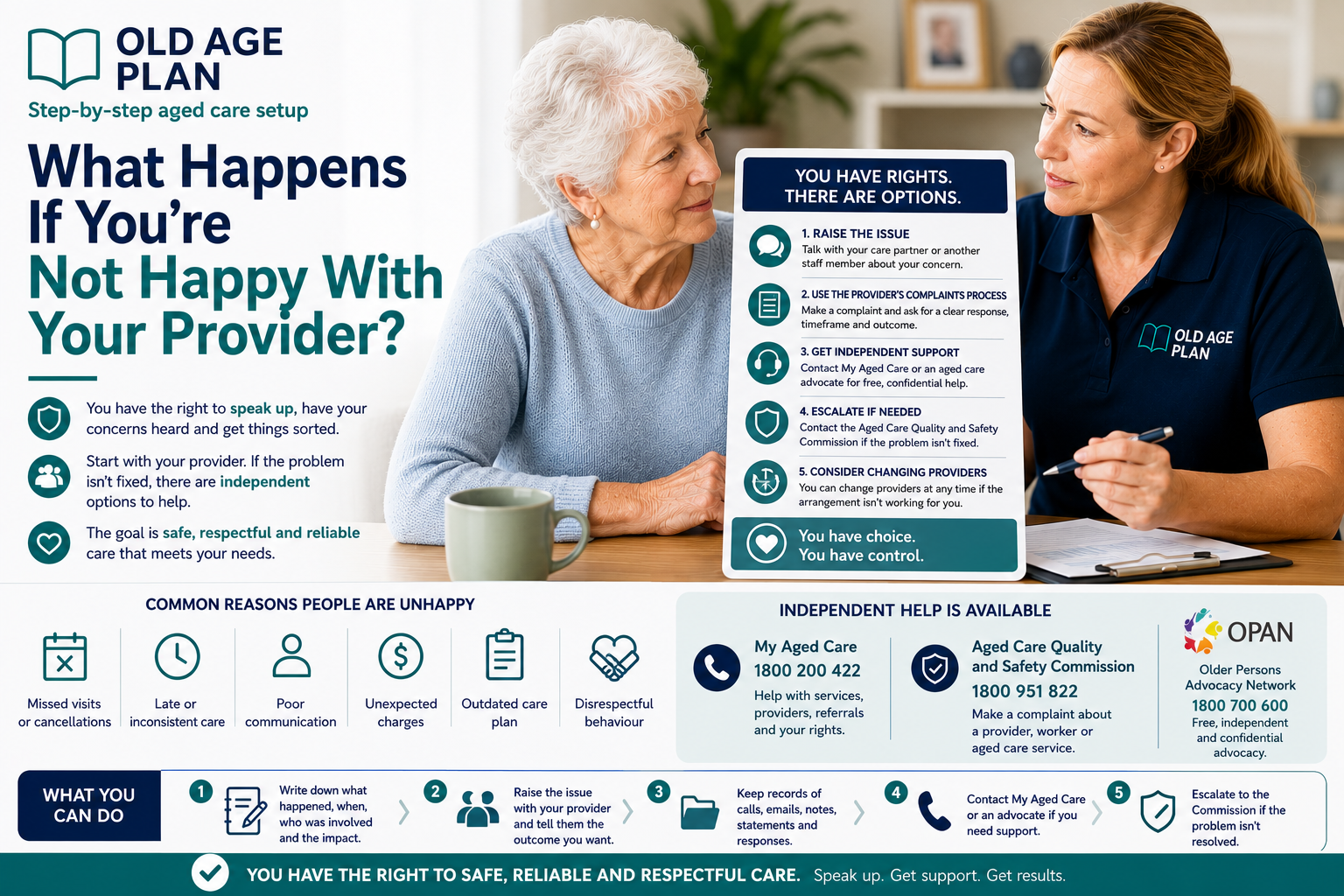

What Happens If You’re Not Happy With Your Provider?
If you are unhappy with your Support at Home provider, you have the right to raise the concern, ask for it to be addressed and make a formal complaint if the problem is not resolved.
You may begin by speaking with your care partner, another staff member or the provider’s complaints team. You can also seek independent advocacy, contact the Aged Care Quality and Safety Commission or change providers when the current arrangement is no longer suitable.
The best next step depends on the problem, the outcome you need and whether anyone’s health, safety or rights may be at immediate risk.
What Can You Do If You Are Unhappy With Your Provider?
Start by clearly describing the problem and the outcome you want. Ask the provider to investigate, respond and explain what it will do next.
If you are uncomfortable raising the issue directly, the provider does not resolve it or the concern involves care quality, safety or rights, you can contact the Aged Care Quality and Safety Commission.
You can also receive free, independent and confidential support from an aged care advocate through the Older Persons Advocacy Network.
Key Takeaway
A complaint should not begin with the question, “How far can we escalate this?”
It should begin with: “What needs to change so the person receives safe, reliable and respectful care?”
Do You Have The Right To Complain?
Yes. You have the right to raise concerns and complain about an aged care provider, worker or responsible person.
A complaint may relate to:
- services not being delivered as agreed
- poor-quality or unsafe care
- repeated cancellations or late visits
- unexplained prices or charges
- incorrect participant contributions
- weak care management
- poor communication
- disrespectful behaviour
- privacy concerns
- failure to respond when needs change
- difficulty accessing records or information
- problems changing providers
You do not have to wait until the problem becomes serious or happens repeatedly before raising it.
Early feedback can give the provider an opportunity to correct a problem before it begins affecting other parts of the care arrangement.
What Problems Can Be Raised With A Provider?
Missed Or Unreliable Services
Workers arrive late, visits are cancelled or essential services occur inconsistently.
Worker Concerns
The participant feels uncomfortable, rushed, disrespected or unsafe with a worker.
Billing Problems
Statements include services that did not occur, unexpected prices or unexplained adjustments.
Poor Care Management
Needs, risks and service problems are not being reviewed or coordinated properly.
Care Plan Problems
The written care plan is outdated, incomplete or does not reflect what is happening at home.
Rights And Respect
The participant is excluded from decisions, treated without dignity or not given information they can understand.
What Should You Do First?
If it feels safe and comfortable, begin by raising the issue directly with the provider.
You may speak with:
- the care partner
- the worker’s supervisor
- a service coordinator
- a clinical lead
- a provider manager
- the provider’s complaints team
Explain the issue as specifically as possible.
Instead of saying:
“The service has been terrible.”
You might say:
“Personal care was cancelled three times this month, no replacement worker was arranged and Mum was left without showering assistance.”
This identifies what happened, how often it occurred and why it matters.
What Outcome Should You Ask For?
A complaint is easier to address when the provider understands what outcome you are seeking.
An Explanation
You may want to understand why a service failed, a price changed or a decision was made.
A Correction
You may want an incorrect invoice, statement, contribution or care record corrected.
A Service Change
You may need a different worker, schedule, subcontractor or service arrangement.
A Care Review
You may want the care plan, risks, goals and budget reviewed.
Improved Communication
You may want a reliable contact person, clearer notices or agreed response timeframes.
A Formal Investigation
A serious or repeated concern may require investigation, documented findings and corrective action.
You do not need to know the perfect solution before making a complaint.
However, identifying the practical result you need can stop the discussion becoming a debate about who is to blame.
Should You Use The Provider’s Complaints Process?
Providers must have a process for receiving, managing and responding to complaints.
Ask the provider for information explaining:
- how to make a complaint
- who will investigate it
- how the provider will communicate with you
- when you should expect a response
- how the outcome will be recorded
- what you can do if you remain dissatisfied
You may make the complaint verbally, but putting important concerns in writing can create a clearer record.
A written complaint may include:
- What happened.
- When it happened.
- Who was involved.
- How the participant was affected.
- What has already been done.
- What outcome is being requested.
What Records Should You Keep?
Keep enough information to show the pattern and practical impact of the concern.
Useful records may include:
- dates and times of missed visits
- worker names where known
- monthly statements and invoices
- service rosters
- emails and letters
- notes from telephone calls
- care plans and service agreements
- photos where relevant and appropriate
- incident or hospital information
- the effect on the participant or family carer
Record facts as clearly as possible.
For example:
“The worker did not arrive on 4, 11 and 18 July. The provider was contacted each time. No replacement was arranged.”
This is usually more useful than a long emotional description without dates or examples.
What If The Problem Is About Prices Or Charges?
You can ask the provider to explain its prices, service charges and participant contribution calculations in a way you can understand.
Compare:
- the service agreement
- the provider’s published prices
- the individualised budget
- the monthly statement
- the participant’s contribution-rate notice
- what services were actually delivered
Ask the provider to explain:
- which service was charged
- the date and duration of the service
- the agreed service price
- which contribution category applies
- how the participant amount was calculated
- whether a cancellation charge was applied
- why a price changed
You may also request a review of the service agreement where prices or service terms are no longer clear or suitable.
What If The Problem Is A Particular Worker?
You can raise concerns about a worker’s conduct, suitability, reliability or performance.
Depending on the concern, you may ask the provider to:
- discuss the issue with the worker
- provide further supervision or training
- clarify care instructions
- arrange a different worker
- prevent that worker from returning
- investigate a serious allegation
Be clear about whether the concern is:
A Preference Issue
The worker may be competent, but the participant does not feel comfortable with the match.
A Performance Issue
The worker may be late, rushed, poorly prepared or not completing agreed tasks.
A Safety Or Conduct Issue
The concern may involve unsafe practice, disrespect, intimidation, abuse, neglect or another serious matter.
The response should match the seriousness of the concern.
What If You Are Unhappy With Your Care Partner?
You can complain about care management as well as direct service delivery.
Concerns may include:
- calls or messages not being returned
- changes in needs being ignored
- repeated service failures not being followed up
- an outdated care plan
- poor coordination between workers
- unclear explanations about the budget
- family workload not being recognised
- reassessment requests not being progressed
You may ask to speak with the care partner’s manager or request that another care partner be allocated.
Care management should not be treated as adequate merely because someone makes occasional contact.
The question is whether the care partner is helping keep the overall arrangement coordinated, responsive and reliable.
What If The Provider Does Not Resolve The Complaint?
If the provider does not respond, the response is inadequate or you are uncomfortable dealing with the provider directly, you can contact the Aged Care Quality and Safety Commission.
You can complain about an aged care:
- provider
- worker
- responsible person
- failure to meet aged care obligations
You can contact the Commission:
- by telephone on 1800 951 822
- through its online complaint form
- in writing
The Commission’s complaint service is free.
You do not necessarily have to complete the provider’s entire internal process before contacting the Commission.
Can You Make A Confidential Or Anonymous Complaint?
The Aged Care Quality and Safety Commission allows people to raise concerns with different confidentiality options.
You may choose to make:
An Open Complaint
Your identity may be shared with the provider so the Commission can involve you, seek information and work towards the requested outcome.
A Confidential Complaint
You may provide your details to the Commission while asking that they not be shared more broadly.
An Anonymous Complaint
You may raise a concern without identifying yourself, although this can limit how the matter can be investigated or resolved.
Discuss the options with the Commission if you are worried about being identified.
The Commission can explain how the confidentiality choice may affect what it can do with the complaint.
What Happens When You Contact The Commission?
The Commission will consider the information provided and determine how the concern should be handled.
Depending on the complaint, it may:
- ask for further information
- contact the provider
- help clarify the outcome being sought
- support communication between the parties
- assess whether the provider has met its obligations
- consider whether regulatory action is required
- refer the matter to another appropriate organisation
The exact process depends on the seriousness, complexity and evidence available.
Making a complaint does not guarantee that every requested outcome will occur, but it creates an independent pathway for the concern to be considered.
Can An Advocate Help You?
Yes. An independent aged care advocate can help an older person understand their rights and raise concerns.
The Older Persons Advocacy Network provides free, independent and confidential aged care advocacy.
An advocate may help you:
- understand the complaint options
- prepare what you want to say
- identify the outcome you need
- speak with the provider
- attend or support a meeting
- understand correspondence
- contact the Commission
- protect the older person’s involvement in decisions
Contact the Aged Care Advocacy Line on 1800 700 600.
Can A Family Member Make The Complaint?
A family member may raise a concern, but the older person should remain involved wherever possible.
Before acting, clarify:
- whether the participant agrees with the complaint
- whether they want the family member to speak for them
- whether a registered supporter is involved
- whether anyone has formal legal authority
- whether the issue involves immediate risk
A family member’s concern may still be important even where they do not hold formal authority.
However, family dissatisfaction should not automatically replace the participant’s own preferences or decisions.
What If The Participant Has Dementia Or Communication Difficulties?
Dementia or communication difficulty does not automatically remove the person from the complaint process.
Support may include:
- using shorter explanations
- discussing one issue at a time
- allowing more time
- using familiar examples
- involving a registered supporter
- using an advocate or interpreter
- checking the person’s wishes consistently
The central question is whether their decisions remain reliable enough for the specific complaint decision being considered.
Needing assistance to communicate does not mean the person’s views should be ignored.
What If You Are Worried About Making Things Worse?
People sometimes avoid complaining because they depend on the provider and fear damaging the relationship.
You may feel more comfortable by:
- asking an advocate to help
- putting the issue in writing
- bringing a supporter to meetings
- asking who will investigate the complaint
- requesting communication through one contact person
- discussing confidentiality options with the Commission
- researching alternative providers before escalating
The practical dependence on the provider is real, especially where essential daily care is involved.
That is why the complaint strategy should consider both resolving the issue and protecting continuity of care.
When Should You Consider Changing Providers?
A complaint may resolve the problem without requiring a transfer.
Changing providers may become appropriate when:
- the provider cannot deliver an essential service
- the same failures continue after complaints
- trust has materially broken down
- the participant feels unsafe or consistently disrespected
- the provider lacks the required capability
- communication has become unworkable
- another provider offers a more suitable arrangement
Do not end essential services before confirming that a suitable replacement provider can begin.
A planned transfer can be part of resolving the problem, but it should not create a new risk through an avoidable care gap.
When Is The Concern Urgent?
Some concerns should not wait for an ordinary complaint response.
Immediate Medical Risk
Call emergency services or seek urgent clinical assistance where the person is seriously unwell or injured.
Abuse Or Neglect
Take immediate steps to protect the person and contact the appropriate authority or emergency service where necessary.
Unsafe Care Practice
Stop the unsafe activity where possible and escalate the issue immediately.
Missing Essential Care
Seek an urgent replacement plan when the person cannot safely manage without the cancelled service.
Financial Exploitation
Protect accounts and records and seek appropriate professional or legal support.
Immediate Danger
Contact police or emergency services where anyone is in immediate danger.
A complaints process can still follow, but immediate safety comes first.
What If The Problem Involves My Aged Care Rather Than The Provider?
Not every problem is controlled by the provider.
Contact My Aged Care when the concern relates to areas such as:
- referral codes
- assessment records
- support plan information
- finding another provider
- changing providers
- requesting reassessment
- general Support at Home pathway information
My Aged Care can be contacted on 1800 200 422.
If the problem concerns provider conduct, service quality, safety or rights, the Aged Care Quality and Safety Commission may be the more appropriate independent complaints body.
Common Complaint Mistakes To Avoid
Waiting Until Everything Fails
Raise repeated or meaningful problems before the arrangement reaches crisis.
Describing Only How Angry You Feel
Include specific examples, dates, consequences and the outcome you need.
Complaining To The Wrong Organisation
Separate provider problems, My Aged Care issues, clinical emergencies and criminal concerns.
Failing To Protect Essential Care
Plan continuity while a complaint or provider transfer is underway.
Keeping No Records
Save statements, correspondence and practical details of repeated failures.
Assuming A Complaint Must Be Made Alone
Use a supporter, representative or independent advocate when help is needed.
What You May Really Be Trying To Decide
The visible question is:
“Should we make a complaint?”
The deeper question is often:
“What is the safest and most effective way to make this care arrangement work properly?”
A formal complaint is one possible tool.
The right outcome may instead involve:
- correcting an invoice
- changing a worker
- updating the care plan
- reviewing the budget
- improving communication
- requesting reassessment
- changing providers
- independent regulatory action
The strongest response is the one that matches the seriousness of the problem and protects the older person’s care, rights and involvement.
Decision Support
Before choosing the complaint pathway, separate four questions.
What Happened?
Identify the specific service, conduct, charge, decision or failure causing concern.
How Serious Is It?
Separate inconvenience, repeated poor service, rights concerns and immediate safety risks.
What Outcome Is Needed?
Decide whether you need an explanation, correction, service change, investigation or provider transfer.
Who Can Produce That Outcome?
Choose the provider, My Aged Care, an advocate, the Commission or an emergency authority according to the issue.
Not every concern needs immediate external escalation.
But repeated failure, unsafe care or serious rights concerns should not be minimised merely because the participant depends on the provider.
The purpose of complaining is not to create conflict. It is to restore accountability when the care arrangement is no longer delivering what the person has the right to expect.
Summary
You have the right to raise concerns and make a complaint about your Support at Home provider, workers, prices, care management or service quality.
Where comfortable, begin by explaining the problem to the provider and identifying the outcome you need. Use the provider’s formal complaints process when the issue requires investigation or documented action.
Keep clear records of what happened, when it occurred, how the participant was affected and what response was provided.
If the provider does not resolve the concern, you can contact the Aged Care Quality and Safety Commission. Complaints may be open, confidential or anonymous, depending on the circumstances and the options selected.
Free, independent and confidential aged care advocacy is available through OPAN.
The central decision is not simply whether to complain. It is which pathway is most likely to protect the person, correct the problem and restore a reliable care arrangement.
Support at Home Provider Complaint FAQs
Do you have the right to complain about a Support at Home provider?
Yes. You may complain about a provider, worker, responsible person, service quality, prices or failure to meet aged care obligations.
Do you have to complain to the provider first?
Speaking with the provider is often a useful first step when you feel comfortable doing so. You may also contact the Aged Care Quality and Safety Commission directly.
Can you make an anonymous aged care complaint?
Yes. The Commission accepts anonymous complaints, although anonymity may limit its ability to investigate or achieve a particular outcome.
Can an aged care complaint be confidential?
Yes. Discuss confidentiality options with the Commission so you understand how your identity and information may be handled.
Can a family member complain for an older person?
A family member may raise concerns, but the older person should remain involved where possible. Consent, supporter status or legal authority may affect how information and decisions are handled.
Can you complain about provider prices?
Yes. Ask the provider to explain its prices and charges clearly. Providers must have a process for responding to complaints, including concerns about service pricing.
Who can help with an aged care complaint?
OPAN provides free, independent and confidential advocacy through the Aged Care Advocacy Line on 1800 700 600.
What number do you call to make an external aged care complaint?
Contact the Aged Care Quality and Safety Commission on 1800 951 822.
Can you change providers instead of continuing a complaint?
Yes. You can change Support at Home providers. Confirm that a suitable replacement can begin before ending essential services with the current provider.
What should you do if someone is in immediate danger?
Contact emergency services or police where immediate medical attention or protection is required. Do not wait for the ordinary complaints process.
Sources
- My Aged Care — Understanding Your Rights And How To Raise Concerns
- My Aged Care — Sharing Feedback And Making A Complaint With Your Provider
- My Aged Care — New Consumer Protections For Support at Home Services
- Aged Care Quality and Safety Commission — Make A Complaint
- Aged Care Quality and Safety Commission — How To Raise A Concern
- Aged Care Quality and Safety Commission — Aged Care Complaints FAQs
- Older Persons Advocacy Network — Raising Concerns And Making An Effective Complaint
Disclaimer
This article provides general information only and is not legal, medical, financial or aged care advice.
Aged care complaint processes, provider obligations, consumer protections, contact details and government procedures may change. The most appropriate response also depends on the seriousness of the concern, the participant’s circumstances and whether immediate safety risks exist.
For current information, speak with the provider, My Aged Care, OPAN or the Aged Care Quality and Safety Commission. Contact emergency services or police where immediate medical attention or protection is required.