
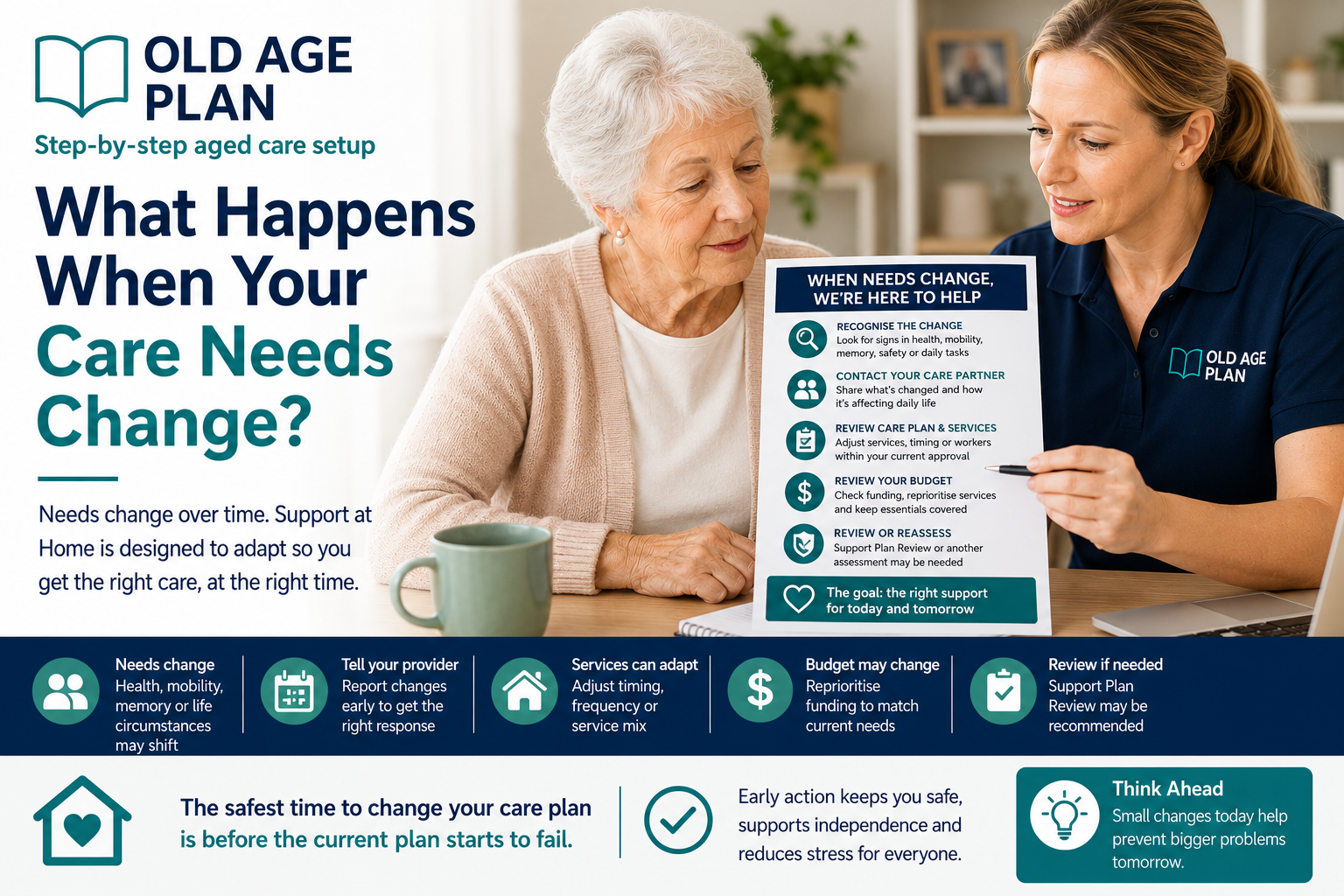

What Happens When Your Care Needs Change?
When your care needs change, your Support at Home arrangement should be reviewed rather than left to continue as though nothing has happened.
Some changes can be managed by adjusting the timing, frequency or mix of services already approved. More significant changes may require an updated support plan, further professional assessment or a formal reassessment through My Aged Care.
The important distinction is whether the current arrangement can still respond safely within the person’s existing approval and funding, or whether their needs have moved beyond what the present plan can reliably support.
What Should You Do When Care Needs Change?
Contact the provider or care partner and explain what has changed, when it began and how it is affecting the person’s daily life.
The provider should review the care plan, services, risks and individualised budget. Some support may be reorganised within the current approval.
If the person’s needs have changed significantly, a Support Plan Review or reassessment may be required before additional services or a higher Support at Home classification can be approved.
Key Takeaway
You do not need to wait until the current care arrangement completely fails before asking for change.
The safest time to review support is usually when the first reliable signs appear that the person’s needs and the existing plan are beginning to move apart.
Why Do Care Needs Change?
Care needs can change gradually over months or suddenly after a particular event.
Common causes include:
Health Changes
A new diagnosis, worsening condition, pain, infection or reduced physical function may increase the support required.
Falls Or Mobility Decline
The person may need more help transferring, showering, walking or moving safely around the home.
Cognitive Change
Increasing confusion, memory loss or reduced decision reliability may affect medication, meals, safety and daily routines.
Hospital Admission
The person may return home with changed mobility, nursing, medication or rehabilitation needs.
Carer Capacity Changes
A spouse, child or friend may no longer be able to provide the same level of unpaid support.
Living Circumstances Change
A move, bereavement, family change or loss of community support may alter what the person can safely manage.
Is The Change Gradual Or Sudden?
The first decision is whether the change appears gradual or sudden.
Gradual Change
The person may slowly need more help with showering, meals, mobility, medication, household tasks or supervision.
This usually requires a timely care review, but it may not be an immediate emergency.
Sudden Change
Rapid confusion, collapse, weakness, breathing difficulty, severe pain, a serious fall or sudden inability to manage may require urgent medical attention.
Do not wait for an ordinary provider review when immediate health or safety is at risk.
Support at Home providers coordinate aged care services. They do not replace emergency services, hospitals, GPs or other clinical care when an urgent medical response is required.
What Changes Should Be Reported?
Tell the care partner when a meaningful change affects the person’s safety, independence, wellbeing or ability to complete ordinary activities.
New Falls Or Near Falls
Even when no serious injury occurs, repeated instability may indicate a growing mobility or home-safety problem.
Difficulty With Personal Care
The person may no longer be able to shower, dress, toilet or transfer safely with the current level of help.
Medication Problems
Missed doses, duplicate doses, confusion or difficulty opening and organising medication should be raised promptly.
Reduced Food Or Fluid Intake
Weight loss, poor appetite, dehydration or swallowing difficulty may require clinical review and changed support.
Increasing Confusion
Changes in memory, judgment, orientation or behaviour may affect whether the existing plan remains safe.
Carer Exhaustion
The formal arrangement may need to change when unpaid carers are becoming overwhelmed or unable to continue.
Who Should You Contact First?
For a non-urgent change, the first contact will often be the person’s Support at Home provider or care partner.
Explain:
- what has changed
- when the change started
- whether it is getting worse
- which daily activities are now harder
- what family members are doing to fill the gap
- whether there have been falls, incidents or hospital visits
- which parts of the existing service arrangement are no longer working
Specific examples are more useful than saying only that the person “needs more help”.
For example:
“Dad now needs physical help getting out of the shower and has nearly fallen twice this week.”
This gives the provider clearer information about the actual change, risk and possible response.
What Should The Care Partner Do?
The care partner should help determine whether the current arrangement can be adjusted or whether further assessment is required.
This may involve:
- discussing the change with the participant
- involving a registered supporter or family member where appropriate
- reviewing current risks and goals
- checking the support plan and care plan
- reviewing the individualised budget
- considering whether another approved service would be more useful
- coordinating nursing or allied health input where appropriate
- helping request a Support Plan Review or reassessment
The provider should not continue an outdated service schedule merely because changing it creates administrative work.
Can Services Be Changed Without Another Assessment?
Sometimes.
The provider may be able to adjust services when the proposed change:
- fits within the person’s existing approval
- uses services available under the Support at Home service list
- remains consistent with the support plan
- can be afforded within the available budget
- does not require a new formal eligibility decision
Possible adjustments may include:
Changing Service Times
Moving a visit to a time that better reflects the person’s current routine or risk.
Changing Frequency
Increasing one approved service while reducing another where funding allows.
Changing The Service Mix
Redirecting funding towards a more useful approved service.
Changing Workers
Arranging a worker with more suitable skills, availability or communication ability.
Adding Clinical Input
Using an approved nursing or allied health service to assess a specific concern.
Considering Equipment
Exploring approved assistive technology or home modifications through the correct pathway.
The provider should explain what can be changed immediately and what requires approval from an assessor.
When Should The Care Plan Be Updated?
The provider’s care plan should reflect the person’s current needs, risks, preferences and service arrangements.
It may need updating when:
- personal care needs increase
- mobility or transfer instructions change
- medication support changes
- new equipment is introduced
- a new risk is identified
- family support reduces
- services are added, removed or rescheduled
- the person’s goals or preferences change
Workers should not be expected to respond safely to a major change when the written instructions still describe the person’s previous condition.
Does The Individualised Budget Need To Change?
When services change, the individualised budget should also be reviewed.
Ask whether:
- the new service mix fits within the quarterly funding
- essential services are being prioritised
- provider prices have changed
- participant contributions affect affordability
- funding is being used faster than expected
- unspent funding can support a temporary adjustment
- the current classification is no longer sufficient
A care plan that promises additional services without a workable budget is not a reliable plan.
What If The Budget Can Cover The Change?
If the person has available funding and the required service is already within their approval, the provider may be able to reorganise the arrangement without waiting for a new classification.
For example, the participant may reduce a lower-priority service to fund more personal care or transport.
This may create a useful short-term response, but it should not hide a larger funding problem.
Moving funding between services can solve a priority problem while creating a new gap somewhere else.
If every change requires sacrificing another essential service, the issue may no longer be budget organisation. The person may now require a higher level of approved support.
What Is A Support Plan Review?
A Support Plan Review examines whether the person’s existing support plan still reflects their care needs.
The provider may contact the assessment organisation when changed needs cannot be properly addressed through ordinary service adjustments.
If the change is relatively limited, the assessor may recommend changes to the support plan. If care needs have changed significantly, the assessor may recommend a reassessment.
A Support Plan Review may be appropriate when:
- a needed service is not reflected in the current plan
- the person’s goals or circumstances have materially changed
- a new care risk has emerged
- the provider needs clarification about approved support
- the existing plan no longer describes the person’s situation accurately
When Is A Reassessment Needed?
A reassessment may be needed when the person’s care needs have changed significantly or the existing approval is no longer adequate.
Examples may include:
Substantial Functional Decline
The person now needs considerably more assistance with mobility, transfers or essential daily tasks.
Major Cognitive Change
Increased confusion or dementia-related risk has changed the level of supervision and support required.
Repeated Health Deterioration
Hospital admissions, infections or worsening conditions have altered the person’s ongoing care needs.
Loss Of Informal Support
A family carer has become ill, moved away or can no longer provide essential daily assistance.
Insufficient Classification
The current Support at Home funding cannot reasonably cover the person’s essential approved services.
Care At Home May No Longer Be Sustainable
The person may need assessment for other aged care options if their needs exceed what can safely be delivered at home.
A participant can contact My Aged Care about reassessment, and the provider can also help initiate the process.
Do You Have To Start The Whole Process Again?
Not necessarily.
A changed need does not automatically mean repeating every step from the beginning.
The next action depends on the scale of the change:
Small Change
The provider may adjust timing, workers or the existing service mix.
Moderate Change
The care plan, budget and support plan may need formal review.
Significant Change
A reassessment may be required to consider different approvals or a higher funding classification.
Urgent Change
Immediate medical or safety action may be needed before the aged care arrangement is reviewed.
What Happens After A Hospital Admission?
Hospital discharge is a common point at which care needs change.
Before the person returns home, clarify:
- whether they can walk and transfer safely
- whether medication has changed
- whether wound care or nursing is required
- whether personal care needs have increased
- whether equipment is required
- whether family can provide the support expected
- when existing provider services will restart
The care partner may help coordinate changes to the home-care arrangement, but this does not replace the hospital’s discharge planning responsibilities.
Some people recovering from illness, injury or functional decline may be assessed for the Restorative Care Pathway. This pathway can provide short-term intensive allied health and nursing support for up to 16 weeks.
What If The Person Needs Temporary Extra Help?
Not every increase in need will be permanent.
Temporary support may be relevant after:
- illness
- a minor injury
- temporary loss of a family carer
- a hospital admission
- a short period of reduced mobility
The provider may consider whether existing services can be temporarily reorganised or whether another approved pathway or health service is more appropriate.
Ask what will happen when the temporary period ends. A short-term change should have a review point rather than becoming an unexplained permanent arrangement.
What If Dementia Needs Increase?
Dementia-related needs may change gradually and can be easy to underestimate when family members adapt one task at a time.
Changes may include:
- missed meals or medication
- wandering or getting lost
- unsafe use of appliances
- difficulty recognising workers
- increasing distress or agitation
- reduced ability to manage personal care
- sleep disruption
- greater dependence on family supervision
The review should consider whether the current decisions, routines and service instructions remain reliable enough for the specific risks now present.
Dementia progression should not automatically remove the person from decisions. Support should be adapted so they remain involved wherever possible.
What If Family Carers Can No Longer Cope?
A change in family capacity is a change in the care arrangement, even when the older person’s medical condition has not changed.
Tell the provider when family members are:
- providing more hours of care than before
- losing sleep
- missing work
- managing unsafe transfers
- unable to leave the person alone
- becoming physically or emotionally exhausted
- planning to reduce or stop their caring role
A formal plan should not be judged adequate only because unpaid relatives are preventing it from failing.
Family care is part of the real care system, even when it does not appear on the provider’s invoice.
When that support reduces, the funded arrangement may need to change immediately.
What If The Provider Cannot Deliver The Extra Support?
A person may have approval and funding but still face service shortages.
Ask whether the barrier is:
Approval
The service is not included in the current support plan.
Funding
The existing classification cannot afford the required frequency.
Workforce
The provider does not have suitable workers available.
Location
The service is difficult to access in the participant’s area.
Clinical Scope
The required support belongs with a health professional or another service system.
Provider Capability
The provider may not be equipped to manage the person’s increased complexity.
These barriers require different responses.
More funding will not solve a workforce shortage. Changing providers will not solve a missing formal approval. The problem must be identified before the next step is chosen.
What If Support at Home Is No Longer Enough?
Some people eventually need more care than can be safely or reliably delivered through Support at Home.
This does not mean residential aged care should be assumed at the first sign of difficulty.
Before reaching that conclusion, consider whether:
- the person has been reassessed
- the correct Support at Home classification is in place
- essential services are available locally
- equipment or home modifications could reduce risk
- restorative support may improve function
- respite could make the family arrangement sustainable
- a different provider could deliver the required services
If the person needs more care and support than Support at Home can provide, My Aged Care advises discussing reassessment and whether residential aged care should be considered.
What Should You Record?
Keep practical records when needs are changing.
Useful information may include:
- dates and details of falls
- hospital admissions
- new diagnoses or clinical recommendations
- changes in mobility or personal care
- missed medication or meals
- changes in cognition or behaviour
- hours of unpaid family support
- missed or unsuitable provider services
- communications with the provider
- changes agreed during reviews
Records help the provider and assessor understand the practical effect of the change rather than relying only on a general description.
They should support the discussion, not become a complete replacement for professional assessment.
Common Mistakes To Avoid
Waiting For The Annual Review
Ask for an earlier review when meaningful change occurs.
Describing Only The Diagnosis
Explain how the change affects daily tasks, risks and family support.
Assuming The Provider Can Increase Funding
The provider may adjust services but cannot independently approve a higher government classification.
Using Family To Hide The Gap
Unpaid care should be acknowledged when judging whether the formal arrangement remains adequate.
Changing Services Without Updating Documents
The care plan and budget should reflect the arrangement being delivered.
Treating Sudden Decline As An Aged Care Issue Only
Rapid deterioration may require urgent medical assessment before service planning.
What You May Really Be Trying To Decide
The visible question is:
“What happens when care needs change?”
The deeper question is often:
“How much worse does this have to become before the system will respond?”
The answer should not depend only on whether a crisis has already occurred.
The more useful question is:
“Has the current care arrangement become less reliable than the person’s current needs?”
If the answer is yes, some form of review, adjustment or reassessment is already justified.
Decision Support
When needs change, separate four different decisions.
Is Immediate Action Required?
Respond first to urgent medical or safety concerns.
Can The Current Plan Adapt?
Determine whether approved services and available funding can be reorganised.
Does The Support Plan Need Review?
Consider whether the existing approval still describes the person’s needs accurately.
Is Reassessment Required?
Seek reassessment when needs have changed significantly or the current classification is no longer enough.
Families often fear acting too early or waiting too long.
A review does not automatically remove independence or force a move into residential care. It creates an opportunity to understand what has changed while more options may still be available.
The strongest response is usually the one that recognises change early, preserves the person’s involvement and updates support before the existing arrangement becomes unsafe or unsustainable.
Summary
When care needs change, the Support at Home arrangement should be reviewed promptly.
Some changes can be addressed by updating the care plan, rescheduling services or reorganising the individualised budget within the existing approval.
A Support Plan Review may be required when the current support plan no longer reflects the person’s needs. Significant change may require a formal reassessment and consideration of different approvals or a higher Support at Home classification.
Sudden health or safety changes may require immediate medical attention rather than waiting for an ordinary aged care review.
The central test is whether the current care arrangement remains reliable enough for the person’s needs today. If it does not, action should begin before the gap becomes a crisis.
Changing Care Needs FAQs
Who should you tell when care needs change?
Tell the Support at Home provider or care partner. Contact an appropriate health professional or emergency service when the change is sudden or urgent.
Can Support at Home services be changed without another assessment?
Some services may be adjusted within the person’s existing approval and available funding. More significant changes may require a Support Plan Review or reassessment.
What is a Support Plan Review?
A Support Plan Review checks whether the existing support plan still reflects the person’s needs. The assessor may recommend plan changes or reassessment depending on the extent of the change.
When is a reassessment needed?
A reassessment may be required when needs have changed significantly, new service approvals are needed or the current Support at Home classification is no longer adequate.
Can the provider approve more Support at Home funding?
No. The provider may reorganise available services and help request a review, but it cannot independently approve a higher government-funded classification.
What happens when family carers can no longer provide the same support?
Tell the care partner. Reduced family support can materially change the care arrangement and may justify service changes, a support plan review or reassessment.
Can temporary extra support be arranged after hospital?
The provider may adjust approved services where funding allows. Some people may also be assessed for a short-term pathway such as Restorative Care.
What if Support at Home can no longer meet the person’s needs?
Ask for reassessment and discuss whether a higher classification, different services, another provider or residential aged care should be considered.
Sources
- My Aged Care — What To Do When Your Needs Change
- My Aged Care — When To Get A Support Plan Review Or Reassessment
- My Aged Care — Managing Your Support at Home Services
- Australian Government Department of Health, Disability and Ageing — How Support at Home Works
- Australian Government Department of Health, Disability and Ageing — Care Management for Support at Home
- Australian Government Department of Health, Disability and Ageing — Restorative Care Pathway
Disclaimer
This article provides general information only and is not legal, medical, financial or aged care advice.
Support at Home service arrangements, review processes, assessment requirements, funding classifications and government policies may change. Individual circumstances also vary according to assessed needs, available funding, provider capacity and location.
Seek urgent medical assistance where immediate health or safety concerns exist. For current aged care information, speak with the provider or My Aged Care and refer to the Australian Government Department of Health, Disability and Ageing.