
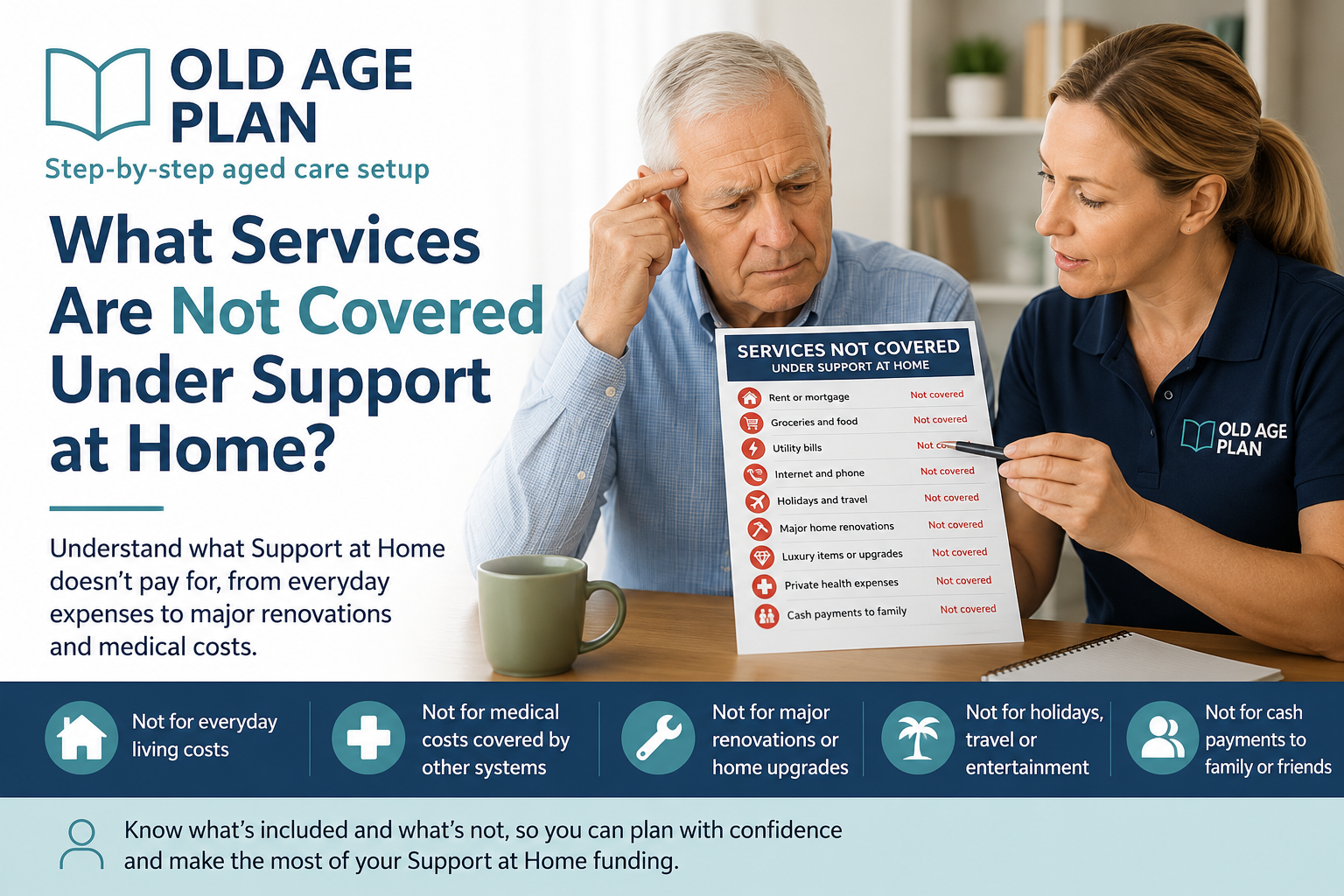

What Services Are Not Covered Under Support at Home?
Support at Home funding cannot be used for every household expense, health cost, personal purchase or service that might make life easier.
Funding is restricted to services and supports permitted under the official Support at Home service list. The service must also relate to the older person’s assessed needs, goals and approved support plan.
Ordinary living expenses, major property improvements, services funded through another government system and purchases unrelated to aged care needs generally remain outside Support at Home.
What Does Support at Home Not Pay For?
Support at Home generally does not pay for ordinary household and personal expenses such as rent, mortgage payments, utilities, groceries, clothing, entertainment, holidays or gifts.
It also does not operate as a general medical-payment scheme, home-renovation fund, property-maintenance program or source of unrestricted cash.
A service or purchase must be within the official service list, connected to an assessed aged care need and approved through the correct funding pathway.
Key Takeaway
Something can be useful without being eligible for Support at Home funding.
The program pays for defined aged care support. It does not take over the ordinary costs of running a household or every expense associated with ageing.
Why Does Support at Home Have Funding Boundaries?
Support at Home is designed to fund approved aged care services that help an older person remain safe, independent and connected while living at home.
The Australian Government maintains a defined service list covering three broad categories:
Clinical Supports
Approved health-related services such as nursing and allied health support.
Independence Services
Approved support with personal care, mobility, transport, respite and community participation.
Everyday Living Services
Approved domestic assistance, meals, home maintenance and related support within defined limits.
Each service type has activities that are in scope and activities that are excluded.
This means eligibility cannot be decided only by asking whether something would help. The provider must identify the relevant service category and confirm that the proposed activity is permitted.
Are Ordinary Living Expenses Covered?
No. Support at Home does not generally pay the ordinary expenses that everyone must meet regardless of whether they receive aged care services.
Housing Costs
Rent, mortgage repayments, strata fees, council rates and ordinary property costs are not aged care services.
Household Bills
Electricity, gas, water, internet, telephone and ordinary insurance expenses remain personal responsibilities.
Personal Purchases
Clothing, toiletries, furniture and general household goods are not automatically covered merely because the person is older.
Financial Obligations
Loans, credit-card debts, taxes, fines and other personal liabilities cannot be paid from a Support at Home budget.
A support worker’s time assisting with an approved activity may be funded even when the underlying purchase is not.
For example, assistance with grocery shopping may be an approved service, but the participant still pays for the groceries.
Does Support at Home Pay For Groceries?
Support at Home does not generally pay for ordinary groceries, food ingredients or personal shopping.
Funding may be used for approved assistance with:
- preparing a shopping list
- accompanying the person while shopping
- completing essential shopping on their behalf
- arranging an online grocery order
- transport connected with approved shopping assistance
The participant remains responsible for the cost of the items purchased.
Meal services can involve a different cost structure. Support at Home may contribute to approved meal preparation or delivery, while the ordinary cost of ingredients or food may remain payable by the participant.
Are Professional Cleaning And Specialist Household Services Covered?
Support at Home may pay for approved domestic assistance that helps keep the home safe and liveable.
However, this does not create unlimited access to every cleaning or household service.
Activities generally outside ordinary domestic assistance may include:
- specialist or premium cleaning unrelated to assessed aged care needs
- pest-control services
- dry cleaning
- pet care
- large-scale rubbish removal
- cleaning connected primarily with moving house
- work that goes beyond maintaining a reasonably safe and liveable home
The provider should explain the difference between approved domestic assistance and a private household service.
Does Support at Home Pay For Pet Care?
Routine pet expenses and pet-care services are generally not covered.
This includes costs such as:
- pet food
- veterinary bills
- grooming
- boarding
- dog walking
- routine cleaning performed solely for the pet
A provider may consider immediate safety issues within an approved service visit, but Support at Home is not a pet-care program.
Where pet care has become a barrier to the person accepting help or remaining safely at home, the care partner may help identify community, family or privately funded alternatives.
Are Major Renovations Covered?
Support at Home can fund approved home modifications through the Assistive Technology and Home Modifications scheme.
That does not mean it will pay for general renovations or property upgrades.
Potentially Eligible
Prescribed modifications directly connected to safety, access or independence, such as approved grab rails, ramps or bathroom-access changes.
Generally Not Eligible
Cosmetic renovations, complete room upgrades, property extensions or improvements that are not required to address an assessed aged care need.
Examples of work that should not be assumed to qualify include:
- renovating a kitchen for appearance or resale value
- replacing an entire bathroom when a smaller safety modification would meet the assessed need
- building an extension
- installing luxury fixtures
- painting or decorating the home
- general property modernisation
Home modifications generally require assessment, prescription, approval and use of the correct funding pathway before work begins.
Are Major Repairs And Property Maintenance Covered?
Support at Home may fund limited home maintenance and minor repairs where they directly support the older person’s safety and ability to remain at home.
It is not intended to replace the property owner’s responsibility for maintaining the house.
Work that may fall outside the program includes:
- major structural repairs
- roof replacement
- extensive plumbing or electrical upgrades
- repairs caused by long-term property neglect
- general improvements unrelated to an aged care need
- work primarily intended to increase property value
- maintenance that would ordinarily be required whether or not an older person lived there
The distinction is usually whether the work is minor and directly connected to the participant’s assessed safety or independence.
Does Support at Home Pay For Major Gardening Or Landscaping?
Limited gardening may be approved where it helps maintain safe access and reduces risks around the home.
Support at Home does not generally fund landscaping, garden redesign or extensive property work.
Activities that should not be assumed to qualify include:
- landscape design
- installing decorative gardens
- major tree removal unless a specific approved safety need is established
- building retaining walls
- installing irrigation systems
- large-scale clearing unrelated to the participant’s immediate safety
- routine maintenance of investment properties or areas not used by the participant
A provider should define the approved gardening tasks rather than describing the service only as general garden maintenance.
Are Medical Appointments And Hospital Costs Covered?
Support at Home does not replace Medicare, public hospitals, the Pharmaceutical Benefits Scheme or state and territory health services.
The program may fund approved assistance connected with accessing health care, such as:
- transport to an appointment
- a support worker accompanying the participant
- approved nursing at home
- approved allied health services within the support plan
- care coordination between services
It does not generally pay costs that belong to another health system, such as:
- hospital treatment
- ambulance charges
- ordinary GP fees
- specialist medical fees
- medical procedures
- diagnostic tests
- services already funded through Medicare or another government program
Some services sit near the boundary between health care and aged care. The provider should explain why the cost belongs within Support at Home rather than another funding system.
Does Support at Home Pay For Medicines?
Support at Home may fund approved medication assistance delivered through nursing or personal care.
This could include:
- medication prompting
- assistance with self-administration where permitted
- clinical medication support within a nurse’s scope
- monitoring and escalating medication concerns
The medication itself is generally a personal or health-system expense and may instead be subsidised through the Pharmaceutical Benefits Scheme.
Ordinary pharmacy purchases should not be charged to a Support at Home budget unless the item is specifically eligible under an approved service or equipment pathway.
Are Dental, Optical And Hearing Costs Covered?
Support at Home does not operate as a general dental, optical or hearing-benefits scheme.
Routine costs such as dental treatment, prescription glasses and ordinary hearing expenses should not be assumed to be covered.
Certain assessments, therapeutic supports, prescribed assistive technology or related services may be available through Support at Home or another government program when eligibility requirements are satisfied.
The provider should identify the exact service-list or assistive-technology category before suggesting that funding can be used.
Are Holidays, Entertainment And Recreation Covered?
Support at Home does not generally pay for holidays, tickets, accommodation or ordinary entertainment costs.
This includes expenses such as:
- airfares
- hotel accommodation
- cruises
- holiday packages
- restaurant meals
- cinema or theatre tickets
- club memberships
- sporting-event tickets
- general recreational purchases
An approved social-support worker may help the person participate in a community activity, but the participant may still need to pay their own admission, food and personal costs.
The provider should separate the cost of delivering the approved support from the participant’s ordinary recreational expenses.
Can Support at Home Pay Family Members Or Friends?
Support at Home is not designed as an unrestricted payment to compensate relatives or friends for informal care.
Family members may continue providing unpaid support, but their time does not automatically become a claimable Support at Home service.
Where a family member has a formal role within a registered provider’s workforce or subcontracting arrangement, separate provider, employment, conflict and service-delivery rules may apply.
Families should not create private payment arrangements and assume the provider can reimburse them from the participant’s budget.
Can Funding Be Given To The Participant As Cash?
No. A Support at Home budget is not a cash allowance or personal bank account.
Government funding is held within the aged care payment system and used to pay for eligible services delivered and claimed through the provider.
The participant cannot ordinarily:
- withdraw unused funding as cash
- transfer the budget to a family member
- use it to pay personal debts
- spend it on unrelated goods
- keep the entire unused balance indefinitely
Participants retain choice and control over their approved service arrangements, but that control operates within program rules.
Are Services For Other Household Members Covered?
Support at Home funding belongs to the approved participant.
It should not be used primarily to provide services for:
- a spouse who has not been assessed for the service
- adult children
- grandchildren
- housemates
- visitors
- another person living at the property
Some approved work may naturally benefit the household. Cleaning a shared bathroom used by the participant is different from providing a full cleaning service for every resident.
The central question is whether the service is being delivered to meet the approved participant’s aged care need.
Can Support at Home Pay For Services At An Investment Property?
Funding is intended to support the participant in the home and daily environment in which they live.
It should not be used for maintenance, cleaning, gardening or modifications at an investment property, holiday home or another property unrelated to their approved care needs.
Where a person regularly lives across more than one location, the provider should confirm what can be delivered under the support plan rather than assuming every property is covered.
Are Luxury Or Premium Upgrades Covered?
Support at Home funding is intended to meet approved care needs, not provide premium lifestyle upgrades.
A participant may sometimes choose a more expensive item, service or modification than the program will fund.
In that situation, the participant may need to:
- pay the difference privately
- choose a lower-cost eligible option
- demonstrate why the higher-cost option is clinically or functionally necessary
- obtain approval before committing to the purchase
Never assume the budget will cover an upgrade simply because a basic version of the item may be eligible.
What Happens If A Provider Says Something Is Not Covered?
A provider should give a clear reason rather than responding only with “the program does not pay for that”.
Ask which of the following barriers applies:
Service-List Exclusion
The activity is outside the official Support at Home service list.
Support-Plan Mismatch
The service is potentially eligible but is not connected to the participant’s current assessed needs or approval.
Funding Limitation
The service may be eligible, but there is not enough available funding in the current budget.
Incorrect Funding Pathway
The request may require assistive-technology funding, a home-modification approval, Medicare or another program.
Provider Capacity
The service may be permitted, but the provider cannot currently arrange or deliver it.
Evidence Requirement
An assessment, prescription, quotation or other evidence may be required before approval.
These are different problems and may lead to different next steps.
A service-list exclusion cannot usually be fixed by changing the budget. A support-plan gap may require review. A provider-capacity problem may require a different worker, subcontractor or provider.
Common Mistakes To Avoid
Buying Before Approval
Do not purchase equipment or arrange modifications and assume reimbursement will follow.
Relying On A Verbal Promise
Ask the provider to confirm the service category, price and approval pathway in writing.
Confusing Helpful With Eligible
A useful purchase may still fall outside the defined aged care service list.
Ignoring Other Funding Systems
Some health, medication, disability, veterans’ or community costs belong under another program.
Assuming Similar Services Have Identical Rules
The permitted activities and exclusions may differ between individual service types.
Paying Privately Without Clarifying The Boundary
Confirm whether the whole service is private or only the non-funded portion.
What You May Really Be Trying To Decide
The visible question is:
“Is this covered under Support at Home?”
The deeper concern is often:
“Are we about to agree to a cost because we misunderstood what the government funding would pay for?”
That uncertainty becomes more serious when a family has already committed to a service, purchased equipment or scheduled building work.
The safest time to establish the funding boundary is before money is spent.
Decision Support
Before agreeing to any uncertain purchase or service, work through four questions.
Is It An Approved Service?
Ask the provider to identify the exact Support at Home service type or Assistive Technology and Home Modifications category.
Does It Meet An Assessed Need?
Confirm how the service connects to the participant’s support plan, safety, function or independence.
Which Funding System Is Responsible?
Check whether the cost belongs under Support at Home, Medicare, the PBS, a state health service or private funding.
What Will The Participant Pay?
Clarify contributions, ordinary living costs, upgrades and any privately funded portion before proceeding.
A rejection does not always mean the underlying need is unimportant.
It may mean the family needs a different service, another funding pathway, a support-plan review or a private solution for the part that aged care funding cannot cover.
Summary
Support at Home funding is restricted to services and supports permitted under the official service list and approved funding pathways.
It generally does not cover ordinary living costs such as housing, utilities, groceries, clothing, entertainment, holidays, personal debts or unrestricted household spending.
It also does not replace Medicare, hospitals, the Pharmaceutical Benefits Scheme or the participant’s ordinary responsibility for maintaining and improving their property.
Approved assistance may be funded even when the underlying personal expense is not. A worker may assist with shopping, for example, while the participant pays for the groceries.
Before committing money, confirm that the proposed service is in scope, connected to an assessed need, approved through the correct pathway and affordable within the participant’s available funding.
Support at Home Exclusions FAQs
Can Support at Home pay for groceries?
Support at Home may fund approved shopping assistance, but the participant generally pays for the groceries and other personal items purchased.
Can Support at Home pay electricity or utility bills?
No. Electricity, gas, water, telephone, internet and other ordinary household bills are personal living expenses.
Can Support at Home pay for major home renovations?
It may fund approved safety-related home modifications, but general renovations, cosmetic improvements and major property upgrades are not the program’s purpose.
Can Support at Home pay for pet care?
Routine pet food, veterinary treatment, grooming, boarding and pet-care services are generally not covered.
Can Support at Home pay for holidays?
No. Holiday accommodation, airfares, cruises and ordinary recreational expenses are not generally covered. Approved support-worker assistance may sometimes be provided during eligible community activities.
Can Support at Home pay family members for caring?
Support at Home is not an unrestricted payment for informal family care. Any formal arrangement involving a relative would need to comply with provider, employment, conflict and service-delivery requirements.
Can unused Support at Home funding be withdrawn as cash?
No. The budget is used for eligible services delivered through the Support at Home payment system and is not a personal cash allowance.
What should you do when a provider says a service is not covered?
Ask whether the issue is a service-list exclusion, support-plan gap, funding shortage, evidence requirement, incorrect funding pathway or provider-capacity problem.
Sources
- Australian Government Department of Health, Disability and Ageing — Support at Home Service List
- Australian Government Department of Health, Disability and Ageing — Services Under Support at Home
- My Aged Care — Support at Home Program
- My Aged Care — Domestic Assistance Inclusions and Exclusions
- Australian Government Department of Health, Disability and Ageing — Assistive Technology and Home Modifications List
- Australian Government Department of Health, Disability and Ageing — Assistive Technology and Home Modifications Scheme
Disclaimer
This article provides general information only and is not legal, medical, financial or aged care advice.
Support at Home service inclusions, exclusions, funding pathways, approval requirements and provider practices may change. Eligibility also depends on the participant’s assessment, support plan, available funding and individual circumstances.
Before purchasing a product, arranging a service or approving home-modification work, confirm current eligibility with the provider, My Aged Care and the Australian Government Department of Health, Disability and Ageing.