

What Services Can Support at Home Pay For?
Support at Home funding can pay for approved aged care services that help an older person remain safe, independent and connected while living at home.
The program includes clinical supports, independence services and everyday living services. It may also fund approved assistive technology, equipment and home modifications through a separate funding pathway.
However, having a Support at Home budget does not mean the funding can be spent on anything that appears helpful. The service must fall within the official Support at Home service list, relate to the person’s assessed needs and be included in their support plan and care arrangements.
What Can Support at Home Funding Be Used For?
Support at Home can fund approved services such as nursing, allied health, personal care, transport, respite, social support, cleaning, meal support, gardening and minor home maintenance.
It can also provide separate funding for approved assistive technology, equipment and home modifications.
The service must be permitted under the official service list and connected to the person’s assessed needs, goals and support plan.
Key Takeaway
The question is not only whether Support at Home can pay for a service.
The more important question is whether that service has been approved, fits the person’s current needs and represents the best use of limited funding.
How Are Support at Home Services Organised?
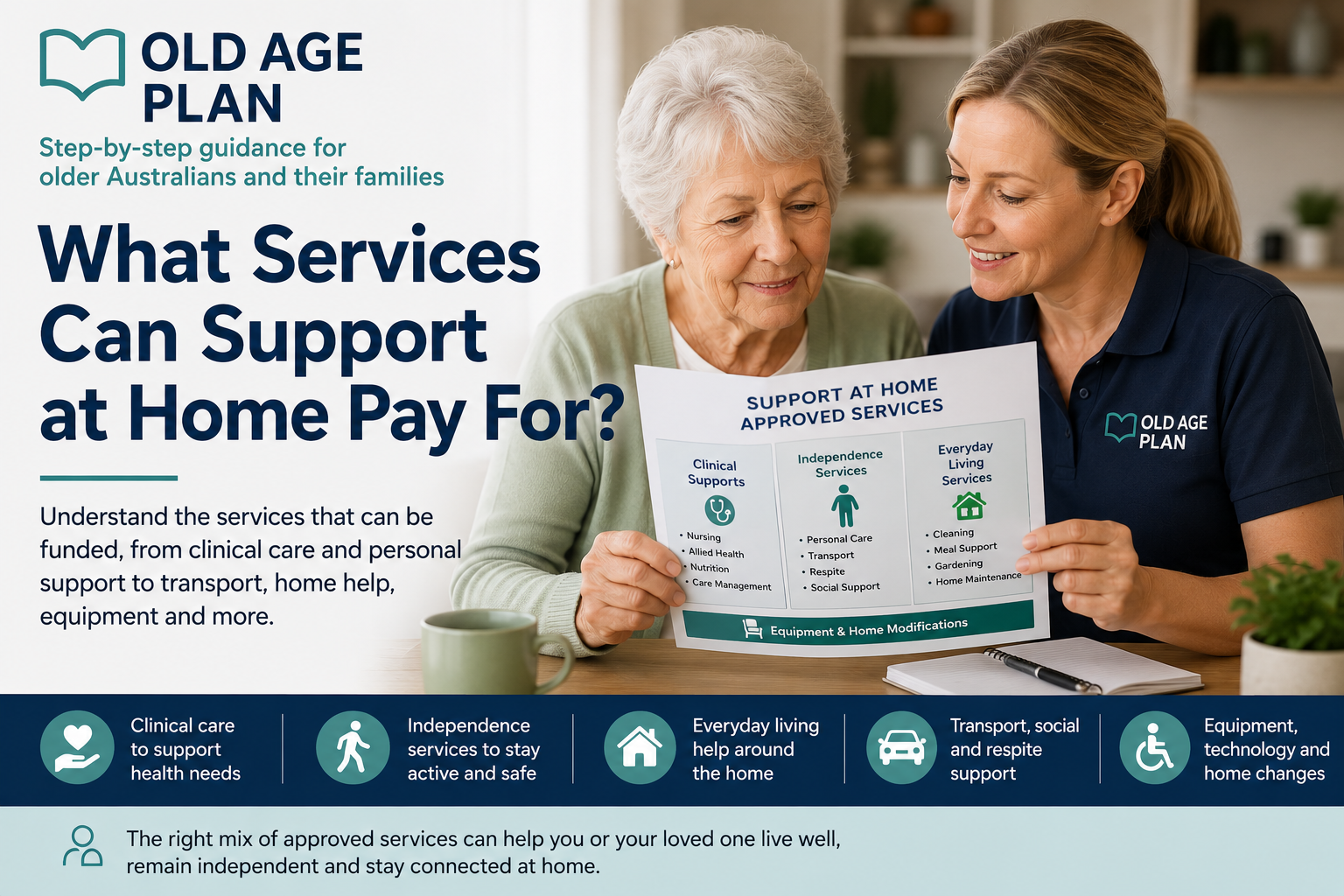
The official Support at Home service list contains three main contribution categories:
Clinical Supports
Health-related services delivered by qualified health professionals.
Examples include nursing care, physiotherapy and nutrition support.
Independence Services
Services that help a person manage daily activities, mobility, personal care and community participation.
Examples include personal care, transport, respite and social support.
Everyday Living Services
Services that help maintain the person’s household and ordinary living environment.
Examples include cleaning, meal preparation, gardening and minor home maintenance.
The official list contains multiple service types and individual services within these categories. Each service also includes guidance about what activities are in scope and what activities are excluded.
What Clinical Supports Can Be Funded?
Clinical supports are services that help manage health conditions, functional decline, nutrition, mobility and other clinical needs.
Depending on the person’s assessment and support plan, Support at Home may pay for services such as:
Nursing Care
Clinical assessment, wound care, medication support, continence care and other nursing interventions delivered within professional scope.
Allied Health
Services such as physiotherapy, occupational therapy, podiatry, speech pathology and other approved allied health support.
Nutrition
Dietetic assessment, nutrition planning and professional support where nutrition or swallowing concerns affect health and independence.
Care Management
Coordination, monitoring and review of the participant’s services, needs, goals and risks.
Clinical support does not replace services that should be provided through Medicare, hospitals, state health systems or another clinical program.
The provider should explain which clinical services belong within Support at Home and which should be accessed through another health system.
Can Support at Home Pay For Personal Care?
Yes. Support at Home can fund approved personal care where the person needs help completing essential daily activities.
Personal care may include assistance with:
- showering and bathing
- dressing and grooming
- toileting and continence routines
- eating and drinking
- getting in and out of bed
- basic mobility around the home
- self-administration of medication where permitted
The service should support the person to do as much as they can safely manage rather than automatically taking over every task.
From 1 October 2026, approved personal care services under Support at Home will be fully government-funded where personal care is included in the participant’s support plan and sufficient funding is available.
Can Support at Home Pay For Transport?
Support at Home may fund approved transport assistance when transport helps the person maintain independence, access essential services or participate in the community.
This may include support to attend:
- medical or allied health appointments
- shopping and essential errands
- social activities
- community programs
- other approved appointments or activities
The form of transport support may vary. It could involve a worker accompanying the person, transport arranged by the provider or another approved transport service.
The service agreement should explain how transport is priced, what is included and whether any restrictions apply.
Can Support at Home Pay For Social Support?
Yes. Approved social support may be funded when it helps reduce isolation, maintain relationships or support community participation.
Depending on the person’s needs, this may include:
- one-to-one social support
- accompanied community activities
- support to attend appointments or groups
- group-based social activities
- assistance maintaining community connections
Social support should have a clear purpose connected to the person’s wellbeing, independence or participation goals.
It is not intended to fund ordinary entertainment, holidays or general lifestyle spending unrelated to assessed aged care needs.
Can Support at Home Pay For Respite?
Support at Home may pay for approved respite services that give an unpaid carer a temporary break while ensuring the older person continues receiving appropriate support.
Respite may help when:
- a family carer needs regular time away
- the carer has appointments or other responsibilities
- the care arrangement is becoming difficult to sustain
- the older person needs supervision while the carer is unavailable
- a planned break may prevent carer burnout or crisis
The type, frequency and setting of respite should be agreed with the provider and reflected in the care plan and individualised budget.
Respite is not evidence that a family has failed.
Used early enough, it can help preserve the care arrangement before exhaustion, resentment or an emergency forces a much larger decision.
Can Support at Home Pay For Cleaning?
Yes. Domestic assistance may be funded when the person cannot safely or reasonably complete essential household tasks because of age-related care needs.
Approved domestic assistance may include tasks such as:
- vacuuming and mopping
- cleaning bathrooms and kitchens
- laundry and changing bed linen
- basic household organisation
- other essential cleaning connected to a safe living environment
The service is intended to maintain a safe and functional home. It is not an unlimited general housekeeping or premium cleaning service.
The provider should document which tasks are included, how long the visit lasts and what the worker is expected to complete.
Can Support at Home Pay For Gardening And Home Maintenance?
Support at Home may fund minor gardening, home maintenance or repairs when they are necessary to help the person remain safe and continue living at home.
This may include limited assistance with:
- reducing trip or access hazards
- basic lawn or garden maintenance
- minor repairs
- replacing simple fittings
- maintaining safe access around the home
- small safety-related household tasks
Support at Home is not intended to pay for major renovations, general property improvement, extensive landscaping or work that would normally be the owner’s responsibility regardless of aged care needs.
The distinction is usually whether the work is minor, necessary and directly connected to the person’s safety or independence.
Can Support at Home Pay For Meals?
Support at Home may fund approved assistance with meals and nutrition.
This may include:
- help planning suitable meals
- assistance preparing food at home
- meal delivery services
- nutrition support
- assistance with eating where personal care is required
The program may contribute to the cost of preparing or delivering an approved meal service, but the participant may still need to pay for the ordinary cost of the food or ingredients.
The provider should explain clearly which portion is covered through Support at Home and which portion remains the participant’s responsibility.
Can Support at Home Pay For Help With Shopping?
Support at Home may fund assistance that helps a person complete essential shopping or obtain necessary household items.
This may involve:
- a support worker accompanying the person
- a worker completing approved essential shopping
- help preparing a shopping list
- assistance arranging online grocery orders
- transport connected with essential shopping
The support worker’s time may be funded, but the participant remains responsible for paying for their groceries and ordinary personal purchases.
Can Support at Home Pay For Medication Assistance?
Medication-related support may be funded where it falls within an approved nursing, personal care or allied health service and is delivered within the worker’s professional role.
This may include:
- prompting a person to take medication
- assisting with self-administration where permitted
- nursing support for medication management
- monitoring medication-related concerns
- referring problems to a GP, pharmacist or other health professional
Support at Home does not generally pay for the medication itself when that cost belongs under the Pharmaceutical Benefits Scheme or ordinary personal expenses.
The service agreement should clarify exactly what workers are authorised to do.
Can Support at Home Pay For Dementia Support?
Yes. A person living with dementia may use approved Support at Home services where those services respond to their assessed care needs.
Dementia-related support may involve a combination of:
- personal care
- nursing
- occupational therapy
- social support
- respite
- meal assistance
- transport
- domestic assistance
- assistive technology
- home modifications
- care management
Support at Home does not create a separate unlimited dementia budget. Services still need to fit within the person’s approval, available funding and care plan.
If dementia-related needs increase, the service arrangement may need review rather than simply adding more tasks to an already stretched budget.
Can Support at Home Pay For Assistive Technology?
Support at Home may provide separately allocated funding for approved assistive technology.
Assistive technology may include equipment that helps a person:
- move safely
- complete personal care tasks
- communicate
- manage daily activities
- reduce falls risk
- maintain independence
Examples may include approved mobility aids, shower equipment, transfer equipment, pressure-care products, communication devices or other prescribed items.
Not every item can be purchased directly from the participant’s ongoing quarterly budget. Items may need assessment, prescription or approval under the Assistive Technology and Home Modifications scheme.
The provider should confirm the approval pathway before an item is ordered or purchased.
Can Support at Home Pay For Home Modifications?
Approved home modifications may be funded where they help the person use their home safely and independently.
Examples may include:
- grab rails
- minor access changes
- ramps
- bathroom safety modifications
- doorway or threshold changes
- other prescribed safety modifications
Home modifications usually require professional assessment and must satisfy the official funding and scope requirements.
Support at Home is not a general home-renovation program. Cosmetic upgrades, ordinary maintenance and major works unrelated to assessed care needs are generally outside the program’s purpose.
What Is The Restorative Care Pathway?
The Restorative Care Pathway provides short-term, intensive support designed to help an older person improve or maintain function and independence.
It may be relevant after:
- illness
- injury
- a decline in mobility
- a hospital admission
- a change that has reduced the person’s ability to manage daily tasks
Services may include coordinated nursing, allied health, personal care and other restorative supports directed towards agreed goals.
This is a separate short-term pathway. It should not be confused with simply adding occasional allied health visits to an ongoing Support at Home budget.
What Is The End-of-Life Pathway?
The End-of-Life Pathway provides additional short-term support for eligible older people who have a life expectancy of three months or less and wish to remain at home.
The pathway complements rather than replaces state and territory palliative care services.
Depending on assessed needs, services may help with:
- personal care
- nursing
- care coordination
- equipment
- support for remaining safely at home
Eligibility must be confirmed through the required clinical and aged care assessment process.
Does Approval Mean Every Service Is Automatically Funded?
No. Several conditions need to align before Support at Home funding can be used for a service.
The Service Must Be In Scope
It must fall within the official Support at Home service list or an approved assistive technology and home modification pathway.
The Need Must Be Recognised
The service should relate to the person’s assessed needs, goals and support plan.
Funding Must Be Available
The participant must have enough available funding for the service after other priorities and care management are considered.
The Provider Must Be Able To Deliver It
Approval does not guarantee that every provider has suitable workers or local service capacity.
The Price Must Be Agreed
The provider and participant should agree on the service price before delivery begins.
Contribution Rules May Apply
Some approved services may still require a participant contribution.
Can You Choose Any Combination Of Services?
Participants should have meaningful choice over how approved services are organised, but that choice operates within several boundaries.
The proposed service mix must remain consistent with:
- the Notice of Decision
- the support plan
- the official service list
- the person’s current needs and goals
- available quarterly funding
- provider capacity
- applicable contribution arrangements
A person does not necessarily need every service mentioned in their support plan at the same frequency.
The individualised budget should translate broad approval into a realistic service schedule that can be sustained across the quarter.
How Should Services Be Prioritised?
When the budget cannot fund every preferred service at the desired frequency, the provider and participant may need to decide what should come first.
Immediate Safety
Which services reduce urgent risks such as falls, missed medication, poor nutrition or unsafe personal care?
Essential Daily Function
Which services allow the person to wash, dress, eat, move and manage essential activities?
Care Sustainability
Which services prevent unpaid carers from becoming exhausted or unable to continue?
Independence And Wellbeing
Which services help the person remain active, connected and involved in decisions about their life?
Prioritising safety does not mean social connection, dignity and quality of life should be ignored.
The aim is to develop a balanced service mix rather than using the entire budget on the first visible problem.
What If The Service You Need Is Not In The Support Plan?
If a service is permitted under Support at Home but is not reflected in the person’s current plan, speak with the provider or care partner.
The next step may involve:
- reviewing the care plan
- reorganising the existing service mix
- confirming whether the need is already covered by the support plan
- seeking professional assessment for equipment or modifications
- requesting a support plan review
- requesting reassessment if needs have materially increased
A provider should not simply reject the request because the current schedule does not include it. The provider should explain whether the barrier is approval, scope, funding, evidence or service availability.
What You May Really Be Trying To Decide
The literal question is:
“Can Support at Home pay for this service?”
The deeper decision is usually:
“Which services will make the greatest practical difference before the funding runs out?”
A service can be technically eligible without being the strongest priority for the person right now.
Another service may appear less urgent but prevent a much larger problem. Respite may preserve the family care arrangement. Physiotherapy may reduce falls risk. Meal support may prevent weight loss. Social support may reduce isolation and help the person remain engaged.
The right service mix depends on the consequences of not providing each form of support.
Decision Support
Before adding, removing or replacing a service, consider four questions.
What Problem Is The Service Solving?
Identify the actual need rather than selecting a service because it sounds broadly useful.
What Happens Without It?
Consider safety, health, independence, family workload and the likelihood of escalation.
Is It Producing The Intended Outcome?
A scheduled service should not continue indefinitely if it is unreliable, poorly delivered or no longer useful.
Is There A Better Use Of The Funding?
Compare the benefit, frequency, cost and contribution attached to available alternatives.
The goal is not to collect the largest possible list of services.
The goal is to build a care arrangement that uses available funding to reduce the most important risks while preserving the person’s independence, dignity and quality of life.
Summary
Support at Home can pay for approved clinical supports, independence services and everyday living services.
Depending on the person’s assessment and support plan, this may include nursing, allied health, personal care, transport, social support, respite, domestic assistance, meal support, gardening and minor home maintenance.
Separate funding may also be available for approved assistive technology, equipment and home modifications. Short-term Restorative Care and End-of-Life pathways may provide additional targeted support for eligible participants.
A service must be permitted under the official Support at Home service list, relate to assessed needs and fit within the person’s available funding and care arrangements.
The strongest service plan is not necessarily the one containing the most services. It is the one that directs limited funding towards the support most likely to preserve safety, independence and a sustainable life at home.
Support at Home Services FAQs
Can Support at Home pay for cleaning?
Yes. Approved domestic assistance may cover essential cleaning tasks that help maintain a safe and functional home.
Can Support at Home pay for gardening?
It may fund limited gardening or minor maintenance where the work is necessary for the person’s safety and ability to remain at home. General landscaping and major property improvements are not the program’s purpose.
Can Support at Home pay for personal care?
Yes. Approved personal care may include help with showering, dressing, grooming, toileting, eating and other essential daily activities.
Can Support at Home pay for meals?
It may fund approved meal preparation, delivery or nutrition support. The participant may still need to pay the ordinary cost of food or ingredients.
Can Support at Home pay for transport?
Yes. Approved transport assistance may help a person attend appointments, complete essential errands and participate in community activities.
Can Support at Home pay for mobility equipment?
Approved mobility aids and other assistive technology may be funded through the Assistive Technology and Home Modifications pathway. Assessment or prescription may be required.
Can Support at Home pay for home renovations?
It may fund approved safety-related home modifications, but it does not operate as a general renovation or property-improvement program.
Can you use Support at Home funding for any approved service you choose?
The service must be in scope, connected to the person’s assessed needs and support plan, agreed with the provider and affordable within the available budget.
Sources
- Australian Government Department of Health, Disability and Ageing — Services Under Support at Home
- Australian Government Department of Health, Disability and Ageing — Support at Home Service List
- My Aged Care — Support at Home Program
- Australian Government Department of Health, Disability and Ageing — How the Support at Home Program Works
- Australian Government Department of Health, Disability and Ageing — Restorative Care Pathway
- Australian Government Department of Health, Disability and Ageing — End-of-Life Pathway
- My Aged Care — Support at Home Personal Care Contribution Changes
Disclaimer
This article provides general information only and is not legal, medical, financial or aged care advice.
Support at Home service lists, eligibility requirements, funding arrangements, contribution categories, approval pathways and provider availability may change. Individual services also vary according to assessed needs, support plans, available funding, location and provider capacity.
For current information, review the person’s Notice of Decision and support plan, contact My Aged Care or the provider, and refer to the Australian Government Department of Health, Disability and Ageing’s current Support at Home service list.