

What Is A Support at Home Service Agreement?
Before Support at Home services begin, the provider will give the older person a service agreement.
This document can look like routine paperwork, but it is much more important than that. It records the legal and practical terms between the participant and the provider, including what services will be delivered, what they will cost, how contributions will be handled and what each party is responsible for.
The agreement should be understood before it is accepted. A family should not assume every provider uses the same prices, cancellation rules, worker arrangements or service conditions.
Short Answer
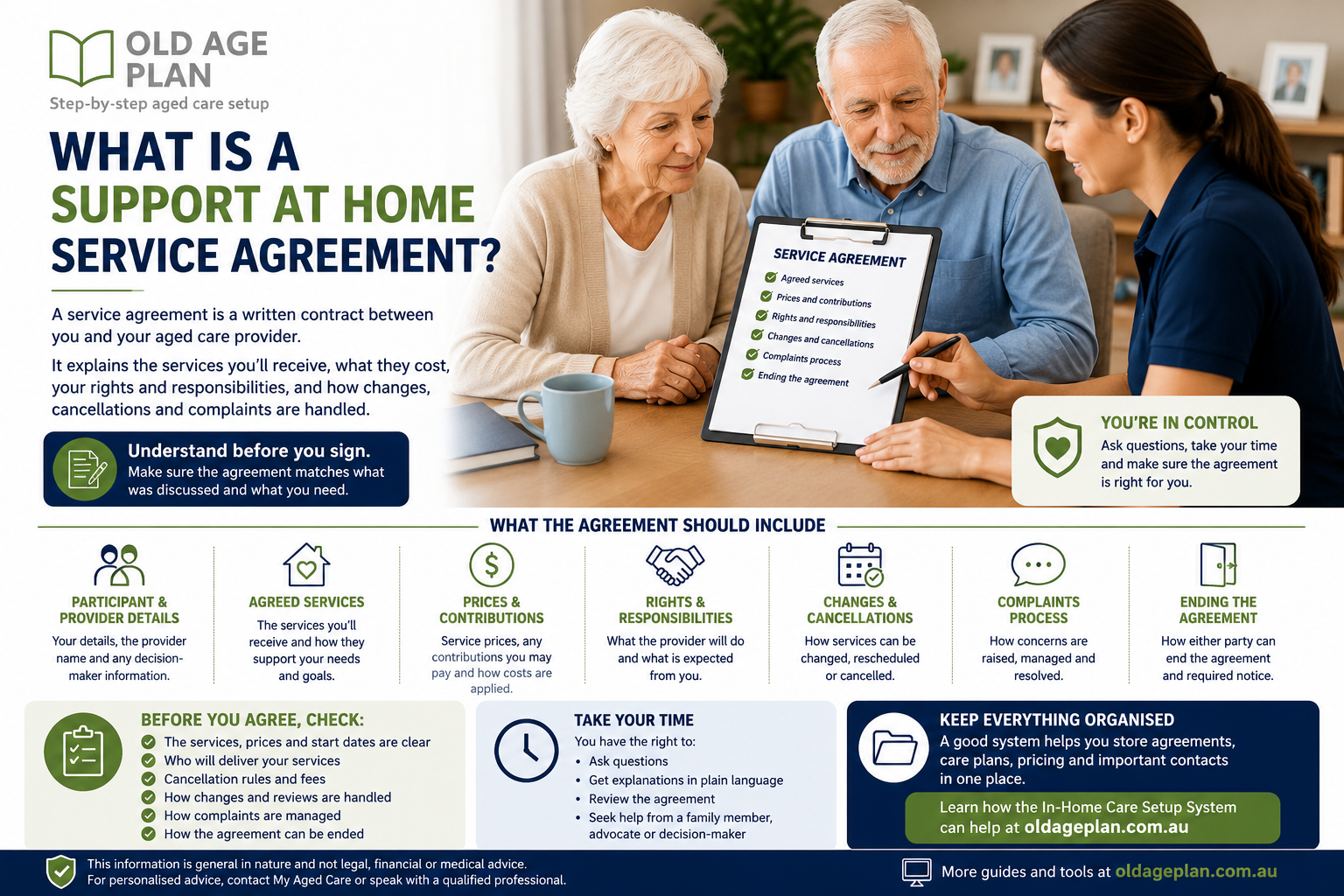
A Support at Home service agreement is a written legal contract between the registered provider and the participant, or their authorised decision-maker. It explains the agreed services, prices, contributions, rights, responsibilities, complaints process and other conditions governing how support will be delivered.
Key Takeaway
A service agreement should translate approved support into clear, enforceable arrangements. Before agreeing, check that the services, prices, responsibilities, cancellation conditions, review process and provider commitments match what was discussed.
Is A Support at Home Service Agreement A Legal Contract?
Yes. A Support at Home service agreement is a written legal contract between the registered provider and the participant.
Where appropriate, an active appointed decision-maker may enter into the agreement for the participant. This person may also be registered as a supporter through My Aged Care.
The agreement should be entered into before or on the day Support at Home services begin.
OAP Reality Check
A document being described as “standard” does not make it unimportant. Once accepted, it becomes the written record of what the provider and participant have agreed to.
What Should A Service Agreement Include?
Participant And Provider Details
The agreement should identify the participant, the registered provider and any authorised decision-maker involved.
Agreed Services
It should explain what services will be delivered and how they connect with the participant’s assessed needs and care plan.
Prices And Contributions
It should explain service prices, participant contributions and how costs will affect the available budget.
Rights And Responsibilities
It should state what the provider must do and what is expected from the participant.
Changes And Cancellations
It should explain how services can be changed, cancelled, rescheduled or temporarily paused.
Complaints And Ending Services
It should explain how concerns are raised and what happens if either party ends the agreement.
The Agreement Should Identify The Services
- personal care
- domestic assistance
- meal preparation
- transport
- social support
- nursing
- allied health
- assistive technology
- home modifications
- care management
- Do not rely on broad wording such as “home support” if the family expects specific tasks.
- For each important service, clarify what the worker will do.
- For each important service, clarify how often the service will occur.
- For each important service, clarify how long visits will last.
- For each important service, clarify preferred days and times.
- For each important service, clarify when services will begin.
- For each important service, clarify whether the provider or a subcontractor will deliver them.
Check That The Agreement Matches The Care Plan
Support Plan
Records the needs, goals and approved pathways identified through the My Aged Care assessment process.
Care Plan
Explains how the provider intends to meet the participant’s needs, goals and preferences.
Service Agreement
Records the legal and practical terms governing the provider-participant relationship.
Service Schedule
Records the practical timing, frequency and commencement of agreed services.
Consistency Check
If the care plan describes one arrangement but the service agreement records something different, ask the provider to explain the inconsistency before accepting the agreement.
Prices Should Be Clear
Worker Time
Check whether the price covers the full scheduled service or only direct time in the home.
Travel
Ask whether travel-related costs are included in the service price.
Subcontracting
Ask whether another organisation will deliver the service and whether this changes the price.
Materials And Equipment
Check whether supplies, equipment or materials create additional costs.
Weekends And Public Holidays
Ask whether different prices apply outside ordinary service hours.
Cancellations
Check whether the participant’s budget may still be charged when a visit is cancelled late.
Understand Participant Contributions
- Depending on the service category and the person’s financial circumstances, the participant may be required to contribute toward some Support at Home services.
- The agreement should explain how the provider will apply the contribution arrangements relevant to the participant.
- which services require a contribution
- what contribution rate applies
- how the contribution will be invoiced or collected
- what happens if the person has difficulty paying
- how contribution changes will be communicated
- Do not confuse the service price with the participant’s personal contribution. The service price affects the available Support at Home budget, while the contribution is the amount the participant may need to pay toward eligible services.
Check How Care Management Is Covered
Main Contact
Who is the participant’s care partner or coordinator?
Regular Contact
How will the provider maintain contact and monitor whether services remain suitable?
Changing Needs
Who should be contacted when health, safety, goals or family support change?
Service Problems
Who takes responsibility when visits are missed or the agreed support is not working?
Check Worker And Subcontractor Arrangements
- the provider’s employees
- independent contractors
- another organisation subcontracted by the provider
- a combination of these arrangements
- how workers are screened
- what qualifications or training apply
- whether consistent workers can be requested
- how replacement workers are managed
- how concerns about a particular worker are reported
OAP Decision Point
The provider named in the agreement may not personally deliver every service. Confirm who will actually provide the care and who remains accountable when subcontractors are used.
Understand Cancellation Rules
- how much notice the participant must give
- whether a late cancellation charge applies
- what happens when the provider cancels
- whether a replacement worker will be offered
- how services are rescheduled
- what happens during hospital stays or extended absences
- Pay particular attention to essential services such as personal care, meals or medication-related support. A cancelled visit may create a practical safety risk even when the contractual rule is clear.
Check How Service Changes Are Made
- service frequency
- visit times
- service types
- worker preferences
- care goals
- risk controls
- provider prices
- Ask whether changes must be made in writing and whether the care plan, budget or service agreement will also be updated.
Can The Provider Change Its Prices?
Notice Period
How much notice will the provider give before a new price begins?
Participant Agreement
How will the provider obtain agreement to the revised service price?
Budget Impact
How will the increase affect the amount or frequency of support available?
Alternative Options
Can the service mix be changed or another provider considered if the new price is unsuitable?
Know Your Rights And Responsibilities
The Provider’s Responsibilities May Include
delivering safe and quality care; respecting dignity, privacy and preferences; providing clear information about services and prices; maintaining appropriate records; responding to changing needs; managing complaints; supporting continuity when services change
The Participant’s Responsibilities May Include
providing accurate information; treating workers respectfully; providing a reasonably safe service environment; giving required cancellation notice; paying applicable contributions; telling the provider when circumstances change
Balance
The agreement should not be written as though all responsibility sits with the participant while provider obligations remain vague.
Check The Complaints Process
- the first person to contact
- how complaints can be made
- how quickly the provider aims to respond
- how the matter can be escalated internally
- what external complaint pathways are available
- whether an advocate or supporter can assist
- A complaints process should be usable in practice, not hidden inside difficult contractual language.
Can You Change Providers?
Find A New Provider
Confirm that another provider can deliver the required services before ending the current arrangement.
Agree On An End Date
Coordinate when the current services finish and when the new provider will begin.
Manage Records And Referrals
Confirm how information, referral arrangements and outstanding records will be transferred.
Protect Service Continuity
Avoid creating a gap in essential personal care, meals, nursing or other support.
Do You Have To Sign Immediately?
- a copy to read
- plain-language explanations
- clarification of unclear clauses
- written prices
- confirmation of agreed changes
- support from a family member, advocate or appointed decision-maker
- Urgent need for care can create pressure, but signing quickly does not solve unclear pricing, unsuitable services or poor provider capacity.
Can The Agreement Be Negotiated?
- service days and times
- worker preferences
- communication arrangements
- who may receive information
- access to the home
- cancellation processes
- how service changes are approved
- how provider commitments are documented
- If the provider will not correct inaccurate information or explain important terms, consider whether the provider is the right organisation to proceed with.
What If The Participant Cannot Sign?
A participant may be unable to sign because of physical disability, communication difficulty or impaired decision-making capacity.
These situations are not all the same.
The first question should be whether the person still understands the agreement and can communicate a decision using appropriate support.
If an appointed decision-maker is involved, the provider should confirm their authority and include the correct details in the agreement.
OAP Decision Reliability
Do not assume that a person lacks decision-making ability simply because they communicate slowly, need support or cannot physically sign. The relevant question is whether they can understand and make this particular decision with appropriate assistance.
Questions To Ask Before Accepting The Agreement
What Exactly Will You Deliver?
Confirm the services, tasks, frequency and expected commencement dates.
What Will Everything Cost?
Ask for the agreed service prices, contribution arrangements and likely budget effect.
Who Will Deliver The Care?
Clarify whether workers are employees, contractors or subcontractors.
What Happens When A Visit Is Cancelled?
Understand participant cancellations, provider cancellations and replacement arrangements.
How Are Changes Approved?
Ask how services, prices and care arrangements will be reviewed and updated.
How Can We End The Agreement?
Confirm notice requirements and how the provider will support a transfer.
What You May Really Be Trying To Decide
The surface question is: What is a Support at Home service agreement?
But the deeper decision is usually: Can we trust this document to protect the care arrangement we believe we are agreeing to?
That is the real implementation issue. Families need to know that the provider’s promises about services, prices, workers, timing and accountability are reflected in the written agreement.
Decision Support: Before You Agree
Clarity
The services, prices, contributions and responsibilities are understandable.
Consistency
The agreement matches the care plan, provider discussions and expected service arrangements.
Practicality
The provider can realistically deliver the services at the agreed times and prices.
Accountability
The agreement explains how problems, changes, complaints and provider transitions will be handled.
Warning Signs Before Agreeing
Services Are Vague
The agreement does not clearly identify what support will be delivered.
Prices Are Missing
The provider relies on verbal explanations instead of written service prices.
Start Dates Are Unclear
The provider wants the agreement accepted but cannot confirm when important services will begin.
Subcontracting Is Hidden
The family does not know that another organisation may actually deliver the care.
Changes Are One-Sided
The provider can change important terms without a clear notice or agreement process.
The Family Is Pressured
The provider discourages questions or insists the document must be signed immediately.
FAQ
What is a Support at Home service agreement?
It is a written legal contract between the registered provider and the participant, or their authorised decision-maker, setting out the terms governing Support at Home services.
When must the service agreement be completed?
The participant and provider must enter into a written service agreement before or on the day Support at Home services begin.
What should the agreement include?
It should include agreed services, prices, participant contributions, rights and responsibilities, complaint arrangements and conditions for changing or ending services.
Do you have to sign the agreement immediately?
You should understand the agreement before accepting it. Ask for explanations, written pricing and time to review unclear terms where needed.
Can a Support at Home service agreement be changed?
Yes. Services, prices and other arrangements may change, but the agreement should explain how changes are discussed, documented and agreed.
Can you leave a Support at Home provider?
Yes. Participants may change providers. Check the agreement’s notice requirements and arrange the transition carefully to avoid gaps in essential services.
What if the participant cannot physically sign?
A physical inability to sign does not automatically mean the person cannot make the decision. The provider should consider supported communication and confirm whether an authorised decision-maker is legally required.
Sources
-
My Aged Care — Agreeing to Support at Home services
-
Australian Government Department of Health, Disability and Ageing — Service agreements for Support at Home
-
Australian Government Department of Health, Disability and Ageing — Support at Home service agreement template
-
My Aged Care — Connecting with Support at Home providers
-
My Aged Care — Support at Home costs and contributions
-
Australian Government Department of Health, Disability and Ageing — Changing Support at Home providers
Disclaimer
This article provides general information only and is not legal, financial, medical or aged care advice. Support at Home service agreement requirements, prices, contribution arrangements, provider obligations and aged care rules may change. Individual agreements also vary between providers and according to the participant’s services, circumstances and decision-making arrangements. For current information, read the proposed service agreement carefully, compare it with the care plan and written pricing, contact My Aged Care, or seek qualified aged care, legal, health or financial advice where needed.
Summary
A Support at Home service agreement is the written legal contract between the participant and the registered provider. It records the agreed services, prices, participant contributions, responsibilities, complaint process and other conditions governing the care arrangement.
Before accepting it, check that the agreement matches the care plan and provider discussions. Services, costs, worker arrangements, cancellations, commencement dates and processes for changing or ending support should all be clear.