
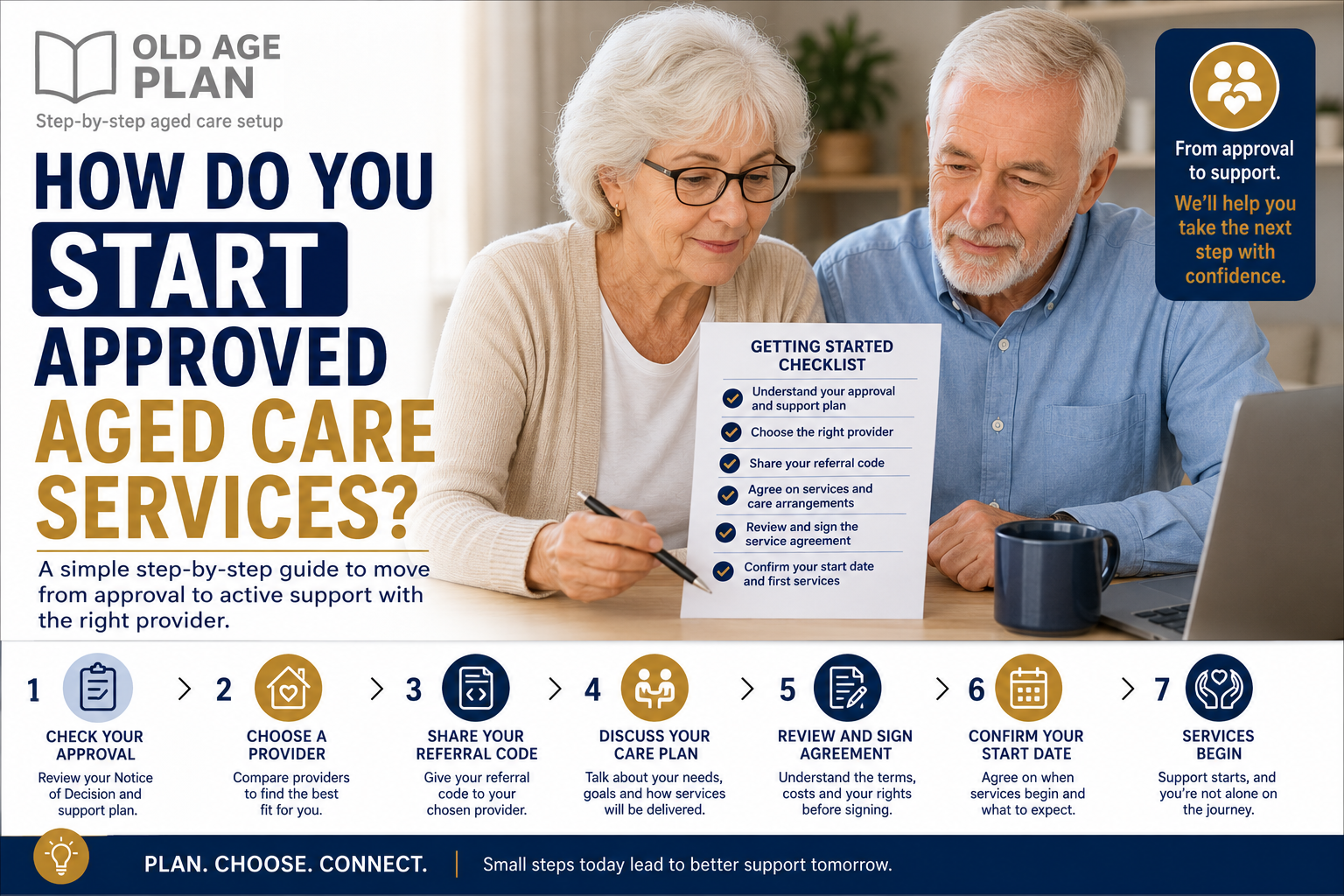

How Do You Start Approved Aged Care Services?
Being approved for aged care support does not mean services will begin automatically.
After approval, the older person may still need to understand the assessment outcome, choose a provider, share the correct referral information, agree on a care plan, review a service agreement and confirm when support will actually start.
For families, this can be the point where a successful assessment suddenly becomes a practical implementation problem.
Short Answer
To start approved aged care services, check the assessment outcome, confirm what support has been approved, choose a suitable provider, give the provider the relevant referral code, discuss the care plan and service arrangements, review the service agreement and agree on a start date. Services begin only after the practical setup has been completed with the provider.
Key Takeaway
Approval opens the pathway to aged care support. It does not complete the setup. Families still need to connect the approval to a provider, agree on how support will work and confirm the practical arrangements before services begin.
Why Services Do Not Start Automatically
My Aged Care helps assess eligibility and connect older people with government-funded support.
But once support has been approved, the older person usually still needs to choose a provider that can deliver the required services.
The provider then needs to review the referral, understand the person’s needs, discuss the proposed care arrangements and complete the required agreements.
OAP Reality Check: Approval is permission to move forward. It is not proof that a suitable provider has been found, workers are available or services have been scheduled.
The Main Steps To Starting Approved Aged Care Services
Step 1: Check The Assessment Outcome
Confirm what aged care program, services, classifications or pathways have been approved.
Step 2: Review The Support Plan
Check the assessed needs, goals, recommended support and any important safety or personal care information.
Step 3: Choose A Provider
Compare approved providers based on service capacity, prices, worker availability, communication and personal fit.
Step 4: Share The Referral Code
Give the relevant referral code to the chosen provider so it can access and accept the referral.
Step 5: Develop The Care Arrangements
Discuss the person’s goals, routines, risks, preferences and how approved services will work in practice.
Step 6: Review The Service Agreement
Check the services, prices, contributions, responsibilities, cancellation rules and complaints process.
Step 7: Confirm The Start Date
Agree on when services will begin, which workers will attend and what the first visits will involve.
Step 1: Understand What Has Been Approved
Start by reading the Notice of Decision, support plan and any funding allocation information carefully.
Do not rely only on what the family remembers from the assessment conversation.
Confirm:
- which aged care program applies
- which services or pathways were approved
- the person’s assessed needs and goals
- whether referral codes were provided
- whether funding has been allocated
- whether a take-up or commencement date applies
- what the person must do next
Step 2: Check The Support Plan
The support plan helps explain what the assessment identified and what support may be suitable.
Before speaking with providers, check whether the plan reflects the real situation.
Daily Living Needs
Does the plan reflect help needed with meals, cleaning, shopping, transport, mobility or household tasks?
Personal Care
Does it include showering, dressing, toileting, continence or transfer support where needed?
Safety Risks
Does it recognise falls, medication mistakes, wandering, confusion or emergency response concerns?
Family Support
Does it reflect what family members or carers already do to keep the person safe and supported?
If the plan appears incomplete or the person’s needs have changed, contact My Aged Care before assuming the provider can fix the assessment outcome.
Step 3: Choose A Suitable Provider
Use the My Aged Care Find a Provider tool to identify organisations operating in the person’s area.
Then contact providers directly and compare whether they can deliver the required support.
Service Capacity
Can the provider deliver the approved services in the person’s location?
Start Time
When can support realistically begin?
Worker Availability
Are suitable workers available on the days and times required?
Prices And Contributions
What will each service cost, and what personal contributions may apply?
Personal Fit
Can the provider accommodate language, cultural, gender, communication and routine preferences?
Communication
Who will coordinate the support, and how quickly will the provider respond when something changes?
Step 4: Give The Provider The Referral Code
Once a suitable provider has been selected, give it the relevant My Aged Care referral code.
The code allows the provider to access the relevant client record and support plan, accept the referral and begin organising services.
Do not treat the referral code as something that must be handed to every provider contacted during the comparison process.
OAP Decision Point: Compare providers first. Share the referral code when you have selected the organisation you are prepared to move forward with.
Step 5: Discuss How Support Will Work
The provider should use the assessment information and support plan as a starting point.
But the practical service arrangement still needs to be worked out with the older person and, where appropriate, their family, carer or registered supporter.
This discussion may cover:
- which services will be delivered
- how often each service is required
- preferred days and times
- personal routines and preferences
- mobility, transfer or falls risks
- memory and communication needs
- worker gender or cultural preferences
- what family will continue to do
- what happens if a worker cancels
- who should be contacted when needs change
The Difference Between A Support Plan And A Care Plan
These documents have different roles.
Support Plan
Created through the assessment process and records assessed needs, goals and recommended support.
Care Plan
Developed with the provider and explains how services will be organised and delivered in practice.
Service Agreement
Sets out the contractual terms, services, prices, contributions, rights and responsibilities.
Service Schedule
Records the practical timing of visits, workers and agreed support arrangements.
Step 6: Review The Service Agreement
Before or when Support at Home services begin, the person must enter into a service agreement with the chosen provider.
The service agreement is a contract. It should be understood before it is accepted.
Services And Frequency
Check exactly what will be delivered and how often.
Prices
Check service prices, personal contributions and any additional conditions or costs.
Cancellations
Understand what happens if the person or provider cancels a scheduled service.
Worker Arrangements
Check whether workers are employees, contractors or subcontracted through another organisation.
Complaints
Know how concerns are raised, escalated and resolved.
Changing Providers
Check notice requirements and what happens if the person later decides to move.
Ask for clarification before agreeing to any term that is unclear.
Step 7: Confirm The Service Start Date
Do not assume that signing paperwork automatically tells the family when the first worker will arrive.
Confirm the service commencement arrangements in writing.
First Service Date
When will the first service actually occur?
First Worker
Who is expected to attend, and how will they be introduced?
First Tasks
What will happen during the first visit, and what should the person prepare?
Ongoing Schedule
Are regular days, times and service frequencies confirmed?
How Quickly Must Support At Home Services Start?
After receiving a Support at Home funding allocation letter, a participant generally needs to enter into a service agreement with a provider and start services within 56 days.
A further 28-day extension may be requested through My Aged Care when more time is needed to find a suitable provider.
Check the take-up date shown in the person’s Notice of Decision or funding allocation information rather than relying on a general timeframe alone.
OAP Timing Warning: Do not let a provider search drift indefinitely. Record the take-up date, provider contacts and any extension request so approved funding is not placed at risk.
What If You Cannot Find A Suitable Provider?
Provider capacity can vary by location, service type and worker availability.
If suitable services cannot be found:
- contact more than one approved provider
- ask when capacity is expected to become available
- check whether another service schedule could work
- ask My Aged Care about available assistance
- request an extension before the relevant deadline where permitted
- keep written records of providers contacted and their responses
Do not sign with an unsuitable provider solely because the process feels urgent. But do not allow the commencement deadline to pass without contacting My Aged Care.
What If The Provider Cannot Deliver Everything In The Support Plan?
A provider may be able to deliver some services but not others.
Before agreeing to proceed, ask whether the provider:
- uses subcontractors
- can arrange allied health services
- has workers with the necessary skills
- can meet preferred schedules
- can respond if care needs increase
- can provide continuity for personal or dementia-related support
The fact that a provider can accept the referral does not automatically mean it can deliver every service in the preferred way.
What If Services Are Delayed After The Agreement Is Signed?
Ask the provider to explain the delay and provide an updated commencement plan.
Record:
- the original agreed start date
- which services are delayed
- why the delay occurred
- what interim arrangement has been offered
- when the provider expects services to begin
- whether the delay creates a safety or carer-pressure risk
If important services repeatedly fail to begin, escalate the issue through the provider’s complaints process and contact My Aged Care where appropriate.
Common Service Setup Mistakes
Assuming Approval Starts Services
The family waits for someone to call without choosing and connecting with a provider.
Choosing Before Comparing
The first available provider is selected without checking costs, capacity or personal fit.
Sharing The Referral Code Too Early
The code is given before the provider decision has been properly considered.
Signing Without Understanding
The service agreement is accepted before prices, contributions or cancellation rules are clear.
No Confirmed Start Date
The agreement is signed, but no one confirms when the first service will happen.
Relying On Memory
Provider promises, contact dates, referral details and outstanding tasks are not recorded.
What You May Really Be Trying To Decide
The surface question is:
How do you start approved aged care services?
But the deeper decision is usually:
How do we turn the approval into reliable support without missing a critical step?
That is the real implementation pressure. The approval may be clear, but several decisions, documents and handovers still need to align before support begins properly.
Decision Support: Before The First Service Starts
Use these four questions as a final readiness check.
Is The Provider Suitable?
The provider can deliver the required services and understands the person’s needs, risks and preferences.
Is The Agreement Clear?
Services, prices, contributions, cancellation rules and responsibilities are understood.
Is The Start Date Confirmed?
The family knows when support begins, who will attend and what the first visit will involve.
Is Anything Still Outstanding?
Referral codes, provider documents, schedules, worker preferences and unresolved questions have been tracked.
Related Old Age Plan Articles
Next Steps With Old Age Plan
FAQ
Do aged care services start automatically after approval?
No. The person usually still needs to choose a provider, share the relevant referral information, agree on the care arrangements, enter into a service agreement and confirm a start date.
What is the first step after aged care services are approved?
Read the Notice of Decision and support plan carefully so you understand what was approved, which program applies and what action is required.
When should you give a provider the referral code?
Give the referral code after comparing providers and selecting the organisation you are comfortable using.
Do you need a service agreement before services begin?
For Support at Home, a service agreement must be entered into before or on the day services begin.
How long do you have to start Support at Home services?
After receiving a funding allocation letter, participants generally need to enter into a service agreement and begin services within 56 days. A 28-day extension may be requested through My Aged Care.
What if no suitable provider is available?
Contact multiple providers, keep records of their responses and contact My Aged Care before the commencement deadline to discuss assistance or an extension where available.
Summary
To start approved aged care services, check the assessment outcome, understand the support plan, choose a suitable provider, share the referral code, agree on the care arrangements, review the service agreement and confirm when services will begin.
Approval is only the beginning of implementation. The setup is not complete until the provider, services, prices, responsibilities and commencement arrangements are clearly understood and agreed.
Sources
- My Aged Care — How to set up your aged care services
- My Aged Care — Assessment outcome: Support at Home
- My Aged Care — Connecting with Support at Home providers
- My Aged Care — Agreeing to Support at Home services
- My Aged Care — Find a provider
- Australian Government Department of Health, Disability and Ageing — How the Support at Home program works
Disclaimer
This article provides general information only and is not medical, legal, financial or aged care advice.
Aged care approval processes, referral requirements, provider arrangements, service agreements, commencement timeframes, prices and contribution rules may change. Individual circumstances also vary depending on the approved program, funding allocation, assessed needs, provider availability and location.
For current information, check the Notice of Decision and support plan, contact My Aged Care, review the provider’s written service agreement or seek qualified aged care, legal, health or financial advice where needed.