
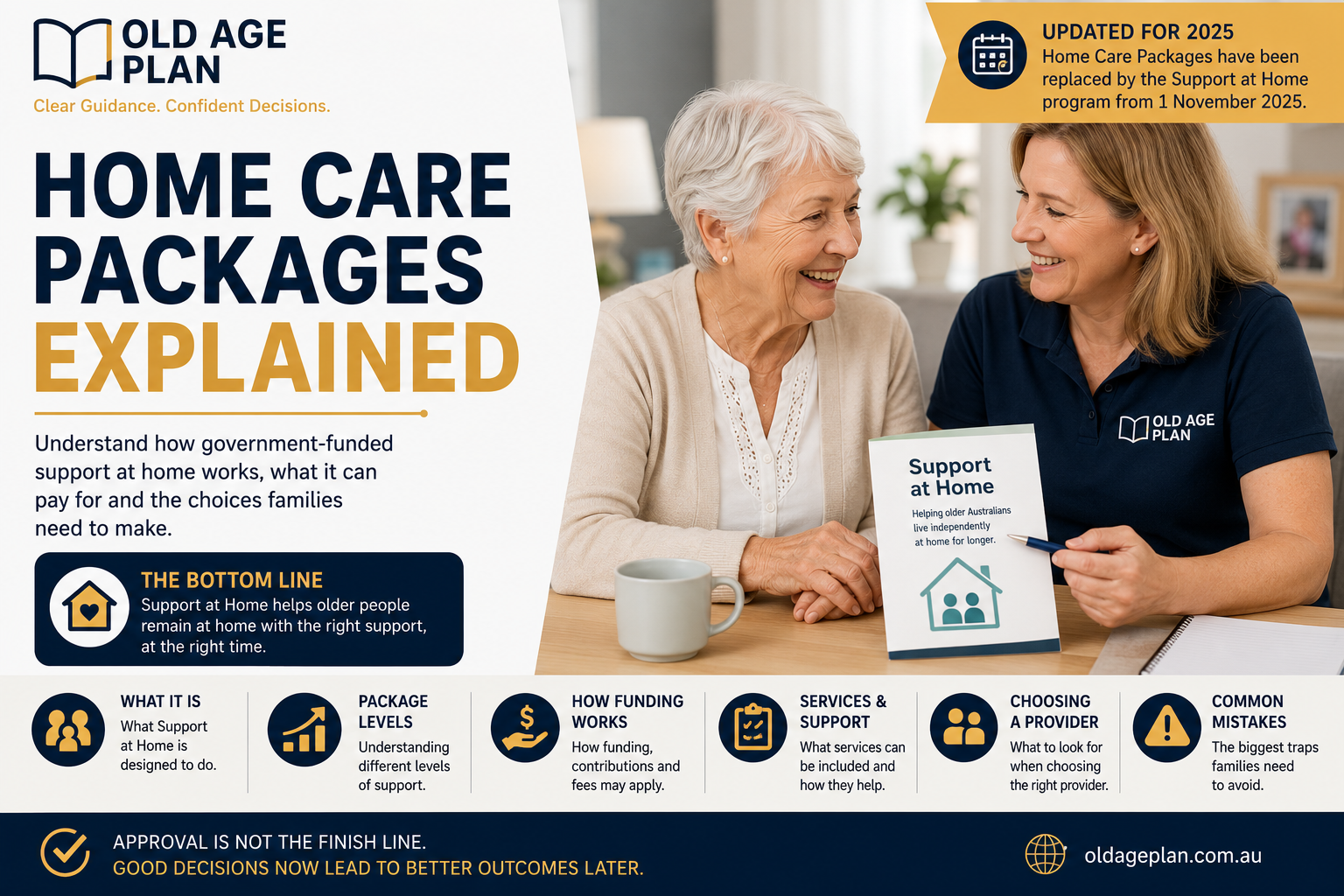

Home Care Packages Explained
Many families still search for Home Care Packages when they are trying to understand help at home for an older person.
But in Australia, the system has changed. The Home Care Packages Program was replaced by the Support at Home program from 1 November 2025.
That means the real question is no longer only “What is a Home Care Package?”
It is:
How does government-funded help at home work now, and what decisions do families need to understand before choosing support?
Short Answer
Home Care Packages were a government-funded way to help older Australians receive coordinated support at home. From 1 November 2025, the Home Care Packages Program was replaced by the Support at Home program.
Support at Home is now the main pathway for higher-level government-funded aged care support at home, after assessment and approval through My Aged Care.
Key Takeaway
If you are searching for Home Care Packages, you are probably trying to understand how home support is funded, what services may be available, how assessment affects approval and how to choose support without getting lost in the system.
What Happened To Home Care Packages?
The Home Care Packages Program used to provide four levels of coordinated home care support.
Those package levels helped families understand whether support needs were lower, moderate, high or more complex.
From 1 November 2025, the Australian Government introduced Support at Home to replace the Home Care Packages Program and the Short-Term Restorative Care Programme.
This matters because older articles, provider pages and family conversations may still use the term Home Care Package even though the official program pathway has changed.
Old Age Plan note: Families may still say “Home Care Package,” but the current system now sits under Support at Home. Understanding that shift can prevent confusion when reading official information or speaking with providers.
What Support At Home Is Designed To Do
Support at Home is designed to help older people remain living independently at home for longer where possible.
It can provide access to services, products, equipment and home modifications depending on assessment outcome, eligibility and individual needs.
Support may relate to:
- clinical care, such as nursing or allied health
- help with independence, such as personal care or medication support
- everyday tasks, such as cleaning, shopping or gardening
- home modifications or equipment where appropriate
- short-term or ongoing support pathways
The important point is that Support at Home is not just “someone comes and helps.” It is a funded support pathway that needs assessment, approval, provider choice and ongoing management.
How Home Support Usually Fits Into The Aged Care Pathway
Families usually reach this stage after concerns have already been raised through My Aged Care.
The broad pathway is:
- support needs are noticed
- the person applies through My Aged Care
- an assessment is arranged
- eligibility and support needs are considered
- an outcome is issued
- home support options are explored
- a provider is chosen
- services are organised and reviewed over time
This is where many families realise approval is not the same as having a working care system at home.
Where Families Get Confused
Home care sounds simple until families have to make it work.
Common points of confusion include:
- whether Home Care Packages still exist
- how Support at Home works
- whether approval means services start immediately
- what services can actually be funded
- how provider fees and contributions work
- what happens if needs increase
- whether family still needs to coordinate support
Most families are not confused because they are careless. They are confused because they are trying to understand funding, services, providers and care needs at the same time.
When Approval Does Not Mean Everything Is Sorted
This is one of the biggest home care traps.
Families often think approval is the finish line.
It is not.
Approval may confirm that support is available or that a pathway has opened. But the family may still need to understand the support budget, compare providers, ask what services are included, understand costs and make sure the support actually matches daily life.
The danger is assuming the system will automatically translate approval into a stable home care arrangement.
It may not.
A person can be approved for support and still have unresolved problems:
- services may not start immediately
- provider availability may vary
- family may still need to coordinate tasks
- support may not cover everything the family expected
- needs may change faster than the care arrangement
Old Age Plan warning: The risk is not only whether support is approved. It is whether the support that starts is strong enough, clear enough and organised enough to hold the person safely at home.
What Home Support May Help With
Home support may help with different parts of daily life depending on the person’s needs and approval.
This may include help with:
- personal care
- domestic tasks
- meals and shopping
- transport
- medication routines
- nursing or allied health
- equipment or home modifications
- social support
This is a broad overview only. The exact services available depend on the assessment outcome, program rules, provider availability and personal circumstances.
Costs And Contributions
Government-funded aged care does not always mean there are no costs.
For Support at Home, My Aged Care explains that contributions can differ depending on the service being delivered and the person’s income and assets.
Families should be careful not to assume that approval means every service will be free, unlimited or delivered in the way they expect.
The safer question is:
What support is approved, what will it cost, and what does the family still need to organise?
Choosing A Provider
Once support is approved, families may need to choose a provider.
This is not only an administrative step. It affects how support is delivered in real life.
Families may need to ask:
- what services the provider can deliver
- how soon support can start
- how fees and contributions work
- how changes in needs are handled
- who coordinates the care
- what happens if a worker is unavailable
- how communication with family is managed
This article does not provide a full provider setup system. That belongs in a structured implementation resource.
Setting up care at home?
If the challenge has moved from understanding approval to organising practical support, the In Home Care Setup System helps families build a clearer home care arrangement without trying to manage everything from memory.
What You May Really Be Trying To Decide
If you are searching for Home Care Packages, you may not only be asking what the program is called.
You may be trying to decide:
- Can Mum or Dad stay at home safely?
- What support can actually be funded?
- Will this replace what family is already doing?
- What happens if the support is not enough?
- How do we choose a provider?
- Are we closer to residential care than we think?
- How do we stop home care becoming another thing the family has to manage alone?
Those are decision questions. They matter more than the label on the program.
Decision Support
The key question is not simply whether home support is available.
The better question is:
Is home support likely to make the current living arrangement safer, more stable and more sustainable?
Support at home may be a good direction when:
- the person wants to remain at home
- risks can be reduced with the right support
- family care is becoming stretched but not broken
- daily tasks are becoming harder but still manageable with help
- the home environment can be made safer
But families should be cautious when:
- support needs are increasing quickly
- one carer is already exhausted
- the person is unsafe for long periods alone
- memory or decision reliability is affecting safety
- family members disagree about what is realistic
The goal is not to force residential care or avoid it at all costs. The goal is to understand whether home support can genuinely hold the situation safely.
Old Age Plan Pathway
Different families need different support depending on where they are in the home care pathway.
- Starting point: Use Free Tools if you are still working out what has changed and what questions to ask.
- Focused planning: Browse the $19 Planners if you need help organising one part of the aged care pathway.
- Assessment preparation: Use the My Aged Care Assessment Protection System if assessment is coming and support needs may be understated.
- System orientation: Use the Aged Care Starter Pack if you need to understand how home support fits into the wider aged care system.
- Home care setup: Use the In Home Care Setup System if you are moving from approval into practical home care organisation.
Frequently Asked Questions
Do Home Care Packages still exist?
The Home Care Packages Program was replaced by the Support at Home program from 1 November 2025. Many people still use the phrase Home Care Package, but the current program pathway is Support at Home.
What replaced Home Care Packages?
Support at Home replaced the Home Care Packages Program and the Short-Term Restorative Care Programme from 1 November 2025.
Is Support at Home the same as CHSP?
No. The Commonwealth Home Support Program is separate and is expected to transition to Support at Home no earlier than 1 July 2027.
Can Support at Home help with cleaning and shopping?
Support may include everyday tasks such as cleaning, shopping or gardening, depending on assessment outcome, program rules and individual needs.
Can Support at Home pay for nursing or allied health?
Support at Home may include clinical supports such as nursing or allied health, depending on the person’s assessed needs and eligibility.
Do you receive the money directly?
Families should not assume support works like receiving cash directly. Funding, budgets and service delivery rules depend on the program structure and provider arrangements.
Do you still need My Aged Care?
Yes. Government-funded aged care support at home is accessed through My Aged Care assessment and approval pathways.
What if home support is not enough?
If home support is not enough, the family may need to seek reassessment, discuss changing needs with providers or consider other aged care pathways, including respite or residential aged care where appropriate.
Related Old Age Plan Guides
This guide sits inside the My Aged Care and home support pathway. Related guides in this series include:
- What Is My Aged Care And How Does It Work?
- How To Apply For My Aged Care
- What Is An ACAT Assessment?
- What Happens During A My Aged Care Assessment?
- Residential Aged Care Explained
Next Steps With Old Age Plan
If you are still trying to understand how the aged care system fits together, start with the Aged Care Starter Pack.
If support has been approved and the next challenge is turning that approval into a real home care arrangement, the In Home Care Setup System may be the stronger next step.
If assessment has not happened yet, the My Aged Care Assessment Protection System can help families avoid understating needs before the assessment conversation.
Sources
- My Aged Care — Support at Home
- Department of Health, Disability and Ageing — About the Support at Home Program
- My Aged Care — Improving Australia’s Aged Care System
- My Aged Care — Working Out Your Costs
- My Aged Care — Find a Provider
Disclaimer
This article provides general information only. It is not legal, medical, financial or aged care advice.
Aged care laws, policies, procedures, eligibility rules, fees and service availability may change. Individual circumstances can vary significantly.
You should seek qualified professional advice where appropriate and refer to official Australian Government resources, including My Aged Care and the Department of Health, Disability and Ageing, for current information about Support at Home, aged care assessments, eligibility and service pathways.