
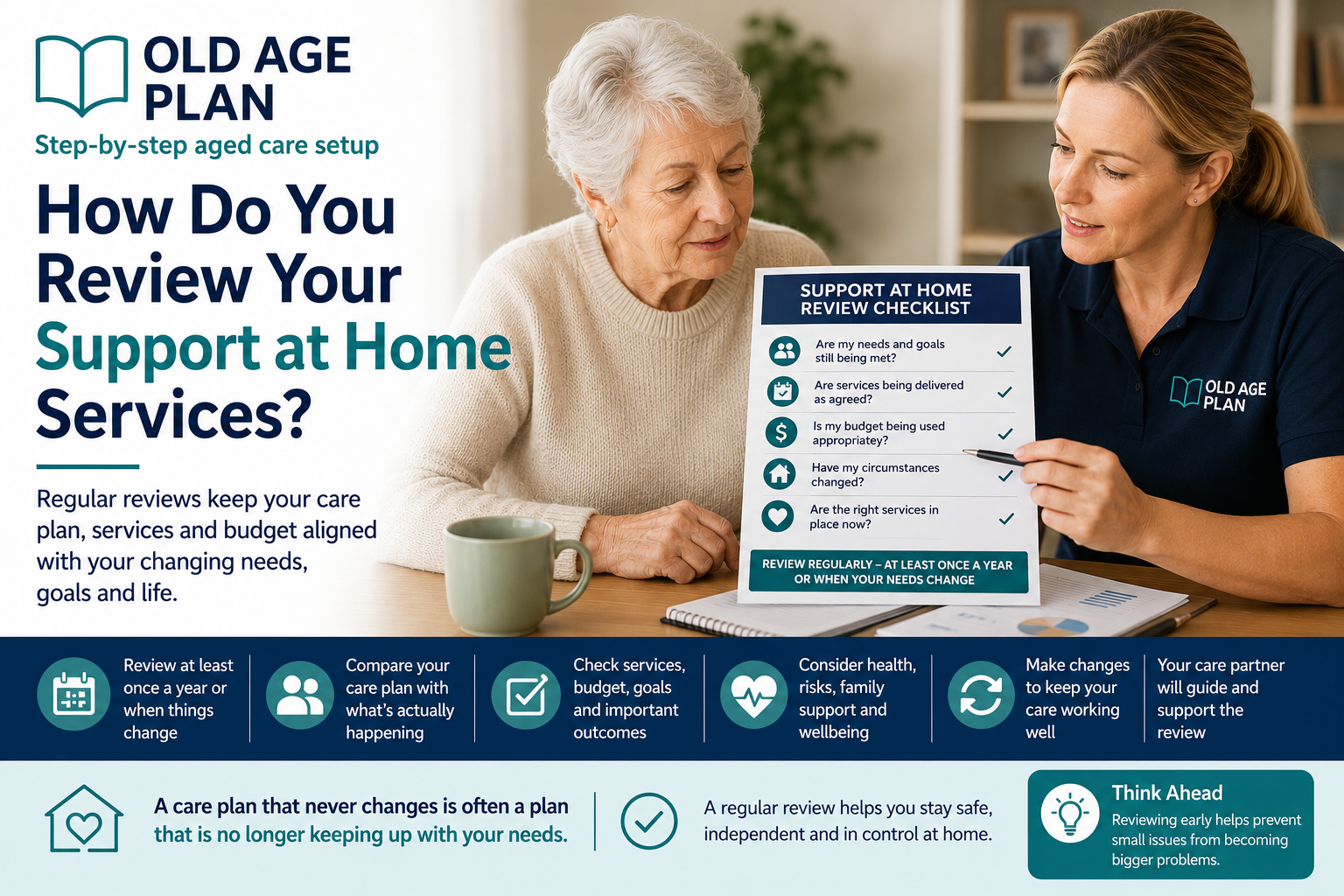

Reviewing your Support at Home services means checking whether the care arrangement still reflects the older person’s current needs, goals, routines and risks.
A review should look beyond whether scheduled visits occurred. It should consider whether the services are reliable, whether they are producing useful outcomes and whether the individualised budget is still being directed towards the support that matters most.
Your care partner should help review the arrangement regularly and when circumstances change. You can also ask for a review when the current services no longer seem suitable.
How Do You Review Support at Home Services?
Start by comparing the care plan, service agreement, individualised budget and monthly statements with what is actually happening at home.
Discuss whether services are being delivered as agreed, whether they still meet the person’s needs and whether any risks, goals or family circumstances have changed.
The review may result in services continuing unchanged, being rescheduled, increased, reduced, replaced or referred for further assessment.
Key Takeaway
A service can be delivered exactly as scheduled and still no longer be the right service.
The purpose of a review is not only to confirm that visits occurred. It is to decide whether the overall care arrangement is still solving today’s problems.
Why Should Support at Home Services Be Reviewed?
An older person’s needs rarely remain completely unchanged.
Health, mobility, cognition, confidence, family support and living circumstances may gradually shift. A service plan that worked six months ago may no longer provide the right balance of support.
Regular reviews can help identify:
Changing Needs
The person may now need more help, less help or a different type of support.
Service Problems
Missed visits, unsuitable workers or poor communication may be reducing the value of the arrangement.
Budget Pressure
Funding may be running down faster than expected or remaining unused while needs go unmet.
New Risks
Falls, medication problems, weight loss, confusion or carer exhaustion may require a different response.
Changed Priorities
The participant’s goals and preferences may have changed since the original plan was created.
Provider Performance
The review may reveal whether the provider is consistently delivering what was agreed.
Who Can Ask For A Review?
The participant can ask the provider or care partner to review their services.
A review may also be raised by:
- a registered supporter
- a family member or informal carer, with appropriate consent
- a legally authorised representative
- the care partner
- a nurse or allied health professional
- another worker who notices a meaningful change
The participant should remain involved in decisions wherever possible.
A family member may identify a concern, but that does not automatically give them authority to change the person’s services without the participant’s involvement or appropriate legal authority.
When Should Support at Home Services Be Reviewed?
The provider should review the care arrangement regularly and complete a formal care-plan review at least annually.
A review should occur sooner when there is evidence that the current arrangement may no longer be suitable.
After A Hospital Admission
Mobility, medication, personal care or nursing needs may be different when the person returns home.
After A Fall Or Injury
The person may need equipment, physiotherapy, additional supervision or changes to daily support.
When Cognition Changes
Increasing confusion, memory problems or dementia-related risks may affect safety and service reliability.
When Family Support Reduces
The formal care arrangement may need to replace tasks previously completed by relatives or friends.
When Services Keep Failing
Repeated cancellations, missed visits or unsuitable workers should trigger more than another informal complaint.
When The Budget Stops Working
Rapid spending, persistent unused funding or reduced service hours may indicate that the budget needs restructuring.
What Documents Should You Review?
A useful review should compare the written care arrangement with the services actually being delivered.
Notice Of Decision
Shows the formal assessment outcome and approved Support at Home services or pathways.
My Aged Care Support Plan
Records the person’s assessed needs, goals and approved service types.
Provider Care Plan
Explains how the approved support will be delivered in the person’s daily life.
Service Agreement
Sets out prices, responsibilities, service terms, cancellation rules and how changes are managed.
Individualised Budget
Shows how available funding is expected to be distributed across services.
Monthly Statements
Show which services were delivered, what was charged and how much funding remains.
No single document tells the complete story.
The support plan may show what was approved, while the monthly statements reveal what was actually delivered and charged.
What Should You Prepare Before The Review?
You do not need to create a formal report, but practical notes can help prevent important issues from being forgotten.
Before the review, consider:
- which services are working well
- which visits have been missed or cancelled
- whether workers complete the agreed tasks
- whether the person feels comfortable with the workers
- new falls, injuries or hospital admissions
- changes in mobility, memory, appetite or medication
- increasing family-carer workload
- unexplained charges or price changes
- services that are no longer useful
- important needs that remain unsupported
Bring recent statements, the care plan and any relevant letters or clinical recommendations to the discussion.
Should The Older Person Be Involved?
Yes. The participant should be involved in reviewing their services and deciding what should change.
That involvement may need to be adapted when communication, cognition or decision-making has become more difficult.
Support may include:
- using simple explanations
- discussing one decision at a time
- allowing more time
- involving a registered supporter
- using familiar examples
- checking whether preferences remain consistent
A person should not be excluded merely because their decisions are slower or they need assistance understanding the options.
The central question is whether their decisions remain reliable enough for the particular service decision being considered.
How Do You Review Whether Services Are Being Delivered?
Begin with the basic question of whether the provider is delivering what was agreed.
Check:
Visit Reliability
Are workers arriving on the agreed days and within reasonable timeframes?
Task Completion
Are workers completing the activities described in the care plan and service agreement?
Worker Suitability
Do workers have the skills, communication style and consistency required?
Service Continuity
Does the provider arrange suitable replacement support when a regular worker is unavailable?
Communication
Are changes, delays and cancellations explained promptly?
Statement Accuracy
Do the dates, hours and prices on the monthly statement match the services received?
One missed visit may be an isolated failure. Repeated failures suggest the arrangement itself needs review.
How Do You Review Whether Services Are Helping?
Delivery alone is not enough. The review should consider whether the services are achieving a meaningful result.
Ask whether the arrangement is helping the person:
- remain safe at home
- manage personal care with dignity
- move more safely
- eat and drink adequately
- take medication safely
- maintain social connection
- reduce avoidable stress
- continue important routines
- preserve independence where possible
- reduce unsustainable pressure on family carers
A service should not continue automatically only because it appears on the schedule.
If it is not producing the intended benefit, the provider should discuss whether it needs to be changed, delivered differently or replaced.
How Do You Review The Individualised Budget?
The individualised budget should support the current care plan.
Review whether:
- the planned services fit within the quarterly allocation
- care management has been accounted for
- service prices match the agreement
- participant contributions are being calculated correctly
- funding is being used faster than expected
- important services are being reduced because of price pressure
- unspent funding is accumulating because services are not being delivered
- lower-priority services are consuming funding needed elsewhere
The objective is not to spend every dollar or preserve the largest possible balance.
The objective is to use the available funding deliberately enough to maintain appropriate support across the quarter.
How Do You Review Your Monthly Statements?
Monthly statements provide evidence of how the care arrangement is operating financially.
Compare each statement with the participant’s diary, roster or knowledge of the services received.
Check for:
Services That Did Not Occur
Question visits or hours that do not match what happened at home.
Incorrect Service Types
Make sure the description reflects the support that was actually delivered.
Unexpected Prices
Compare charges with the service agreement and any written price-change notice.
Unclear Contributions
Confirm that the contribution category and participant percentage have been applied correctly.
Unexplained Adjustments
Ask the provider to explain refunds, corrections or changes to previous charges.
Rapid Balance Changes
A faster-than-expected decline may indicate increased use, higher prices or incorrect planning.
How Do You Review Worker Reliability?
The quality of a service depends heavily on the workers delivering it.
Consider:
- whether workers arrive consistently
- whether regular workers are frequently replaced
- whether replacements understand the care plan
- whether the participant feels respected and comfortable
- whether workers communicate concerns
- whether privacy and dignity are protected
- whether tasks are rushed or incomplete
- whether cultural, communication or language needs are respected
Not every personality mismatch requires changing providers.
However, repeated discomfort, poor boundaries, unsafe practice or unreliable service delivery should not be dismissed as something the participant simply has to accept.
How Do You Review Personal Care?
Personal care should support safety, dignity and independence.
The review should consider whether:
- the person receives enough time to complete personal care safely
- workers respect privacy and preferences
- the person is encouraged to do what they can manage
- mobility or transfer needs have changed
- continence support remains appropriate
- skin, pain or hygiene concerns are being escalated
- the service time still suits the person’s routine
A task-focused visit may appear efficient while leaving the person rushed, distressed or less independent.
The outcome matters as much as the completion of the task.
How Do You Review Domestic Assistance?
Domestic assistance should help maintain a safe and functional living environment.
Ask:
- Are the most important areas being cleaned?
- Is the allocated time realistic?
- Are falls or hygiene risks being addressed?
- Are tasks clearly documented?
- Has the person’s ability to manage household activities changed?
- Would another service now create greater benefit?
A larger cleaning list is not always the answer.
Where mobility or cognition has declined, the underlying need may involve personal care, meal support, equipment or greater supervision rather than more domestic assistance alone.
How Do You Review Transport And Social Support?
Transport and social support should connect with the participant’s goals and daily life.
Review whether the services are helping the person:
- attend essential appointments
- complete important errands
- maintain relationships
- participate in meaningful activities
- reduce isolation
- remain involved in their community
If a participant repeatedly cancels social support, do not automatically assume they no longer need it.
The timing, worker match, transport method, confidence level or activity itself may be the real problem.
How Do You Review Respite Services?
Respite should support both the older person and the sustainability of the informal care arrangement.
Consider:
- whether respite occurs often enough
- whether the participant is comfortable with the arrangement
- whether the carer receives a genuine break
- whether care responsibilities are clearly transferred
- whether respite is being introduced before burnout reaches crisis
- whether a different respite format would work better
A respite plan that technically exists but is rarely usable does not protect the care arrangement.
The review should examine whether the service creates a real, reliable break rather than another task for the family to organise.
How Do You Review Care Management?
Care management should also be reviewed.
Ask whether:
- you know who the allocated care partner is
- the care partner has regular direct contact
- concerns receive a clear response
- service problems are followed up
- the care plan reflects current circumstances
- different workers and services appear coordinated
- changes are addressed before they become emergencies
- the provider explains when reassessment may be needed
Care management should produce visible coordination and decision support.
It should not be experienced only as a budget deduction or occasional administrative call.
What Questions Should You Ask During The Review?
Useful questions include:
- Which current services are working well?
- Which goals are no longer being met?
- Have any risks increased?
- Are important needs being covered by family rather than funded services?
- Are the current service prices sustainable?
- Are we using the quarterly budget as planned?
- Could one service be replaced by a more useful service?
- Does the care plan need updating?
- Does the service agreement need changing?
- Is a clinical or allied health review needed?
- Is a Support Plan Review or reassessment required?
- Who is responsible for each agreed action after this meeting?
What Can Change After A Review?
A review may lead to different outcomes depending on what is found.
No Change
The current arrangement remains suitable and can continue with ongoing monitoring.
Schedule Change
Services may occur on different days, at different times or with a different frequency.
Service Mix Change
Funding may be redirected from a lower-priority service towards a more important approved need.
Worker Change
A different worker or subcontractor may be arranged where suitability or reliability is a problem.
Care-Plan Update
Goals, risks, instructions and responsibilities may be revised.
Further Assessment
A support plan review, reassessment or professional assessment may be required.
Agreed changes should be documented and reflected in the relevant care plan, budget or service agreement.
When Is A Provider Review Not Enough?
A provider can reorganise services within the participant’s existing approval and available funding.
It cannot independently increase the person’s government-funded classification.
A Support Plan Review or reassessment may be needed when:
- the participant needs services beyond their current approval
- the available budget cannot meet materially increased needs
- a new short-term pathway may be required
- the existing support plan no longer reflects the person’s circumstances
- significant deterioration has occurred
- family support has reduced and the arrangement is no longer sustainable
The care partner should explain what can be changed immediately and what requires another assessment decision.
What If The Provider Does Not Act On The Review?
Ask for the agreed actions, responsible person and expected timeframe in writing.
If the provider does not respond:
- Follow up with the care partner.
- Escalate the concern through the provider’s complaints process.
- Ask for a senior manager or clinical lead where appropriate.
- Keep records of missed services, correspondence and disputed charges.
- Seek advocacy or complaints support if the issue remains unresolved.
- Consider whether changing providers may be necessary.
Urgent health or safety concerns should not wait for an ordinary provider review.
Contact an appropriate health professional, emergency service or other relevant authority where immediate action is required.
What You May Really Be Trying To Decide
The visible question is:
“How do we review the services?”
The deeper question is:
“Is this care arrangement still reliable enough for the person’s life now?”
Families may become accustomed to the current schedule because changing it feels complicated.
The cleaner still comes on Tuesday. Personal care still occurs three mornings a week. Transport is still booked once a fortnight.
But the person may now be falling, skipping meals, becoming confused at night or depending on family for tasks the formal plan never recognised.
A review is where the written arrangement must be brought back into contact with reality.
Decision Support
A strong review should answer four questions.
Is It Being Delivered?
Are the agreed services occurring reliably, safely and at the correct price?
Is It Still Needed?
Does each service address a current need rather than a problem that has already changed?
Is It Producing A Useful Outcome?
Is the support improving safety, function, independence, wellbeing or care sustainability?
Can The Current Arrangement Keep Working?
Does the budget, provider capacity and family support remain sufficient for what comes next?
The goal is not to change services for the sake of change.
The goal is to identify drift early enough that the arrangement can be corrected before declining health, provider failure or carer exhaustion creates a crisis.
Summary
A Support at Home service review checks whether the current arrangement is being delivered properly and still reflects the participant’s needs, goals, preferences and risks.
The review should compare the care plan, service agreement, individualised budget and monthly statements with what is actually occurring at home.
Services should be reviewed regularly and sooner when health, mobility, cognition, family support, provider performance or budget conditions change.
A review may lead to changes in service timing, frequency, workers, priorities, care-plan instructions or the way available funding is used.
Where the existing approval or funding classification is no longer adequate, a Support Plan Review or reassessment may be required.
The central question is not simply whether services continue. It is whether the complete care arrangement remains reliable enough to support the person’s life at home today.
Support at Home Service Review FAQs
How often should Support at Home services be reviewed?
The care plan should be reviewed at least annually and earlier when the participant’s needs, risks, goals, services or circumstances change.
Can a participant request a service review?
Yes. A participant can ask their provider or care partner to review the arrangement when services no longer appear suitable or reliable.
What should you bring to a Support at Home review?
Bring the care plan, support plan, service agreement, individualised budget, recent monthly statements and notes about service problems or changed needs.
Can services be changed without another My Aged Care assessment?
Services may be reorganised within the participant’s existing approval and funding. A reassessment may be needed when needs have increased beyond the current support plan or classification.
Should monthly statements be included in the review?
Yes. Statements help identify which services were delivered, what was charged, how contributions were applied and whether the budget is being used as planned.
What happens if a service is no longer useful?
Discuss whether it should be delivered differently, reduced, replaced or removed so funding can be directed towards a more useful approved service.
Can family members participate in the review?
Family members may participate where the participant agrees or where a registered supporter or legally authorised representative has an appropriate role.
What if the provider does not implement agreed changes?
Ask for written timeframes, follow up with the care partner and escalate the issue through the provider’s complaints process if necessary.
Sources
-
Australian Government Department of Health, Disability and Ageing — Care Plans for Support at Home Participants
-
Australian Government Department of Health, Disability and Ageing — Care Management for Support at Home
-
Australian Government Department of Health, Disability and Ageing — Responsibilities to Support at Home Participants
-
Australian Government Department of Health, Disability and Ageing — Monthly Statements for Support at Home Services
-
My Aged Care — Managing Your Support at Home Services
-
My Aged Care — Managing Your Support at Home Budget
Disclaimer
This article provides general information only and is not legal, medical, financial or aged care advice.
Support at Home review requirements, provider responsibilities, assessment processes, service arrangements and government policies may change. Individual circumstances also vary according to assessed needs, available funding, location and provider capacity.
For current information, review the participant’s support plan, care plan, service agreement and monthly statements, speak with the provider or My Aged Care, and refer to the Australian Government Department of Health, Disability and Ageing.