

How Does Care Management Work Under Support at Home?
Care management is the part of Support at Home that helps keep an older person’s services coordinated, suitable and responsive as their circumstances change.
A provider must assign a care partner to help plan, monitor and review the person’s care. This responsibility continues even when the participant chooses to self-manage parts of their services.
Care management should not be confused with billing, claiming or routine provider administration. Its purpose is to make sure the overall care arrangement continues to reflect the person’s needs, goals, preferences and safety.
How Does Support at Home Care Management Work?
A care partner works with the participant and, where appropriate, their registered supporter, family or carers to plan and coordinate Support at Home services.
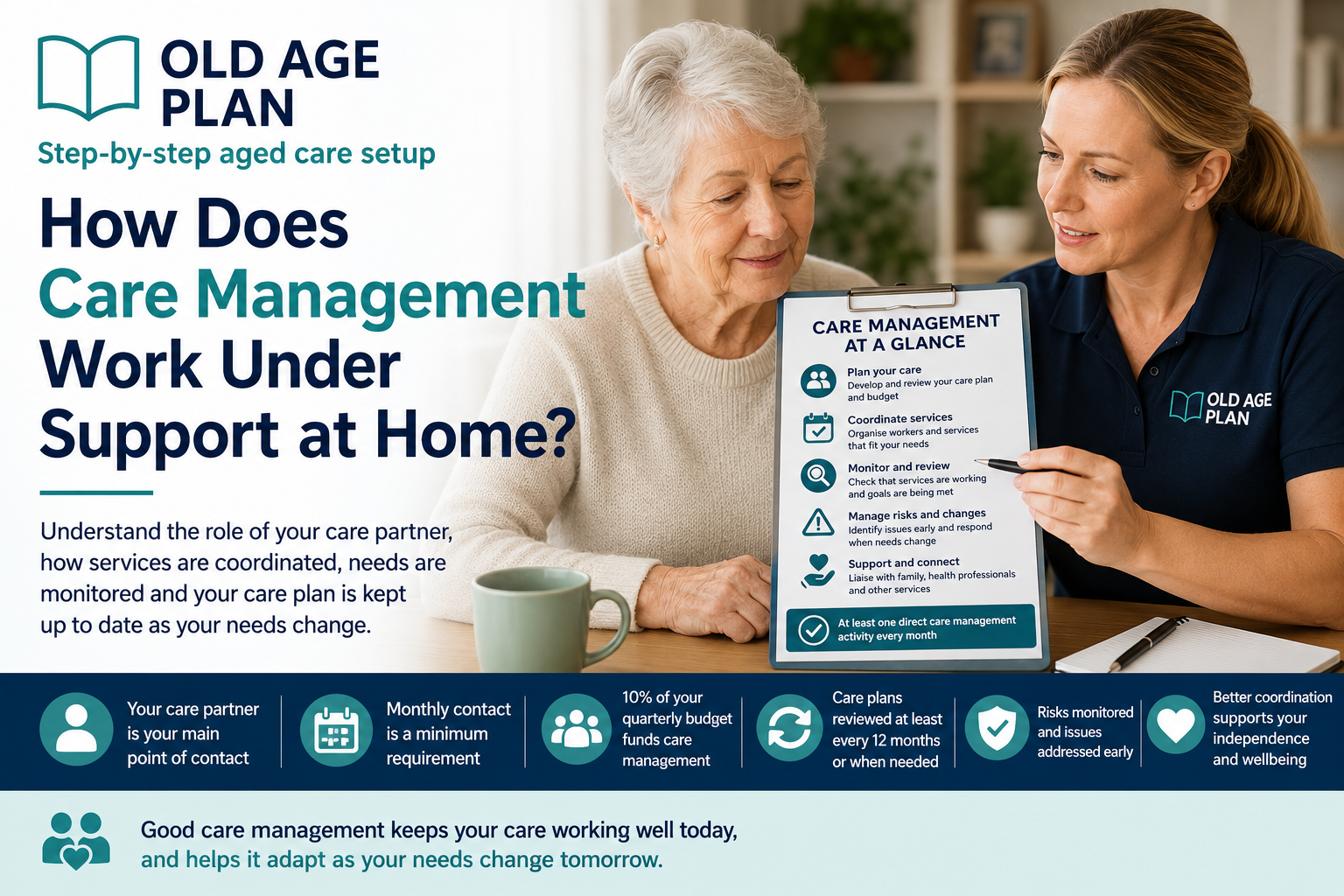
Care management may include developing and reviewing the care plan, monitoring risks, coordinating workers and health professionals, adjusting the service mix and helping arrange a Support Plan Review or reassessment when needs change.
For ongoing Support at Home services, 10% of the participant’s quarterly budget is allocated to care management. The provider must deliver at least one direct care management activity with the participant or their registered supporter each month.
Key Takeaway
Care management is not supposed to be invisible administration.
The participant should be able to identify who their care partner is, how that person is monitoring the care arrangement and what changes have occurred because of their involvement.
What Is Care Management?
Care management is an ongoing Support at Home service provided through the participant’s registered provider.
It helps connect the separate parts of the care arrangement so they work together rather than operating as unrelated visits, invoices and service bookings.
Care management activities may include:
Care Planning
Developing and reviewing the care plan and individualised budget with the participant.
Service Coordination
Helping organise workers, providers and services so care remains reliable and connected.
Monitoring And Review
Checking whether services continue to meet the person’s needs, goals and preferences.
Risk Management
Recognising changes, incidents or emerging risks and helping decide what should happen next.
Information And Support
Helping the participant understand their services, options, rights and available pathways.
Advocacy And Liaison
Communicating with workers, family, supporters and professionals where the participant agrees.
Care management should reflect the individual participant rather than applying the same service pattern to everyone with a similar classification.
Who Provides Care Management?
A staff member known as a care partner provides care management for ongoing Support at Home participants.
The care partner often acts as the main connection between:
- the participant
- their registered supporter
- family members or informal carers
- the provider
- care workers
- nurses and allied health professionals
- other services involved in the person’s care
Care partners are expected to have suitable aged care training and experience. Some may also hold nursing, allied health, disability, ageing or other relevant qualifications.
There is no single mandatory professional qualification for every care partner. The provider remains responsible for ensuring the care management workforce can safely meet the needs of its participants.
A participant with complex clinical needs may reasonably ask whether a clinically qualified care partner or additional clinical oversight is available.
Does Everyone Receive Care Management?
Yes. Providers must deliver care management to all participants receiving ongoing Support at Home services.
This obligation does not disappear when a participant:
- has relatively stable care needs
- receives only a small number of services
- has family helping with coordination
- chooses to self-manage parts of their care
- rarely contacts the provider
The amount and type of care management may vary according to the person’s needs and circumstances. However, the provider cannot simply remove care management because the participant appears independent or has chosen greater control.
How Often Should A Care Partner Contact You?
The provider must deliver at least one direct care management activity to each participant every month.
A direct care management activity involves communicating or meeting with:
- the participant
- their registered supporter
- both the participant and supporter where appropriate
This contact may occur in person, by telephone, by video call or through another suitable communication method.
One monthly contact is a minimum requirement. It does not mean one brief call is automatically enough for every person.
Someone with changing health, repeated service failures, dementia-related risks, recent hospitalisation or increasing family pressure may need more frequent and more involved care management.
How Is Care Management Funded?
For participants receiving ongoing Support at Home services, 10% of each quarterly budget is allocated to care management.
This amount is deducted from the classification funding and placed into the provider’s pooled care management account.
The pooled arrangement allows the provider to deliver different levels of care management according to participant need. A person with a stable arrangement may require less time during one period, while another participant may require intensive coordination because of a sudden change or crisis.
Some specialised participant groups may also attract a care management supplement to support additional care management hours.
The 10% Is Not Direct-Service Funding
It is allocated to care management rather than ordinary personal care, cleaning, transport or other scheduled services.
It Is Not A Separate Participant Cash Balance
The participant cannot withdraw or independently spend the care management allocation.
It Does Not Remove Provider Accountability
The pooled model does not allow the provider to collect funding without delivering meaningful care management.
Care Management Has A 0% Contribution Rate
Participants do not pay an out-of-pocket contribution towards care management.
What Should A Care Partner Do When Services Begin?
Care management begins when the provider starts organising the participant’s funded services.
The care partner should work with the participant and any agreed supporter to prepare the care plan and individualised budget.
This process should connect:
- the person’s Notice of Decision
- their My Aged Care support plan
- their approved service types
- their goals and preferences
- known risks
- the services the provider will deliver
- available quarterly funding
- the provider’s agreed prices
The care partner should also help the participant understand what has been approved, what the available funding can afford and how the planned service mix is expected to work.
The care plan must be prepared before or on the day funded care begins, and the participant or registered supporter should receive a copy.
What Is The Difference Between A Support Plan And A Care Plan?
My Aged Care Support Plan
Prepared through the aged care assessment process.
It records assessed needs, goals and approved service types.
Provider Care Plan
Prepared with the participant by the Support at Home provider.
It explains how the approved services will be organised and delivered in practice.
The support plan establishes the assessment foundation. The provider’s care plan translates that approval into the person’s actual care arrangement.
Care management should keep the care plan aligned with the support plan while responding to changes in the person’s daily life.
How Does A Care Partner Coordinate Services?
A participant may receive several different services from multiple workers or organisations.
Care coordination helps prevent these services from operating independently without anyone considering the complete picture.
The care partner may help coordinate:
- personal care schedules
- nursing visits
- allied health appointments
- domestic assistance
- meal support
- transport
- respite
- assistive technology
- home modifications
- subcontracted services
Coordination may involve checking that workers understand the care plan, reducing schedule conflicts, managing gaps and supporting continuity when a regular worker is unavailable.
It should also include noticing when information from one service affects another. A physiotherapist identifying increased falls risk, for example, may affect personal care, home modifications, equipment and family support.
How Does Care Management Monitor Risk?
Risk monitoring is a central care management responsibility.
The care partner should pay attention to changes such as:
Falls Or Reduced Mobility
New falls, difficulty transferring or reduced confidence moving around the home.
Medication Problems
Missed medication, confusion, side effects or difficulty managing prescriptions.
Nutrition Or Hydration Concerns
Weight loss, reduced appetite, swallowing difficulty or inadequate food and fluid intake.
Cognitive Or Behavioural Change
Increasing confusion, wandering, unsafe decisions, distress or changes in dementia-related needs.
Carer Strain
A family carer becoming exhausted, unavailable or unable to continue the same level of support.
Service Failure
Repeated missed visits, unsuitable workers, poor communication or important tasks not being completed.
The care partner does not personally diagnose every problem or replace emergency, medical or legal professionals.
Their role is to recognise that something has changed, help coordinate the appropriate response and make sure the care arrangement is reviewed rather than continuing unchanged.
How Often Should The Care Plan Be Reviewed?
The care partner should review the care plan with the participant at least once every 12 months.
A review should occur earlier when:
- the participant asks for one
- needs, goals or preferences change
- a new risk or incident occurs
- the participant receives a higher funding classification
- interim funding is replaced by the full allocation
- services or service frequency need to change
- assistive technology or home modifications are approved
- family or informal-carer support changes
- the participant begins the End-of-Life Pathway
When the care plan changes, the individualised budget should also be reviewed so the service schedule and available funding remain aligned.
A yearly review should be treated as the longest routine interval, not a reason to ignore an obvious change for another eleven months.
What Happens When Care Needs Change?
Not every change requires a completely new aged care assessment.
The care partner should first consider whether the need can be managed by:
- changing the frequency of an existing service
- replacing one service with another approved service
- reorganising the individualised budget
- arranging an approved clinical review
- adding assistive technology or a home modification
- using respite or another temporary support
If the person’s classification no longer provides enough support for their assessed needs, the care partner may discuss a Support Plan Review or reassessment.
The participant should be involved in this decision. A provider should not request reassessment or redirect the person towards residential care without explaining the concern and discussing available options.
What Role Does Care Management Play After Hospital?
A hospital admission or discharge can expose gaps in an existing home-care arrangement.
With the participant’s consent, the care partner may help:
- understand changed care instructions
- coordinate the restart of suspended services
- arrange additional approved support
- communicate relevant information to workers
- review mobility, personal care or medication needs
- organise allied health or nursing where approved
- review the care plan and individualised budget
- identify whether reassessment is needed
Care management does not replace hospital discharge planning or clinical treatment.
Its value is helping translate the changed situation into a home-care arrangement that is realistic once the person returns home.
How Are Families And Registered Supporters Involved?
The participant should remain central to decisions about their care.
A family member does not automatically control the care arrangement merely because they provide substantial unpaid support.
Where the participant agrees, the care partner may involve:
- a registered supporter
- a spouse or partner
- adult children
- another family member
- an informal carer
- a legally authorised representative
The care partner should understand who may receive information, who may assist the participant and who has formal decision-making authority where capacity or legal authority becomes relevant.
Family involvement should support the participant’s voice rather than automatically replace it.
What If Family Members Disagree?
Care management may help clarify disagreements about service priorities, risks, schedules or the amount of family support available.
The care partner should separate:
The Participant’s Preferences
What does the older person want, and can those wishes be supported safely?
Assessed Care Needs
What needs and risks are identified in the support plan and professional assessments?
Family Capacity
What support can relatives realistically continue providing without the arrangement becoming unsustainable?
Formal Authority
Who has legal authority if the participant cannot reliably make a particular decision?
The care partner is not a tribunal, lawyer or family mediator. However, good care management should identify when unresolved conflict is undermining the care arrangement and when external professional support may be needed.
Does Care Management Continue If You Self-Manage?
Yes. A participant may choose to self-manage parts of their Support at Home arrangement, but the provider must still deliver care management.
Self-management may allow the participant to take a greater role in decisions about:
- the mix of approved services
- how the budget is organised
- when and where services are delivered
- which workers provide services, where provider requirements are met
The care partner must still oversee the arrangement sufficiently to ensure services remain safe, appropriate and consistent with the participant’s care plan.
Self-management means greater control. It does not transfer every legal, quality and care-management obligation away from the provider.
What Is Not Care Management?
Care management should not be used as a label for every internal provider activity.
Routine administrative costs funded through service prices are not care management.
Billing
Preparing invoices and collecting participant contributions are administrative functions.
Government Claiming
Submitting service claims and managing provider payment processes are not participant care management.
General Account Management
Routine bookkeeping and internal financial administration should not be presented as personalised care activity.
Ordinary Rostering Alone
Scheduling a worker is not automatically meaningful care management unless it forms part of coordinating the participant’s care.
Administrative work may be necessary for the provider to operate. The distinction is whether an activity directly helps plan, coordinate, monitor, review or support the participant’s care.
How Can You Tell Whether Care Management Is Working?
Care management should produce visible outcomes.
Signs of effective care management may include:
- you know who your care partner is
- the care partner contacts you regularly
- questions and concerns receive a clear response
- service failures are followed up
- the care plan reflects current circumstances
- changes are discussed before documents are updated
- workers appear to understand important care needs
- risks are identified before they become emergencies
- the provider explains when another assessment or service is needed
- you receive copies of updated plans and budgets
The care partner will not prevent every problem. The stronger test is whether the provider notices, responds and adapts when problems occur.
Warning Signs Of Weak Care Management
You Do Not Know Your Care Partner
No one has clearly explained who is responsible for coordinating the overall arrangement.
Contact Is Only About Invoices
Communication focuses on charges while needs, goals and service quality are rarely discussed.
The Care Plan Is Outdated
The written plan no longer reflects the person’s health, routines, risks or current services.
Repeated Failures Continue
Missed visits or unsuitable workers recur without a clear response or service adjustment.
Family Is Carrying Unrecognised Care
The arrangement appears stable only because relatives are filling substantial service gaps.
No One Responds To Change
Falls, hospitalisation, cognitive decline or carer burnout occur without a care-plan review.
One delayed call does not necessarily indicate systemic failure. A repeated pattern of passive or unresponsive management deserves closer review.
What Should You Ask Your Care Partner?
Useful questions include:
- Who is my allocated care partner?
- How often will we have direct care-management discussions?
- How do I contact you when circumstances change?
- When was the care plan last reviewed?
- What risks are currently recorded?
- Are the current services achieving the intended goals?
- How are missed visits or worker concerns followed up?
- Does the individualised budget still support the care plan?
- What happens if family support reduces?
- At what point would you recommend a Support Plan Review or reassessment?
The purpose is not to interrogate the care partner. It is to establish whether both sides share the same understanding of what the care arrangement is trying to achieve.
What You May Really Be Trying To Decide
The visible question is:
“What does care management include?”
The deeper concern is often:
“Is anyone actually watching the whole care arrangement, or are we paying for coordination that the family is still doing alone?”
A participant may receive every scheduled service and still have a weak care arrangement.
The cleaner may arrive. Personal care may occur. Transport may be booked. Yet nobody may be noticing that mobility is declining, medication has become confusing or the family carer is close to exhaustion.
Care management exists to recognise the gap between services being delivered and the overall arrangement remaining reliable.
Decision Support
When deciding whether care management is adequate, assess more than how friendly or responsive the care partner seems.
Visibility
Can you identify what care-management activity has occurred and why it mattered?
Continuity
Is someone connecting information across workers, services, family and health professionals?
Responsiveness
Does the care arrangement change when needs, risks or circumstances change?
Reliability
Is the current care plan still reliable enough to support the person safely at home?
Care management should not wait for complete failure before acting.
The strongest value often comes from noticing that the current arrangement is beginning to drift before missed care, family exhaustion or deteriorating health turns the problem into a crisis.
Summary
Care management is a mandatory part of ongoing Support at Home services.
A care partner helps develop and review the care plan, coordinate services, monitor risks, support informed decisions and respond when the participant’s needs or circumstances change.
For ongoing services, 10% of the quarterly budget is allocated to care management. The provider must deliver at least one direct care management activity with the participant or registered supporter every month.
The care plan should be reviewed at least once every 12 months and earlier when needs, risks, preferences, services, family support or funding arrangements change.
Good care management does more than keep documents updated. It helps ensure the separate parts of the care arrangement continue working together before service gaps or changing needs become a crisis.
Support at Home Care Management FAQs
Is care management compulsory under Support at Home?
Yes. Providers must deliver care management to all participants receiving ongoing Support at Home services.
How much of the Support at Home budget goes to care management?
For ongoing services, 10% of the participant’s quarterly budget is allocated to care management.
How often should a care partner contact a participant?
The provider must deliver at least one direct care management activity with the participant or registered supporter every month. More frequent contact may be needed when circumstances are complex or changing.
Does care management continue if you self-manage?
Yes. Participants may self-manage parts of their services, but the provider must still provide care management and retain responsibility for safe and suitable care.
Is billing part of care management?
No. Routine billing, account administration and government claiming are provider administrative costs rather than personalised care management.
How often should a Support at Home care plan be reviewed?
The care plan should be reviewed with the participant at least once every 12 months and earlier when needs, goals, risks, services or circumstances change.
Can a care partner request another aged care assessment?
If the participant agrees and their current classification no longer meets their needs, the provider may help request a Support Plan Review or reassessment through My Aged Care.
Can family members speak with the care partner?
Family members may be involved where the participant agrees or where a registered supporter or legally authorised representative has an appropriate role.
Sources
- Australian Government Department of Health, Disability and Ageing — Care Management for Support at Home
- Australian Government Department of Health, Disability and Ageing — Responsibilities to Support at Home Participants
- Australian Government Department of Health, Disability and Ageing — Care Plans for Support at Home Participants
- My Aged Care — Care Management
- My Aged Care — Managing Your Support at Home Services
- My Aged Care — Support at Home Costs and Contributions
Disclaimer
This article provides general information only and is not legal, medical, financial or aged care advice.
Support at Home care-management requirements, funding arrangements, provider responsibilities, assessment processes and government policies may change. Individual care arrangements also vary according to assessed needs, available services, location and personal circumstances.
For current information, review the participant’s support plan, care plan and service agreement, speak with the provider or My Aged Care, and refer to the Australian Government Department of Health, Disability and Ageing.