
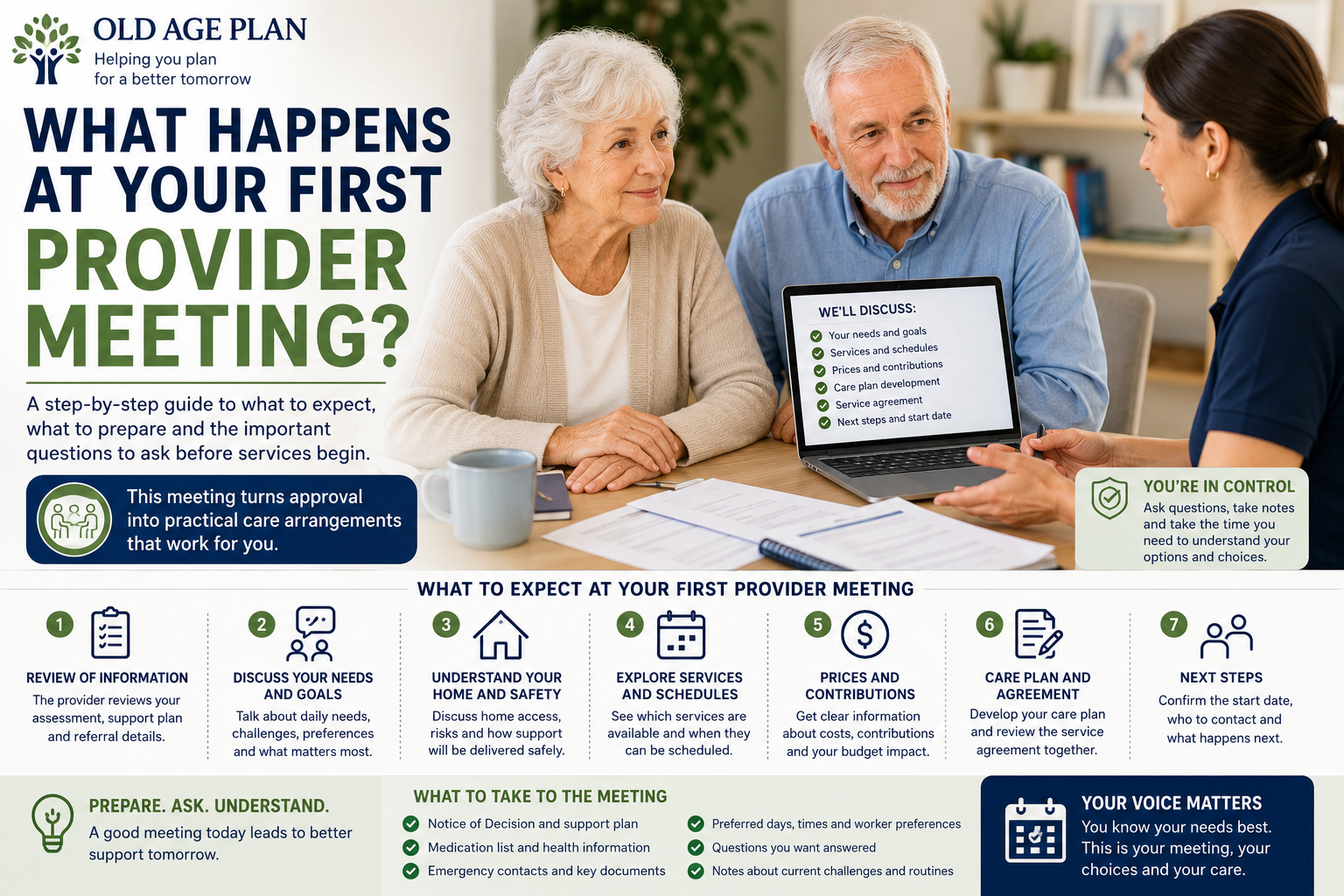

What Happens At Your First Aged Care Provider Meeting?
After choosing an aged care provider and sharing the referral information, the next step is often a first meeting with the provider.
This meeting may happen in the older person’s home, over the phone, by video call or at the provider’s office. It is usually where the assessment outcome begins to turn into practical care arrangements.
Families may expect services to start immediately. But the provider first needs to understand the person’s needs, goals, routines, risks and preferences before agreeing on how support will be delivered.
Short Answer
At the first aged care provider meeting, the provider will usually review the assessment and support plan, discuss the older person’s goals and daily needs, explain available services and prices, identify risks and preferences, develop care arrangements and begin preparing the service agreement. The meeting is also an opportunity to ask questions before services begin.
Key Takeaway
The first provider meeting is not just an introduction. It is where families begin deciding how approved support will work in real life. Important details about services, schedules, workers, prices, responsibilities and safety should be understood before the setup is treated as complete.
Is The First Provider Meeting Another Assessment?
The first provider meeting is generally not the same as the My Aged Care assessment.
The assessment determines the older person’s eligibility, needs, goals and approved support pathway.
The provider meeting focuses on implementation. The provider reviews the approved information and works with the older person to decide how services will be organised and delivered.
My Aged Care Assessment
Identifies care needs, goals, eligibility and the types of support that may be approved.
Provider Meeting
Works out how the approved support will be delivered by the chosen organisation.
Care Plan
Records how the provider proposes to meet the person’s assessed needs and goals.
Service Agreement
Sets out the services, prices, responsibilities, contribution arrangements and contractual terms.
OAP Reality Check: The assessment says what support may be needed. The provider meeting decides whether this particular provider can deliver that support properly.
Who Usually Attends The Meeting?
The older person should remain central to the conversation.
Depending on their wishes and circumstances, the meeting may also include:
- a family member
- a carer
- a registered supporter
- an advocate
- an interpreter
- the provider’s care partner or coordinator
- another relevant provider representative
A support person can help remember information, ask questions and explain care needs that may not be obvious during a short meeting.
What Information Will The Provider Review?
The provider may review information connected with the person’s assessment and referral.
This can include:
Assessment Outcome
The provider may review the approved aged care pathway, classifications and service types.
Support Plan
The provider may review the person’s assessed needs, goals and recommended support.
Health And Safety Information
Relevant mobility, falls, medication, personal care, communication or home safety concerns may be discussed.
Current Support
The provider may ask what family members, carers or other services are already doing.
Families should still explain anything important that is missing, outdated or unclear.
The Provider Will Ask About Goals
Support at Home services should connect with the older person’s goals rather than becoming a generic list of tasks.
The provider may ask what the person wants help to achieve.
Examples may include:
- remaining safely at home
- maintaining personal hygiene
- reducing falls risk
- preparing and eating regular meals
- attending appointments
- staying socially connected
- reducing pressure on family carers
- improving strength, mobility or confidence
The goal should help explain why a service matters, not simply name the service.
The Provider Will Discuss Daily Care Needs
The provider needs enough practical information to understand what support will involve.
Personal Care
Showering, dressing, grooming, toileting, continence, transfers and preferred personal routines.
Domestic Support
Cleaning, laundry, changing bed linen and maintaining a safe home environment.
Meals And Nutrition
Shopping, meal preparation, dietary needs, food safety and whether the person is eating properly.
Mobility And Transport
Walking, transfers, mobility aids, transport needs and support attending appointments or activities.
Memory And Communication
Confusion, repeated questions, communication preferences, hearing needs and support with routines.
Family And Carer Support
What family already provides, what they will continue doing and where formal support needs to take over.
Home Safety May Be Discussed
If the meeting happens at home, the provider may notice practical risks or ask questions about the environment.
This is not necessarily a formal property inspection.
The aim is usually to understand whether services can be delivered safely for the older person and the worker.
Topics may include:
- stairs and access
- bathroom safety
- pets
- smoking in the home
- lifting or transfer risks
- mobility equipment
- infection risks
- parking and entry arrangements
- how workers enter the home
- emergency contacts
Worker Preferences Should Be Discussed
The first meeting is an appropriate time to explain preferences that affect whether care feels safe and respectful.
Gender Preference
The person may prefer a male or female worker for personal care or cultural reasons.
Language Preference
The person may need a worker who speaks a particular language or communicates in a particular way.
Cultural And Religious Needs
Practices, routines, dietary requirements and cultural expectations may affect service delivery.
Worker Continuity
Consistent workers may be particularly important for dementia, anxiety, trauma or personal care.
The provider may not be able to guarantee every preference, but it should explain what it can realistically accommodate.
Services And Schedules Will Be Discussed
The provider should explain which approved services it can deliver and how they may be scheduled.
Families should ask:
- which services can begin first
- how often each service will occur
- which days and times are available
- whether visit times are fixed or flexible
- how long each visit will last
- what happens when a worker is unavailable
- whether weekend or public holiday support is available
- how much notice is given if a service changes
OAP Decision Point: “We offer personal care” is not enough. Confirm when it will happen, who will deliver it and what the worker will actually do.
Prices And Contributions Should Be Explained
The provider should explain its published prices and how they apply to the person’s approved services.
Depending on the service and the person’s circumstances, personal contributions may apply.
Ask for clear written information about:
Service Prices
What will each agreed service cost?
Personal Contributions
What amount may the person need to contribute toward particular services?
Additional Costs
Do travel, materials, subcontractors, weekends or cancellation conditions affect the price?
Budget Impact
How will the proposed services affect the person’s available quarterly budget?
Do not rely only on verbal estimates if the service agreement will contain different or more detailed terms.
A Care Plan May Be Developed
Support at Home providers are required to create a care plan with the participant.
The care plan should connect the person’s assessed needs and approved services with the way the provider intends to deliver support.
It may include:
- the person’s goals
- agreed services
- care needs and preferences
- identified risks
- how services will be delivered
- who is responsible for particular actions
- how changes will be monitored
- when the care plan will be reviewed
The older person should be involved in developing the plan and should receive a copy.
The Service Agreement May Be Introduced
The provider may explain or provide the service agreement during the first meeting.
This document is a contract between the older person and the provider.
It should include clear information about:
Agreed Services
What the provider will deliver and how the arrangements connect to the care plan.
Prices And Contributions
What services cost and how the person’s contribution arrangements apply.
Rights And Responsibilities
What the provider and participant are each expected to do.
Cancellations And Changes
How visits can be cancelled, rescheduled or changed.
Complaints
How concerns are reported, escalated and resolved.
Ending The Agreement
What notice is required and what happens if the person changes providers.
Families do not need to pretend they understand unclear terms. Ask questions and request time to read the agreement where needed.
Do You Have To Sign During The First Meeting?
The provider may ask the person to enter into a service agreement as part of the setup process.
But the agreement should be understood before it is accepted.
Do not sign merely because:
- the meeting has already taken a long time
- the provider representative is waiting
- the family feels embarrassed asking questions
- services are urgently needed
- the document appears standard
Ask the provider to explain anything unclear, including prices, cancellation rules, worker arrangements and how services can be changed.
Questions To Ask At The First Provider Meeting
Who Will Coordinate The Care?
Ask for the name and contact details of the main care partner or coordinator.
When Can Services Start?
Ask for realistic commencement dates for each important service.
Who Will Deliver The Services?
Ask whether workers are employees, contractors or subcontractors and how they are matched.
Can We Have Consistent Workers?
Ask how the provider supports continuity and what happens when a regular worker is unavailable.
How Are Changes Handled?
Ask how services are reviewed when needs, goals, health or family support change.
How Are Problems Escalated?
Ask who to contact when services are missed, workers are unsuitable or concerns remain unresolved.
What Should You Prepare Before The Meeting?
Preparation can make it easier to keep the meeting focused on the person’s real needs.
Consider having these items ready:
- the Notice of Decision
- the My Aged Care support plan
- referral information
- a current medication list
- relevant health or mobility information
- emergency contact details
- preferred service days and times
- language, cultural or worker preferences
- examples of current safety concerns
- a list of questions for the provider
What If The Older Person Minimises Their Needs?
Some older people may say they need very little help, even when family members are already doing a significant amount behind the scenes.
This may be because of pride, embarrassment, memory problems, fear of losing independence or not recognising how much support they receive.
A family member or supporter can help by giving specific examples without taking over the meeting.
What They Say
“I manage my meals.”
What Actually Happens
Family shops, prepares meals, checks food and removes expired items.
What The Provider Needs To Know
The person may not manage nutrition safely without ongoing support.
How To Explain It
Use calm, factual examples rather than arguing about whether the person is independent.
What If The Provider Meeting Reveals A Service Mismatch?
The meeting may reveal that the provider cannot deliver everything the person needs.
This may involve:
- no workers available at suitable times
- no capacity for personal care
- limited cultural or language matching
- inability to provide consistent workers
- prices that make the proposed service mix unsustainable
- reliance on subcontractors the family did not expect
- no realistic service commencement date
If the mismatch is significant, pause before signing the agreement.
It may be better to continue comparing providers than to begin with an arrangement that cannot meet the person’s priority needs.
Warning Signs During The First Meeting
The Provider Does Most Of The Talking
The older person’s goals, concerns and preferences receive little attention.
Prices Remain Vague
The provider cannot explain what services will cost or how the budget will be affected.
No One Can Confirm Availability
The provider wants an agreement but cannot provide realistic service start dates.
The Agreement Is Rushed
The family is pressured to sign before important terms are understood.
Important Risks Are Dismissed
Falls, memory, personal care or carer pressure concerns are treated as minor inconveniences.
Responsibilities Are Unclear
No one can explain who coordinates services or responds when things go wrong.
What Happens After The Meeting?
The provider setup process may continue after the first meeting.
Step 1: Outstanding Information Is Supplied
The family or provider may need to provide documents, preferences or additional details.
Step 2: The Care Plan Is Finalised
The provider records how approved services will address the person’s needs and goals.
Step 3: The Service Agreement Is Completed
The agreed services, prices, responsibilities and conditions are documented.
Step 4: Workers And Visits Are Scheduled
The provider confirms the initial workers, service dates and practical access arrangements.
Step 5: Services Begin
The provider starts delivering support according to the agreed arrangements.
What You May Really Be Trying To Decide
The surface question is:
What happens at your first aged care provider meeting?
But the deeper decision is usually:
Can this provider turn the approved support into care that will actually work for us?
That is the real implementation question. The meeting is where families begin testing whether the provider’s services, workforce, communication and terms match the person’s real needs.
Decision Support: Before Agreeing To Move Forward
Use the first meeting to test four areas.
Needs
Does the provider understand what help is required and why it matters?
Delivery
Can the provider explain who will deliver the support, when it will happen and how cancellations are managed?
Cost
Are the service prices, contribution arrangements and budget effects clear?
Accountability
Is there a clear contact person and a practical process for reviews, changes and complaints?
Related Old Age Plan Articles
Next Steps With Old Age Plan
FAQ
What happens at the first aged care provider meeting?
The provider usually reviews the assessment and support plan, discusses needs and goals, explains available services and prices, develops care arrangements and begins preparing the care plan and service agreement.
Is the first provider meeting another assessment?
Not usually. The My Aged Care assessment determines eligibility and approved support. The provider meeting focuses on how that support will be delivered in practice.
Can a family member attend the provider meeting?
Yes, if the older person wants them there. A family member, carer, supporter, advocate or interpreter may help ask questions and explain care needs.
Do you have to sign the service agreement during the meeting?
The provider may present the agreement during the setup process, but the terms should be understood before it is accepted. Ask for clarification or time to review unclear information.
What should you take to the first provider meeting?
Take the Notice of Decision, support plan, referral details, medication and health information, preferred schedules, worker preferences and a written list of questions.
What if the provider cannot meet the person’s needs?
Pause before entering into the agreement. Ask whether the provider has alternative arrangements, or continue comparing providers if the mismatch affects priority care needs.
Summary
At the first aged care provider meeting, the provider will usually review the assessment outcome and support plan, discuss the person’s needs and goals, explain available services and prices, identify preferences and risks, and begin developing the care plan and service agreement.
Families should use the meeting to confirm whether the provider can deliver suitable support, when services can start, what they will cost and who will take responsibility when arrangements change or problems occur.
Sources
- My Aged Care — Connecting with Support at Home providers
- My Aged Care — Agreeing to Support at Home services
- My Aged Care — How to set up your aged care services
- Australian Government Department of Health, Disability and Ageing — Care plans for Support at Home participants
- Australian Government Department of Health, Disability and Ageing — Service agreements for Support at Home
- Australian Government Department of Health, Disability and Ageing — Care management for Support at Home
Disclaimer
This article provides general information only and is not medical, legal, financial or aged care advice.
Support at Home provider processes, care planning requirements, service agreements, prices, contributions and service availability may change. Individual arrangements also vary depending on assessed needs, approved services, provider capacity, location and personal preferences.
For current information, contact My Aged Care, review the provider’s written care plan and service agreement, or seek qualified aged care, legal, health or financial advice where needed.