
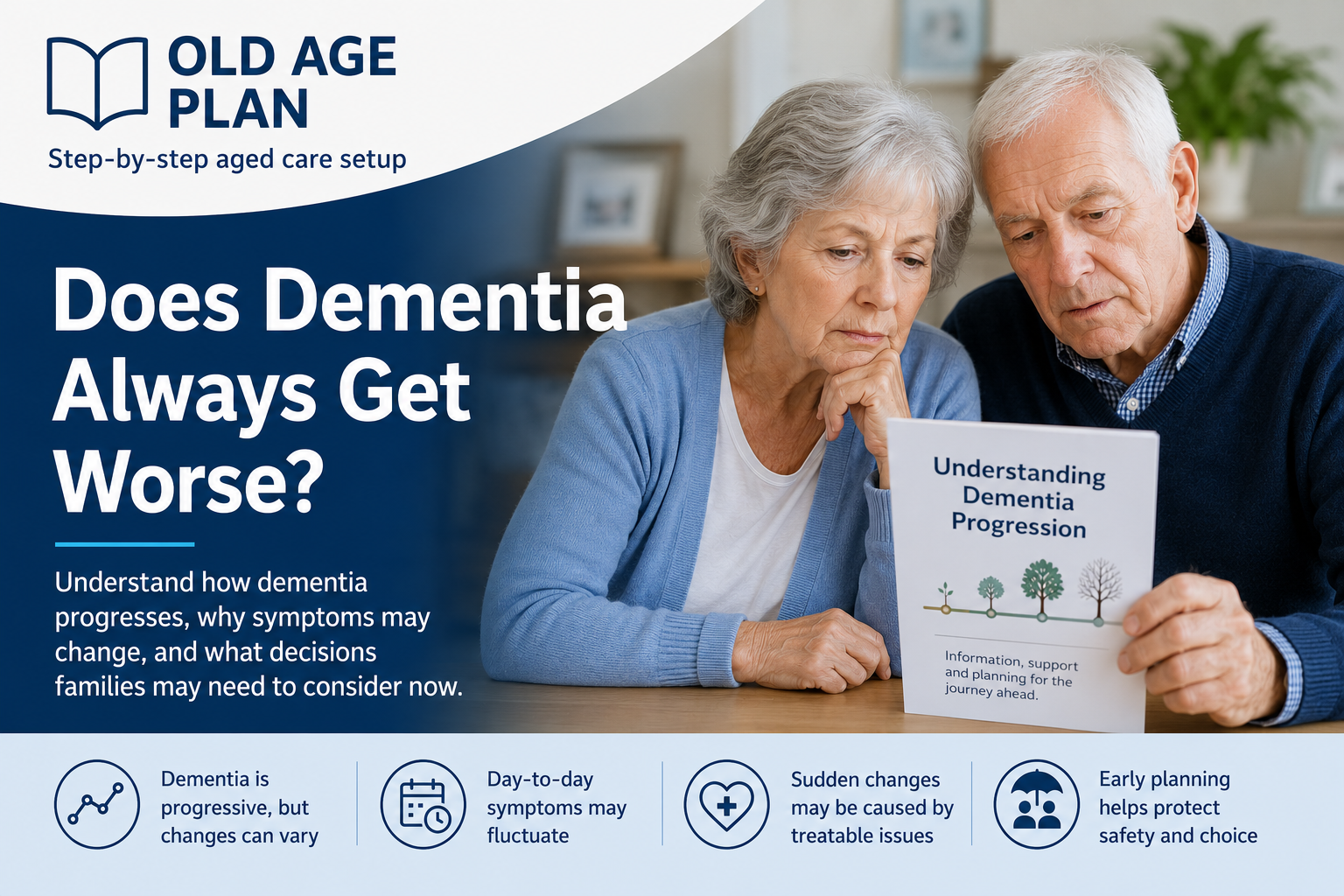

Does Dementia Always Get Worse?
Some families notice a person with dementia seems worse one week, then more settled the next.
A conversation may feel clearer in the morning but harder at night.
There may be a sudden change after an infection, a hospital stay, a medication change or a disrupted routine.
If you are asking does dementia always get worse, you may also be trying to work out whether the change you are seeing is permanent, temporary, or a sign that planning can no longer wait.
Short Answer
Dementia is generally progressive, which means symptoms usually become worse over time.
However, this does not mean every change happens at the same speed or in a straight line.
Some symptoms may fluctuate from day to day. Sudden worsening may also be caused by treatable issues such as infection, pain, dehydration, medication side effects or delirium.
The safest approach is not to assume every change is “just dementia”. It is to notice what has changed, seek medical advice when changes are sudden, and plan before decisions become harder.
Key takeaway: Dementia usually gets worse over time, but day-to-day changes may still fluctuate. Sudden worsening should be checked, because not every change is dementia progression.
Why Dementia Usually Gets Worse Over Time
Dementia is caused by changes in the brain that affect thinking, memory, behaviour and everyday function.
Healthdirect describes dementia as a progressive condition, meaning it gets worse over time.
That progression may affect different areas of daily life at different times.
For one person, memory may be the first major issue.
For another, planning, judgement, communication, walking, behaviour or personality changes may become more noticeable earlier.
This is why families can become confused when dementia does not match the simple picture they expected.
The question is often not only “Is memory worse?”
It may be:
Which part of daily life is becoming harder to manage safely?
Does Dementia Get Worse In A Straight Line?
No, not always.
Dementia progression can feel uneven.
Some periods may seem stable.
Other periods may bring noticeable changes.
Some people decline slowly over many years. Others may change more quickly, especially after illness, hospitalisation, falls or major disruption.
This is why it can be risky to rely only on average timelines.
Families usually need to look at real-life function:
- Is medication still being taken correctly?
- Are meals being managed safely?
- Are bills and appointments being missed?
- Is driving still safe?
- Is personal care changing?
- Is the person getting lost or confused more often?
- Is family support becoming harder to sustain?
These changes often matter more than trying to place someone perfectly inside a stage.
Can Dementia Symptoms Come And Go?
Some symptoms can appear worse at certain times.
A person may seem clearer in familiar surroundings and more confused in a busy place.
They may manage better after good sleep and worse when tired, unwell or overstimulated.
They may be calmer with familiar routines and more unsettled when plans change.
This does not mean dementia has gone away.
It means the person’s ability to cope may depend heavily on health, environment, routine and support.
That matters because the answer is not always “more care immediately”.
Sometimes the first decision is to work out what is making things harder.
Sudden Worsening Should Not Be Ignored
A sudden change in confusion, behaviour, alertness, appetite, walking, continence or communication should usually be checked.
Dementia Australia explains that delirium can be brought on by issues such as severe illness, constipation, dehydration, infection, pain or drug effects.
Delirium can cause sudden changes and may be mistaken for dementia getting worse.
This distinction matters.
If a sudden change is treated as “just dementia”, a medical issue may be missed.
If a temporary change is mistaken for permanent decline, families may rush into decisions before understanding what is really happening.
The better response is:
Slow down. Check what changed. Seek medical advice. Then decide what support is needed.
Can Dementia Stabilise?
Some people may appear stable for a period of time.
They may stay at a similar level for months or sometimes longer.
However, dementia is still usually progressive overall.
A stable period should not be treated as proof that planning is no longer needed.
It may be a useful window to sort out decisions that become harder later.
These may include legal documents, care preferences, family roles, medication support, home safety and future care options.
What Should Families Watch For?
Instead of asking only whether dementia is worse, it may help to watch for changes that affect safety, independence and decision-making.
Important changes may include:
- more frequent missed medication
- repeated missed appointments
- new difficulty managing money
- getting lost in familiar places
- new falls or mobility concerns
- changes in eating or drinking
- increased confusion at night
- new aggression, suspicion or distress
- less ability to manage personal care
- greater reliance on one family member
These signs do not all mean the same thing.
But they can help families see whether the current support arrangement still matches the person’s needs.
Why Waiting For Certainty Can Create Problems
Families often wait because they are not sure whether dementia is really getting worse.
That is understandable.
But waiting for certainty can create its own risks.
By the time everyone agrees that things have changed, decisions about safety, legal authority, care support or home arrangements may already be urgent.
The goal is not to panic.
The goal is to identify decisions that become harder if they are delayed.
Those decisions may include:
- medical review
- support through My Aged Care
- home safety changes
- driving conversations
- medication management
- legal planning
- future care preferences
- family role clarity
What You May Really Be Trying To Decide
If you are searching for whether dementia always gets worse, the real question may be:
Can we wait, or do we need to act now?
The answer depends on what has changed.
If symptoms are mild and stable, the next step may be planning, monitoring and medical follow-up.
If there has been sudden worsening, the next step may be urgent medical review.
If daily risks are increasing, the next step may be more structured support.
The important point is this:
Dementia usually progresses, but not every change means the same thing.
Families make better decisions when they separate three questions:
- Is this dementia progression?
- Could something else be causing this change?
- What support or planning is now needed?
Related Old Age Plan Articles
- What Is Dementia?
- How Fast Does Dementia Progress?
- What Happens In The Early Stages Of Dementia?
- What Happens In The Middle Stages Of Dementia?
- What Happens In Late-Stage Dementia?
- What Happens After A Dementia Diagnosis?
Sources
- Healthdirect Australia – Dementia overview
- Dementia Australia – Delirium
- My Aged Care – Living with memory loss, dementia or depression
- Alzheimer’s Society – The progression and stages of dementia
Disclaimer
This article provides general information only. It is not legal, medical or financial advice.
Dementia progression, medical guidance, aged care services and government policies may change over time and individual circumstances can vary.
Always seek advice from qualified healthcare professionals and refer to official Australian Government, My Aged Care and Dementia Australia resources for current information.
Summary
Dementia usually gets worse over time, but it does not always progress in a straight line.
Some symptoms may fluctuate, and sudden changes may be caused by treatable issues such as infection, pain, dehydration, medication effects or delirium.
The key is not to assume every change means the same thing.
Families should watch what is changing in daily life, seek medical advice when changes are sudden, and plan before decisions become harder to make.