
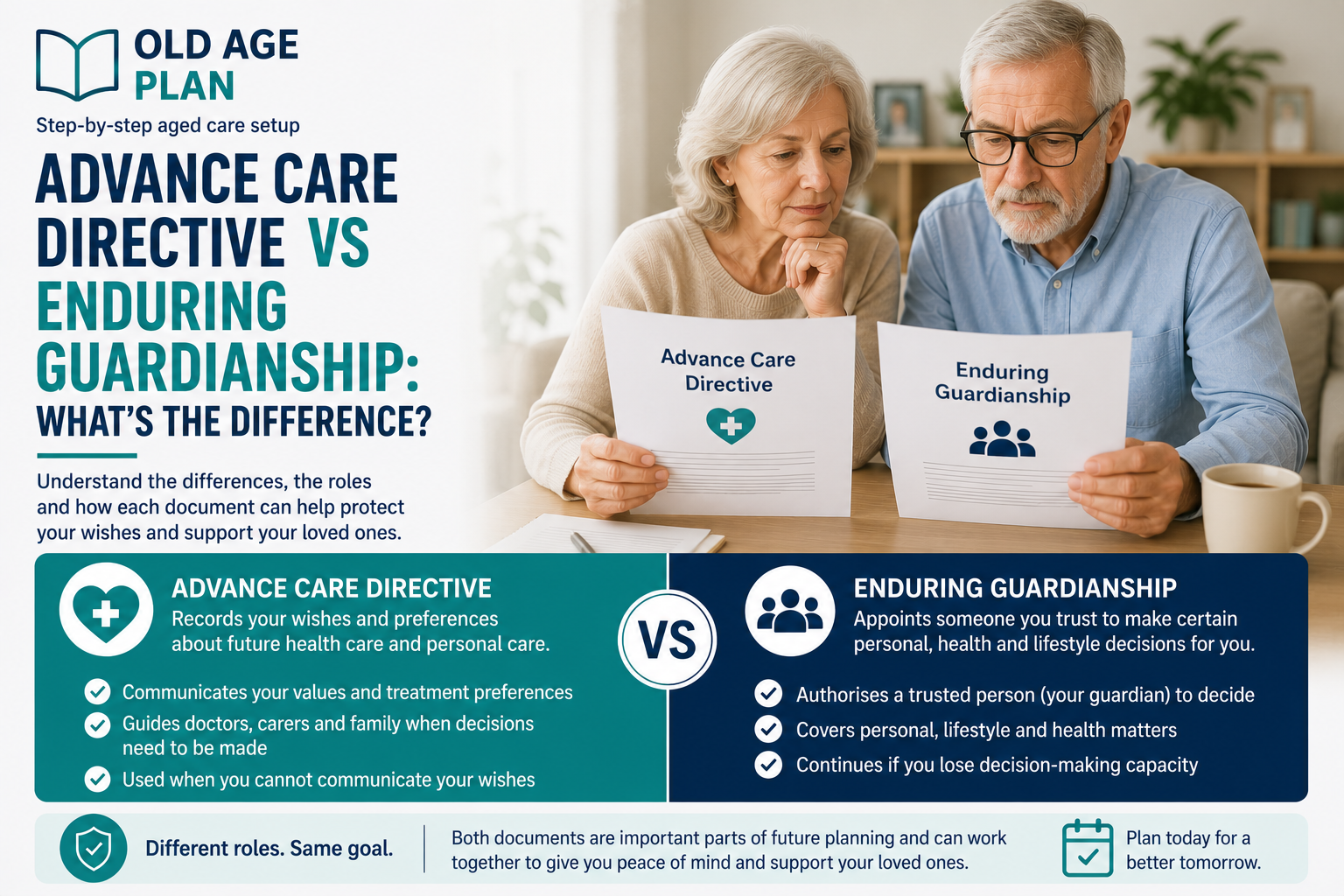

Advance Care Directive vs Enduring Guardianship: What’s The Difference?
Many Australians come across both Advance Care Directives and Enduring Guardianship when planning for the future.
Because both documents can relate to health care and personal decisions, people often assume they do the same thing.
In reality, they generally serve different purposes and may work together as part of a broader future planning strategy.
Why Do People Get Confused?
Both documents are often discussed when families are planning for situations where a person may lose decision-making capacity.
Both may be relevant during illness, injury, dementia or other situations where someone cannot make decisions for themselves.
However, they usually perform different roles.
What Is An Advance Care Directive?
An Advance Care Directive is generally used to record a person’s wishes, preferences and values regarding future health care, medical treatment and personal care.
It focuses on what the person wants if they are unable to communicate those wishes themselves.
The exact rules and terminology vary between Australian states and territories.
What Is Enduring Guardianship?
Enduring Guardianship generally allows a person to appoint someone they trust to make certain personal, health or lifestyle decisions on their behalf if they lose decision-making capacity.
The person appointed is known as an Enduring Guardian.
The powers available depend on the laws that apply in the relevant state or territory.
The Simplest Way To Understand The Difference
Think of it this way:
- An Advance Care Directive records your wishes and preferences.
- Enduring Guardianship appoints someone to make certain decisions for you.
One document focuses on what you want. The other focuses on who may be authorised to help make decisions.
A Real-Life Example
Imagine your mother develops advanced dementia and can no longer communicate her wishes.
Her Advance Care Directive may provide guidance about her values, treatment preferences and future care wishes.
Her Enduring Guardian may be involved in authorised decisions relating to her care, living arrangements or health matters, depending on the powers granted and the laws that apply.
In many situations, both documents can play an important role.
Do You Need Both?
Many Australians choose to have multiple planning documents in place.
An Advance Care Directive can help communicate future health care wishes.
Enduring Guardianship can help ensure a trusted person is authorised to assist with certain decisions if capacity is lost.
The documents often complement each other rather than replace each other.
Do The Rules Differ Across Australia?
Yes.
Different states and territories use different legal frameworks, forms and terminology.
Some locations use Enduring Guardianship, while others use different arrangements for health, lifestyle or personal decisions.
It is important to understand the requirements that apply where you live and seek professional advice where appropriate.
Frequently Asked Questions
Is an Advance Care Directive the same as Enduring Guardianship?
No. They generally serve different purposes and deal with different aspects of future planning.
Can an Advance Care Directive replace Enduring Guardianship?
In many situations, no. The documents often perform different functions and may work together.
Do I need both documents?
Many people choose to have both, but the right approach depends on individual circumstances and the laws that apply.
Can an Enduring Guardian change my wishes?
The answer depends on the circumstances, the legal arrangements in place and the laws that apply in the relevant state or territory.
Can I change my Advance Care Directive or Enduring Guardianship arrangements?
In many circumstances, yes. Requirements vary depending on your location and personal situation.
Sources and Additional Information
For official information and state-specific requirements, the following organisations may be helpful:
Related Resources
- What Is An Advance Care Directive?
- What Is Enduring Guardianship?
- Advance Care Directive vs EPOA
- What Is An Enduring Power Of Attorney?
- Free Aged Care Tools
Disclaimer: This article provides general information only and does not constitute legal, financial or professional advice. Laws vary between Australian states and territories.